
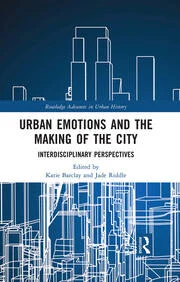
Urban Emotions and the Making of the City: Interdisciplinary Perspectives, edited by Katie Barclay and Jade Riddle (published by Routledge in 2021), explores urban emotions and the making of city spaces, arriving at a time when Indian cities face unprecedented transformations in the wake of the smart city initiative led neoliberal and majoritarian restructuring of urban spaces, and post pandemic economic upheavals. One of the key features of this work is its systematic refusal to treat emotions merely as individual psychological states. This study makes a case that emotions constitute a force in the making of the social life of cities. Katie Barclay and Jade Riddle compile twelve chapters, interdisciplinary in approach yet relating to urban history, into three analytical sections: Emotional Communities, Emotions and Power, and Emotions and Urban Change. Taken together, all build a story of emotions producing and reproducing city spaces. It synthesises Barbara Rosenwein’s conception of emotional communities with Henri Lefebvre’s production of space and combines it with Sara Ahmed’s notion of ‘cultural politics of emotion’ and thus formulates a framework where cities emerge as sites of emotional accumulations that shape belonging, identity and existential capacity to live in urban forms.
This intervention challenges urban sociology’s traditional privileging of political economic and ecological analyses and shows how emotions shape urban morphology, governance, symbolic practices and lived experiences. The contributors to this volume range across history, architecture, linguistics, film studies, and urban planning, and all systematically explore how emotions become inscribed in material structures, produce urban communities, enable resistance to power, and drive processes of urban transformation.
Several authors demonstrate how emotions become embedded within cities’ physical fabric. Andrew May’s history of Australian city bylaws reveals how regulations designed to manage neighbourliness functioned as emotional governance, producing cities “low in conflict” through the management of social feelings. It makes a case that emotions enable agencies rather than constraining them.
Lisa Beaven’s architectural history of Rome’s Spanish Steps provides another lens on emotional materiality. She demonstrates how political conflicts between French and Spanish powers became embodied in the steps’ design, with their flow encouraging movement in multiple directions while creating spaces for pause and performance. The steps function as an emotional tool, a concept the editors develop to describe how urban forms direct and construct affective states.
Rob Amery’s examination of Kaurna language revival in Adelaide’s linguistic landscape extends this materialist approach to signage and naming practices. The dual naming of sites and adoption of Kaurna terms on buildings creates what he terms an affective atmosphere that transforms settler-Indigenous relations. This linguistic inscription demonstrates how material markers accumulate emotional residues. This volume, through these chapters, argues that emotional communities actively construct urban boundaries not only through shared affective norms but through exclusionary practices.
Rebecca Madgin’s chapter on twentieth-century Glasgow reveals how the destruction of the nineteenth-century urban core generated profound anxiety, sadness, and anger that ultimately shaped heritage conservation movements. Drawing on novels and folk songs as archival sources, Madgin shows how public emotional attachments to threatened buildings transformed planning decisions, arguing that heritage policy emerges from contested emotional judgments about value and worth.
Jade Riddle’s chapter employs Ahmed’s concept of emotional stickiness to analyse how London suburbs become associated with hate or fear that “rubs off” on residents. She shows how St. Giles’ parish became a fearful place whose emotional geography structured movements and interactions. Similarly, Jessica O’Leary’s analysis of sixteenth-century Italian cities during the Japanese Tensho Embassy visit illuminates how urban elites mobilise collective emotions such as civic pride, ambition and religious fear to consolidate their power. Derek Pardue’s ethnographic work on Congolese refugees in São Paulo’s black neighbourhoods reveals negotiations of urban space situated between racial hate and hope. Despite experiencing poverty, racism, and exclusion, African migrants forge emotional connections that create possibilities for community formation within hostile environments. On the other hand, Nicolas Kenny’s chapter on postwar Brussels radio broadcasting demonstrates how the radio played a vital role in helping the urban population process collective emotions such as grief and sadness at war loss, as well as the celebratory emotions, such as joy, associated with the city’s liberation.
While focusing on European, Australian, and Chinese cases, the volume’s frameworks resonate powerfully with postcolonial urban experiences. Indian cities’ caste-based spatial segregation operates through emotional registers of purity and pollution that mark neighbourhood boundaries. Communal violence leaves affective residues in urban spaces, mohallas and gullies accumulate memories of riots that structure settlement & interaction patterns across generations. Slum demolitions and smart city projects as part of a wider neoliberal project of space restructuring trigger affective responses and fuel anxieties, fear among residents, contributing to vulnerability as a key element in existential conditions of the urban poor and minorities.
This volume, while demonstrating emotions’ enduring urban significance, undertheorizes contemporary digital mediations of urban affect, e.g. how social media platforms transform emotional communities’ spatial boundaries. Secondly, the major emphasis on historical cases, while demonstrating analytical portability, leaves contemporary urban processes somewhat unaddressed. By revealing how affects constitute rather than merely reflect urban conditions, the volume opens crucial research trajectories for analysing inequality, displacement, and resistance within contemporary cities.
***
Suraj Beri is an Assistant Professor at the Department of Sociology, Nagaland University, India.
<a href=”https://www.univ-msila.dz/site/shs-ar/”>Departamento de Sociologia </a> <a href=”https://www.univ-msila.dz/site/shs/”>Departement of Sociology</a>https://www.univ-msila.dz/site/shs-ar/https://www.univ-msila.dz/site/shs/
Very nice post. I just stumbled upon your blog and wanted to say that I’ve truly enjoyed surfing around your blog posts. <a href=”https://www.univ-msila.dz/site/shs/”>Departement of Sociology</a> <a href=”https://www.univ-msila.dz/site/shs-ar/”>Departamento de Sociologia </a>https://www.univ-msila.dz/site/shs-ar/https://www.univ-msila.dz/site/shs/