
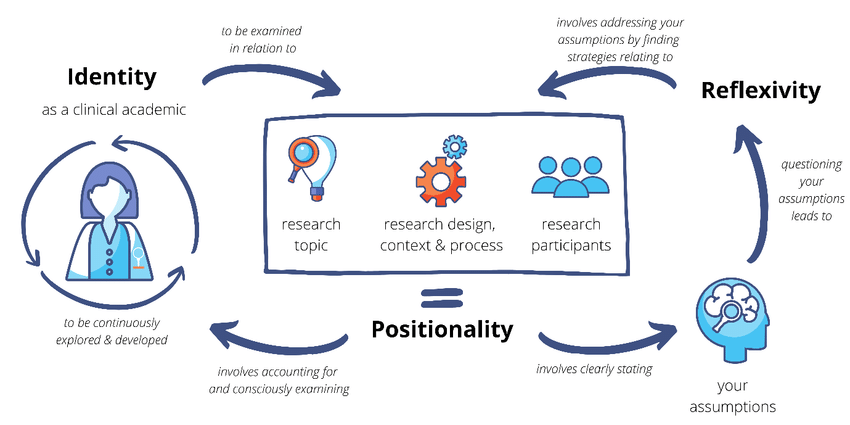
Positionality plays a crucial role in research and varies over time. Convincing and demonstrating your social identity as a researcher to marginalised communities you are interviewing can be challenging. Positionality in research helps researchers understand and share experiences with communities, such as women from the same community (Dalit), facilitating the exchange of experiences and fostering a deeper understanding of communities as individuals. Additionally, depending on positionality, there is an element of power, and the first impression formed by the researcher during the research process affects the participants. When conducting the study, it is also essential to disclose the researchers’ positionality (Jacobson and Mustafa, 2019). Through a social identity map, researchers can visually illustrate how their position influences the research process. It is also easier to navigate the lived experiences of the communities, including their daily lives and perspectives on housing policy, city development, and related issues. Furthermore, as a marginalised community group, what kind of issues did they face as individuals, such as finding a job, interacting with government officials, relocation, and housing eviction? (Jacobson and Mustafa, 2019).
Positionality and being an insider researcher (from the same community) help me identify issues within the communities I study—Dalit and Muslim communities —so I can understand their daily life challenges after rehabilitation and resettlement. This understanding enables me to develop and recommend better living conditions to government authorities and policymakers through my research writings and publications. Positionality aims to improve the lives of the people we study (Berkovic et al., 2020). Being an insider provides a deep understanding and perspective on the community, and it encourages community members to open up and share their experiences. Additionally, sharing our position as a social identity with participants during interviews does not lead to any logical or illogical consequences. During my research, many community members asked about my caste when I interviewed them. Once I shared my identity, they became more open and started sharing their experiences and challenges after relocation. However, based on our shared experiences, some people may feel distrust and hesitate to share details. Alternatively, they can relate their experiences to the examples I provided. I also come from a slum area and belong to a Dalit lower caste community. In my region, access to water, sanitation, and waste management is poor, and housing conditions are impoverished. As a slum dweller, I have taken significant steps to improve conditions in my area, focusing mainly on water and sanitation, and I have shared these efforts with others. These include writing a letter to the Municipal Corporation detailing the poor living conditions, limited access to water, sanitation issues, and requesting improvements. Being an insider—a local native speaker who grew up in slum areas and belongs to one of India’s marginalised communities—gives me greater confidence and motivation when researching and understanding the issues faced by communities in the selected case study sites (Kanuha, 2000).
As a native speaker, I have lived in Mumbai for a decade since completing my Master’s and MPhil, and I have pursued a career here since then. It feels like a second home, and it is the city where I have built my profession. I am much more familiar with the Mumbai slum community, its people, and their issues. Given that I conducted several field assignments and projects during my Master’s and MPhil degrees, as well as throughout my professional career, I had a strong desire to gain a deeper understanding of these communities’ experiences with Mumbai’s slum rehabilitation and resettlement through their personal stories. Therefore, I chose in-depth interviews and observation as tools to gain a detailed understanding of the everyday marginalisation related to slum rehabilitation and resettlement of the Scheduled Castes and Muslim communities.
During my field discussion with the resettled communities of Mahulgaon, I observed that moving from central areas of Mumbai, such as Vidyavihar, Wadala, Sandhurst Road, Kurla, Sewri, Powai, and Bandra, to the outskirts, where polluted and industrial factories are standard, has a profound emotional and financial impact on residents. But beyond that, it also affected these communities’ health and well-being. It was a very emotional and heart-touching experience for me. However, as a research scholar and international student, when seeking permission for initial interactions, interviews, observations, and discussions with the manager of the Panchsheel Cooperative Society (one of the case study sites) and the staff of the Community Design Agency (NGO), I was often viewed as an outsider. It involved many procedures, rules, and regulations to verify my identity. So, I was both an insider and an outsider, and sometimes neither (Mullings, 1999; Sultana, 2007). Therefore, as Giwa (2015) discussed positionality and its navigation, she focused on various aspects, including gender and social factors, as an international researcher.
During my research in my home country and the urban area of Mumbai, India, participants in my study began to perceive me through various identities, including those of media reporters, government surveyors, municipal corporation employees, and NGO workers. However, with these different identities, some questions raised by respondents were common: 1) Can you give us a job? 2) Will you provide us with alternative housing options? 3) Is there any scheme for poor people offering free food, healthcare, and job access? It was somewhat challenging, but I managed to communicate and explain to them. As a woman geographer, I often felt alone and intimidated walking in the field because people assumed I was a media person. Consequently, many refused to share information or give interviews directly. However, some were willing to share their resettlement experiences—mostly street vendors, shopkeepers, and elderly individuals—compared with middle-aged groups. This may be because NGOs and other researchers visit these resettlement colonies multiple times for surveys and research, yet residents do not receive tangible benefits in return. Despite this, some middle-aged women and girls, from a young age, formed friendships with me and expressed curiosity about my research (Sultana, 2007). Therefore, Sultana (2007) emphasised the importance of knowledge, which is fully revealed during fieldwork, primarily through interviews and discussions with communities, government officials, NGOs, and social activists.
As an international student involved in research fieldwork, I find it incredibly exciting to conduct research for the group or the people who have participated. Being part of the same community definitely helps to build trust. However, it can be challenging to gain the trust of all participants, particularly elite government officials, NGOs, and some marginalised communities. Hence, Mandiyanike (2009) discussed the challenges faced by researchers from the Global South conducting research in their home country. Furthermore, embedding positionality, reflexivity, the production of knowledge, and power relations with research participants within a social and political context is essential. Being reflexive helps to understand the study and develop the production of knowledge, which is also helpful in following ethical rules and regulations (Sultana, 2007).
As a female researcher conducting research in an urban area, I find the process overwhelming, and reaching out to participants can be particularly challenging in their busy schedules. But being a native speaker made my journey easier. Understanding the experiences of rehabilitated communities was a thorough and engaging process. These communities were always eager to learn about my studies and where I live. As international students from the UK, they (Slum Dwellers) were curious about life, culture, weather, housing structures, and the UK’s education system (Kusek and Smiley, 2014).
References:
Berkovic, D., Ayton, D., Briggs, A. M., & Ackerman, I. N. (2020). The view from the inside: Positionality and insider research. International Journal of Qualitative Methods, 19, 1609406919900828.
Jacobson, D., & Mustafa, N. (2019). Social identity map: A reflexivity tool for practising explicit positionality in critical qualitative research. International Journal of Qualitative Methods, 18, 1609406919870075.
Kanuha, V. K. (2000). “Being” native versus “going native”: Conducting social work research as an insider. Social Work, 45(5), 439–447.
Kusek, W. A., & Smiley, S. L. (2014). Navigating the city: Gender and positionality in cultural geography research. Journal of Cultural Geography, 31(2), 152–165.
Mullings, B. (1999). Insider or outsider, both or neither: Some dilemmas of interviewing in a cross-cultural setting. Geoforum, 30(4), 337–350.
Sultana, F. (2007). Reflexivity, positionality and participatory ethics: Negotiating fieldwork dilemmas in international research. ACME: An International Journal for Critical Geographies, 6(3), 374–385.
***
Priyanka Mokale is a PhD student in the Department of Geography, Earth, and Environmental Sciences at the University of Birmingham. Her PhD thesis focuses on the impacts of the implementation of Mumbai’s Slum Rehabilitation and Resettlement policy on marginalised communities in Mumbai city. Her research interests include urban gentrification, Displacement, and housing challenges of marginalised communities, Solid Waste Management, urban health and sanitation, and urban policy and governance.