

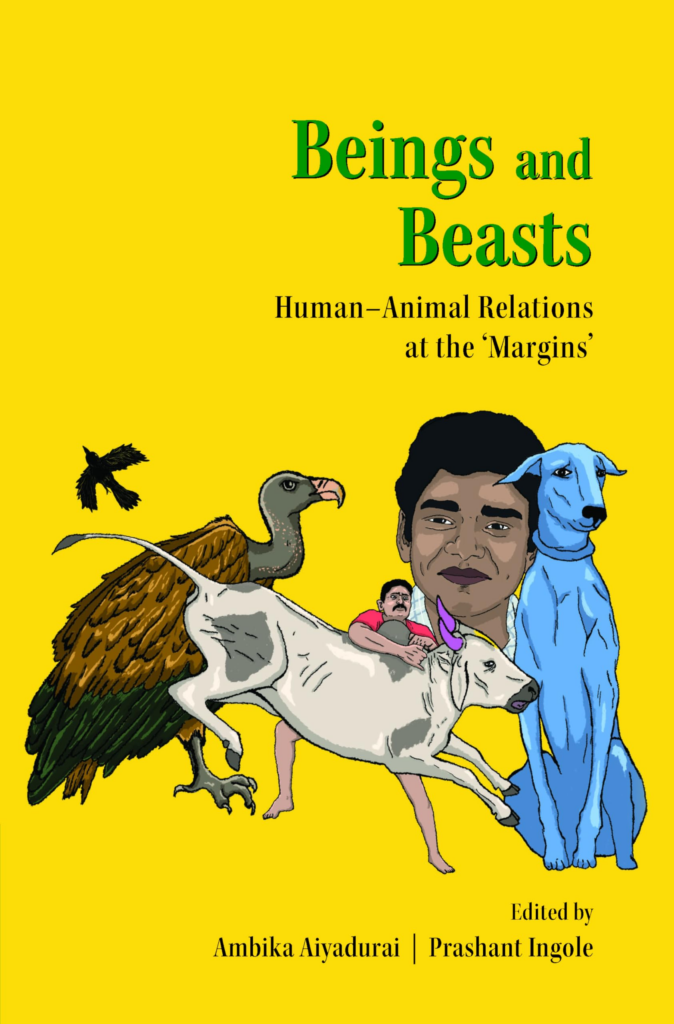
Global academia in Social Sciences and Humanities is experiencing an ‘animal turn’ where animals and plants are finding a centre-stage in social analysis, to theorise about the human condition, and in extension, to the ‘liveliness’ of the other-than-human as well. Ambika Aiyadurai and Prashant Ingole’s edited volume Beings and Beasts: Human-Animal Relations at The Margins, edited by Ambika Aiyadurai and Prashant Ingole (published by Cambridge University Press in 2025) is not only a fresh contribution to this cutting-edge scholarship on human-animal relations, but also a crucial departure to think about the margin. Here, the editors and the authors who contributed to the volume presented the margin as both a place and a relation, developed through more-than-human entanglements. These authors, most of whom are early career scholars from hitherto under-represented regions and communities, seek to de-brahminise the human-animal studies by providing case studies on how relations between marginalised social groups (caste-based or tribal) and specific animals unfold and to what effect.
The edited volume, apart from the context-setting introduction by the editors, consists of four major sections, comprising thirteen chapters. The various contributions to this edited volume provide multidisciplinary engagement on human-animal relations through the analysis of textual and cinematic narratives, artwork and imagery, food and livelihood practices, and companionship. Eco-critical lens on Tamil cinematic work and Dalit autobiographies, ethnographic encounters with animals associated with production and consumption, and affective ecologies across rural and urban life provide the readers a rich understanding of how actual lives and representations of not-so-charismatic animals (tigers or elephants) have been playing a role in developing social relations which are both enmeshed in oppression and resistance.
The first part Animals in Dalit cinema gives us analysis of three Tamil films, Fandry, Pariyerum Perumal and Asuran, where literal and symbolic representations of pigs, hunting dogs and sparrows not only showed how dominant/oppressor caste communities created political violence for the oppressed caste individuals through dehumanisation/animalization of bodies, but also created a hierarchy within the animal world themselves where some animals are treated as pure (therefore, higher) beings than others. While pigs or dogs are a great source of livelihood, companionship and fraternity among the Dalits, the oppressor castes equate the same animals to Dalits for upholding untouchability and denying any agency.
Moving on from cinema to textual imageries and iconographies in the next section, Dalit Imageries and Textual Narratives, the authors analyse a Tamil novel, Koogai, by Cho. Dharman, four Hindi short stories by Ratan Kumar Sambharia, and an English novel, The Revenge of the Non-Vegetarian, by Upamanyu Chatterjee, to show the mechanisms of humanising certain animals or animalising certain kinds of human life in a caste-class divided Indian society. The owl in Koogai, or the sheep, buffaloes, goats in RK Sambharia’s short stories, or the cow in Chatterjee’s novel, become both anthropomorphised, spiritual metaphors and distinct parts of the material culture of food and livelihood, through which Dalit individuals and groups’ lived experiences traversing oppression and resistance become central.
The third section, Human-Animal Relations in the Northeast, focuses on an underrepresented region, from where the authors have presented ethnographic accounts of human-animal cultures. Such animals could be integral for a specific culture as food, such as pigs for the Bodo communities in the plains of Assam, or as livelihood, such as the yaks with whom the Brokpa pastoralists of highlands of Arunachal Pradesh has built a rhythm of movement, or for ritual sacrifice and upholding social status, such as the semi-domesticated mithuns which live a fascinating life alongside the Idu Mishmi communities of the Arunachal Pradesh. Whether consumed or protected, such animals are treated with care and reciprocity, with an affective ecology that the tribal communities developed through their own cosmologies of land and its denizens. However, the authors also present that the dominant Brahminical order creates a particular social or political order, where these animals are treated as ‘impure’ for consumption (pigs), or ‘non-profitable’ for the market (yaks), or too sacred to be killed (mithuns). In doing so, symbolically and literally, these tribal communities from the northeast region are also treated as ‘un/undercivilised’ who need intervention, thereby denying their knowledge, wisdom and autonomy.
The last part of this edited volume, and perhaps the strongest part, Animals as Companions, provides us with intensely self-reflexive, first-person account-based contributions where authors problematize the concept of companionship with animals as a site for both gratitude and grievance. While the agro-pastoralist Dhangar communities from Maharashtra built knowledge of land and its resources through engaging with their livestock’s knowledge, and thereby creating a relation of mutual trust and respect, the pro-Jallikattu (traditional bull-taming sport) protesters in Tamil Nadu not only protested against the court-imposed ban on the sport, citing an attack to the cultural autonomy, but they also used the protest as a site articulate farmers’ vulnerabilities to the authorities. The other two chapters deal with the phenomenological aspects of Dalit ecologies, where the animal life, dogs or vultures, could be treated as a different form of companionship; a relatedness to raise Dalit consciousness towards resistance.
With this set of eco-critical, affective and ethnographic set of writings, this edited volume brings the margin to the centre of analysis, worldbuilding and a way forward. This volume would not only be useful for academia and practice, which interdisciplinary-ly think about anti-caste, pro-tribal, more-than-human justice, but its accessible language, first-person accounts, should also attract a wider audience for an introspective thinking about the Indian society.
***
Sayan Banerjee is a doctoral scholar at the National Institute of Advanced Studies (NIAS) Bengaluru.