
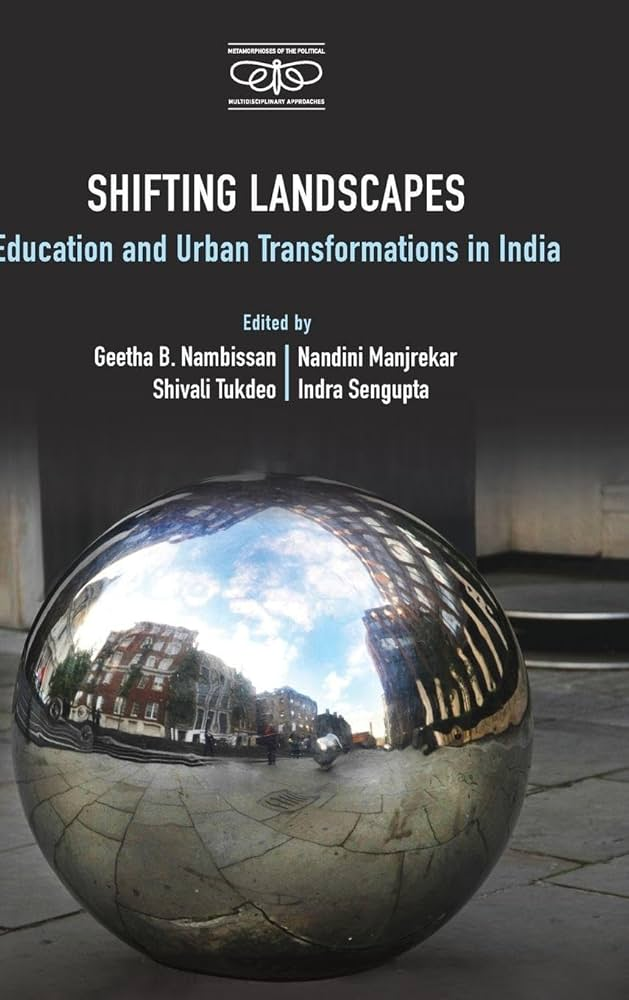
Shifting Landscapes: Educational and Urban Transformation in India (Cambridge University Press, 2025) edited by Geetha B. Nambissan, Nandini Manjrekar, Shivali Tukdeo and Indra Sengupta argue how communities, women, girls, children and youth in urban informal settlements, precarious living, ghettos and in religiously segregated colonies navigate, contest and negotiate their everyday living and education. This book views urban growth from a socio-economic lens and identifies cities as fluid and the epicentre of capital accumulation and strong socio-economic polarisation. The colonial state and philanthropic initiatives provided education to underprivileged communities in Bombay and Uttarpara. Similarly, Jamia Millia Islamia was developed by fusing modernist Muslim identity with Gandhian nationalism by embracing rural and urban components. Later, India’s quest for world-class cities regulated access, spatial segregation and differentiation of education, health, food and housing with sharp privilege and exclusion and unequal luxury and deprivation flourishing side by side. Post liberalisation urban development takes an aesthetic turn, citizens in precarious work and living are identified as encroachers, often face forced evictions, demolition and displacement. They are always in the process of settling, and their struggle for the right to education and the city often denied, neglected and invisibilised.
The agrarian crisis, rise of the service sector and the poor educational infrastructure and teaching learning processes and schools’ unavailability in neighbourhoods have resulted in the mushrooming of low-cost budget private schools (LBS) along with elite CBSE, ICSE and international schools. The LBS cater to the educational needs of the marginalised children, while the rich attend elite schools. Education has become a commodity rather than a public good, and quality of education is available to those who can afford to pay for it. The poor children are entitled to get admitted to elite schools under the Economically Weaker Section provision of the Right to Education Act, 2009. However, few end up getting admission due to other costs of education and the lower or not literacy of the parents, as many of these schools consider the education of parents as an important criterion. Many parents want English-medium education for their children because English has become a marker of success for upward socio-economic mobility. Such a phenomenon stresses substantial financial burdens to the urban marginalised, mostly engaged in informal work, as they try to spend their hard-earned money on English education by compromising other needs. Fearing that their children may fall behind, many parents also provide private tuition to catch up with the rest of the class.
Taking accounts from different small towns, the book argues that the people with no or less socio-economic capital from small towns often end up doing short-term skilling courses run by the government and NGOs. Aspiring for a formal job in an AC room having a laptop in cities like Bangalore is often shattered by low salary, high cost and poor living conditions. The youth often return disappointed to their homes to find ways of earning. The short-term skilling courses are promoted instead of ITI and diplomas, promising better career options, but fail to do so. Similarly, the children of the business and landowning communities of a small town in MP succeed with professional degrees and settle in the USA and other cities, while the children of poor and lower caste groups rarely end up in higher education and end up in informal and manual work. An Insight from Varanasi depicts aspirational change in linguistic patterns as people start speaking in Hindi instead of local dialects and later English at home. Following land acquisition for an educational city in the periphery, altering social interactions and livelihoods. This reinforces existing social, geographical and aspirational disparities.
The book identifies that segregated heterogeneous Muslim ghettos often intensified with communal violence, like Jamia, Seelampur and Bara Hindu Rao in old Delhi and Park Circus in Kolkata. These areas provide surplus labour to small manufacturing and own-account trade, frequently on a piece-rate basis inside value chains that follow the logic of profits in the global economy. Workers are trapped with less or no bargaining power due to a lack of mobility alternatives. Socially constructed biases, prejudices, stereotypes, fears, stigma and criminality are associated with these spaces. The government further strengthens the stereotypes by emphasising on modernisation of Madrasa and Urdu in these spaces termed as ‘ghettoisation of Urdu’, opposite to the secular and English education demand of the Muslim community. The stigma is extended to the rehabilitated widow colony of Tilak Nagar, often characterised as a ‘prostitute colony’ reflects how the anti-Sikh riots of 1984 disrupted education, income and everyday living. Lack of schools in the neighbourhood, religious discrimination, poverty, helping parents and siblings in work frequently exhibit irregularity, which ultimately results in dropout. Once the children drop out, it is difficult to reintegrate them into education. The book offers tick description of the relationship between urban and education, highlighting the challenges and issues the poor face in navigating education and livelihood. These learnings can inform taken in policy discourse to make quality education a reality for millions of poor children and youth in urban spaces.
***
Shadab Anis has a PhD in Education Policy and Planning from the National Institute of Educational Planning and Administration (NIEPA), New Delhi.