
Space
No centre, no above, no below
Ceaselessly devouring and engendering itself
Whirlpool space
(‘Spaces’, Octavio Paz)
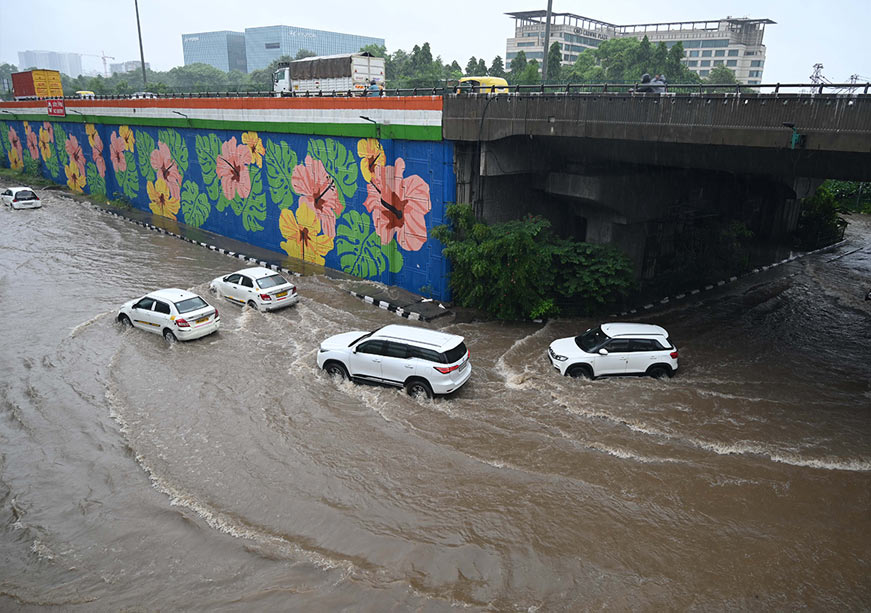
The recent Gurgaon floods, which exposed the city’s divided development concealed under the sheen of its state-of-the-art corporate offices and IT parks, have brought its economy under sociological scrutiny. The city is often invoked as a metonym for India’s urban turn. From a nondescript rural town in the 1980s, Gurgaon crescendoed into a prime corporate hub by the turn of the millennium, primarily hosting outsourced office jobs from the West. The so-called ‘Gurgaon model’ transformed over 35,000 acres of agricultural land into an urban property, producing a city with the third-highest per capita income in India, nearly 260 large and medium-scale industrial units, and more than 250 Fortune 500 companies.
However, Gurgaon’s growth was never a power-agnostic process. The ‘millennium city’ raised for the promise of rising India has been shaped by dispossessions, informalities, and planning failures; fault lines that are made visible, often brutally, during disasters like floods, unleashed year after year.
Gurgaon’s growth was shaped less by organic urbanisation than by the logics of neoliberal urbanism — the roll-back of state welfare functions alongside its active facilitation of private capital.
Power, Politics, and Planning
In 1966, Haryana was carved out of Punjab amidst political churn. The 1960s also saw New Delhi’s first Master Plan (1962) envisioning the National Capital Region to manage congestion, ultimately shaping towns like Gurgaon.
City plans, however, are not merely optical artefacts. The process of planning is imbricated in social relations of power—a juggernaut of development acts, bargaining of power and exemptions exercised via deeply imbued relations of caste, patronage and regional as well as political affiliations.
Gurgaon emerged from two dovetailing forces: Delhi’s restrictive planning and counter-magnet policy in the First Delhi Master Plan (1961–81), and Haryana’s liberal land regime that enabled private developers even before the late 1970s. Its proximity to IGI Airport made it apt to absorb Delhi’s spillover growth.
In the 1980s, Gurgaon became Delhi’s residential–industrial suburb; by the 1990s, it emerged as a global IT-BPO hub, starting with GE Capital in 1977 and soon followed by American Express, Ericsson, and Siemens, etc. This pull drew migrants, with the population rising 74% between 2001–2011, and the urban share by 283%.
Three acts critically shaped Gurgaon’s geography. The 1963 Punjab Scheduled Roads and Controlled Areas Act, extended to Haryana after 1966, sought to regulate substandard growth. The 1972 HUDA Act enabled land acquisition and planned development but excluded urban villages by distinguishing abadi (residential) from agricultural land.
In practice, private developers like DLF and Ansals, aided by local politicians, bypassed these boundaries by paying high prices to villagers. Thus, the initial 8-km ‘controlled area’ expanded to cover all of Gurgaon, creating what scholar S. Gururani calls ‘zones of exemption’ where political and economic priorities could shift.
The 1973–75 Housing Board Act allowed landowners to acquire licenses for development. After 1979, Bhajan Lal’s pro-business government opened these licenses to private players, paving the way for large-scale private urbanisation. Authority was centralised in the CM’s office, which became pivotal in negotiating with developers. Between 1979–96, 6000 acres were allocated to private developers. The Act enabled two things: vesting land-use change powers in the state, and facilitating parastatal land acquisition.
Politics further influenced this trajectory. Leaders projected rustic images even as rural–urban boundaries blurred. Exempting villages while expanding the license regime meant 85% of Gurgaon’s urbanisable land (1981–2014) went to private-led development, while opposition was muted by cordoning off villages as ‘non-urban.’ Corporate tenants, working from leased office parks, benefitted from high-rises, backup power, and operational flexibility, making Gurgaon an attractive global corporate hub.
Industrialisation began with Maruti Suzuki’s plant in 1982, followed by factories in autos, telecom, and garments. Simultaneously, developers like DLF, Ansals, and Unitech received licenses to build private residential townships such as DLF’s Qutab Enclave and Ansal’s Palam Vihar, occupied by 1991. It is on this variegated plane that Gurgaon burgeoned into the city of the future.
Gurgaon’s Patchwork Urbanisation
The developments were not purely economic in nature; they underpinned Gurgaon’s social and spatial hierarchies. Translating from paper to praxis, what is striking about the city is the juxtaposition of global capital against everyday fragility. Because reaching the sky does not mean owning it. Because even its failures do not affect everyone equally. Because the city is comfortable with its unevenness in both its planning and its outcomes.
The city’s urbanisation reduced locals to petty rentiership and speculative investments. Unlike typical narratives around new town development, Gurgaon is an outlier in the sense that 85% of its urban land was bought legally, highlighting market-led accumulation rather than forced evictions.
However, its landscape was skewed by private sector-led development of peri-urban agricultural land, creating a motley of gated enclaves and urban villages, often decaying into slums. In this sense, Gurgaon exemplifies what Tathagata Chatterji calls the selective ‘first worlding’ of cities.
To borrow anthropologist Anna Tsing’s words, Gurgaon is a ‘frontier.’ A zone that stands at the cusp of space and time, being mapped and unmapped simultaneously. Gururani takes this argument a bit further and posits that the whole of Gurgaon is an ‘illegal settlement’, secured through class power, political allegiances and global capital; a phenomenon she refers to as ‘sanctioned illegality’.
Urbanisation Against Nature
Gurgaon’s built environment has jeopardised its natural landscape. The loss of features like the Najafgarh lake, amplified by climate change, overwhelms its existing drainage system, creating chronic flooding problems. The predominance of concrete-asphalt further worsens the situation, as these surfaces lack the permeability needed for evapotranspiration and contribute to the Urban Heat Island effect. The erasure of natural sponges, such as johads and seasonal streams, further intensifies waterlogging.
The drainage system itself fails to match the pace of urbanisation. Built decades ago for a smaller population, drainage lines are often undersized and frequently clogged with solid waste, construction debris, and silt, reducing their capacity to manage runoff. Despite being a planned city, Gurgaon lacks a comprehensive drainage master plan, and its high-rises have been constructed without stormwater management.
Urban flooding also disrupts transportation. Roads like National Highway 8 and Golf Course Road frequently flood, causing traffic gridlocks and delays. In a primarily car-driven city, the underpasses often act as bowls, accumulating water and worsening the impacts of flooding.
At its core, the city’s development has ignored a basic principle: to develop with, not against, the natural topography. Gurgaon’s landscape has been treated as a terra nullius, a clean slate or wasteland, reflecting Lefebvre’s concept of a shift from ‘monumental space’, which is complex and contextualised, to ‘abstract space’, a wholly Euclidean and sterilised cityscape.
The Palimpsest City
A major problem in urban management is inter-agency coordination. Gurgaon is governed by multiple authorities—the MCG, Haryana Shahari Vikas Pradhikaran (HSVP), private developers, and the National Highways Authority of India (NHAI)—with little coordination, creating a jurisdictional disjunct that complicates city management.
Looking ahead, the Gurgaon Master Plan 2031 proposes massive infrastructure upgrades, including a mass rapid transit system, road expansions, and green city planning, to address these longstanding issues. Yet these grand plans overlook the truth that a city cannot be a whirlpool space—cannot be sans people, or depoliticised, or ahistorical, or a covert place.
Gurgaon is not a spotless ‘product’, it is a palimpsest. Its informal areas, including its urban villages, predate the cosmeticised city. Today, these areas absorb the residual residential and industrial activity of Gurgaon’s high-value urbanisation.
K. Sanyal refers to them as ‘wastelands’, inhabited by ‘surplus populations’ dispossessed of land and unintegrated into formal economic development. Cowan, on the other hand, showed how its villages—from Chakkarpur and Sikanderpur to Kapashera and Dundahera—serve as key sites that house workers across sectors and reproduce the city’s cheap labour force. He frames this as a shift from ‘infra-economies’ to ‘infrastructural labour’, where people are churned into cheap, accessible city labour. Thus, the ‘citizens’ and the ‘citified body’ exist as opposites, experiencing the city on uneven axes.
In terms of aesthetics, Gurgaon is, to use Marc Augé’s concept, a ‘non-place’. It is a city with no discernible centre, no cultural core, no politics—always in transit, sensorially deprived. Its Cyber Hub, Ambience Mall, expressways and glass buildings turn residents into consumers rather than citizens.
Augé conceptualises non-places as worlds where transport, homes, people, and things communicate through an abstract, unmediated commerce. What defines such spaces is not memory or meaning, but a contractual relationship: users are customers, and the city itself becomes a transaction. Gurgaon is, in this sense, not inherited, but constantly being bought and sold by those who can afford it.
The city, then, is not a continuum of progress. It is at once globalised and parochial, made-unmade, legal and illicit, complete and splintered. To return to Paz’s metaphor, Gurgaon does not hold a centre, or start and end. It has shifting coordinates of power, speculation and survival. Its future, hence, lies in holding the pulse of the city—the people that make it, the terrain that holds it and the city that is ‘lived in’.
***
Tasneem Khan is an MA student of Cities and Governance at the Tata Institute of Social Sciences (TISS), Hyderabad.
Great….