
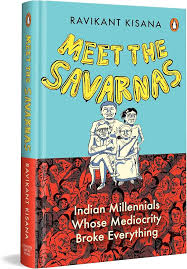
Meet the Savarnas: Indian Millennials Whose Mediocrity Broke Everything- the title of Ravikant Kisana’s 2025 book (published by Ebury books), gives the reader a succinct sense of what the project sets out to do. It provokes the question, why does one need to “meet” the Savarnas? What makes them worthy of renewed attention? Kisana himself defines savarna in the opening chapter as sa (meaning “with,” “having,” or “in possession of”) + varna—referring to the four caste groups: Brahmins, Kshatriyas, Vaishyas, and Shudras. These are, after all, the most socially visible and institutionally dominant units in India.
The answer to these questions lies in the work of the book. The self-reflective project of the Savarna academia has failed to understand the essence of the caste system; they have posited it variously but have misconstrued its ontological nature, its mythic singularity and plural reality.[i] The implications of such an error are far-reaching, as positing a mistaken concept of caste and its injustices threatens to colour the various epistemic mechanisms which inform our institutions of modernity and distort their judgment.
Caste is “a structure based on service and debt; it is anti-experience and thus anti-existence as well” (Roy, 2019). It forecloses reflection and denies the oppressed the capacity to speak from their own experience. To write—and thereby to initiate discourse—demands a counter-episteme[ii]. This is a task of immense difficulty and incommensurable importance given the persistent failure of the Savarna academia both to theorise caste adequately and to conduct a rigorous self-examination. The autobiographical sections of Kisana’s book stand as a testament to that struggle. The Ambedkarite movement, with Babasaheb Ambedkar laying the foundations of this counter-episteme, points towards the growing possibility of thought from beneath what Kisana calls the “glass floor.”
Kisana’s book, emerging out of the social anthropology of everyday life as a marginalised person working within an often-Savarna-dominated sphere of knowledge production, is a testament to the continuing struggle both within and as a result of the fracture in the totality of caste logic[iii]. In the exposition itself, the value of the epistemic knowledge gained through his rich empirical analysis becomes clear; yet it is precisely the prevalence of caste logic that prevents his colleagues from even beginning to consider its “seriousness.”
Running along the contours of the book is a question that recurs in various forms: How can the Savarnas witness the horrors below the proverbial glass floor and remain indifferent? This is why Kisana calls this glass floor “deeply photochromic.” The willful ignorance he points to is reinforced within caste ideology; the service-debt structure fortifies the gaze and renders its subjects morally and emotionally insulated. Yet Kisana notes that the “glass, thus far sealed, is beginning to crack.” These cracks emerge from within, and his book both evidences and enacts them.
The threats to the Savarna lifeworlds (s) from under the “glass floor” are many, and they react by producing further mechanisms that seek to consolidate their own position. This, in turn, has become the bane of Savarna society and, by extension, the India they have built in their image. Kisana’s analysis of the Savarnas becomes particularly significant in the post-independence context, where modernity and its institutions intersect in complex ways with India’s caste society. In this framework, dominant caste logic lays the foundations of these institutions, which, in varying ways, serve Savarna interests. In pointing out these failures of the supposedly egalitarian projects, Kisana’s analysis assumes its most potent form. The result is a sprawling unconcealment of what Indian civil society has sought to obfuscate—from the spirit of liberalisation of the 1990s with its effects on education, dating to the consequent failure of the project as a direct consequence of not only neglecting the caste epidemic but giving it new lives in practice. In doing this, the Millennials (Savarna) have ushered India into an era of mediocrity—their imagined ideas of merit, practices of self-mythologising, all in all, a collective delusion of grandeur have inaugurated a new reality which even they cannot reside in anymore.
Caste categories serve as an effective method of diagnosing the Indian state and society. By foregrounding caste relations, Kisana repeatedly unveils the underlying mechanisms that make Indian society tick. From historical anecdotes about the Bania Jagat Seth Mehtab Chand (who played a key role in the Battle of Plassey) to the MBA graduates shaped by the “Karlo Duniya Mutthi Mein” ethos, products of the Savarna–corporate complex, to the “Brahman–Bania” engine of the present state, the nation-like, self-serving existence of each caste has repeatedly, as Dr Ambedkar noted, “prevented the Hindus from becoming a society with a unified life and a consciousness of its own being” (Ambedkar, 1979).
Kisana’s analysis of state politics becomes particularly valuable in this regard. He traces the contradictions within an Indian state that is now compelled to acknowledge the emergent voices from under the glass floor. This produces a major shift in the nature of Indian politics: any party that seeks to retain power must navigate the contradictory demands of the historically powerful Savarnas, with their totalizing (and exclusionary) vision of India, and the rising political consciousness of marginalised populations—most notably through Bahujan mobilisations such as Kanshi Ram’s Bahujan Samaj Party. In the face of the failures of Savarna development rhetoric, Kisana reads the recent communal pivot in Savarna politics as “their last great stand.” As voices from beneath the glass floor become stronger, political parties that once projected themselves as guardians of Savarna culture have been forced to accommodate these shifts, leaving the Savarna classes perplexed and disoriented.
Kisana’s personal writing returns in the following section on love, relationships, and dating, as in a reflexive moment, he examines the heterosexual caste relationships—the upper caste man and the lower caste woman and vice versa. Herein, he locates the new life of the logic of the caste system—endogamy and the possibilities of inter-caste relationships. This section not only states for the reader some of the more widely established problems in this regard, but Kisana also pays his due to a lens he has been implicitly using all along—that of Frantz Fanon. In a key move, he inverts the lens— “I am more interested in the psychosis of the coloniser’s mind—in this case, the Savarna mind, the Brahmanical mind.” Doing so is a central gesture in his continued analysis of the Savarnas which in this case translates into the rather comfortable survival of what he calls the “spirit of Manu” –the all-encompassing logic of dharma which accounts for all apparent schisms and diversions, be it “woke/anti-capitalist sentiments” which in the young savarnas manifests as a marker of ‘coolness’ and difference but eventually reconciles itself with ‘Manu’s spirit’ in not just marriage but the ritual of wedding.
One would be sorely mistaken to limit the scope of the book as a study of simply the social; Kisana’s eye for incisive cultural analysis picks up on the complex way society produces culture, interacts with and is shaped by it. In a continuation of the ideas discussed in the preceding paragraph, his analysis of the standardisation of weddings—a menace spreading across Savarna and marginalised cultures alike. The complexity in the enactment of a wedding and its powerful symbolic life is discussed in detail by him; however, the spectacle of the wedding with its caste affiliations, especially when it is broadcast in detail as was the case in the highly televised recent marriage of the Ambani family’s younger son, Anant Ambani, is a phenomenon in itself.
The ability of caste to co-exist with modernity is surprisingly potent, and, as mentioned, has produced the very “mediocrity” of the Indian project itself. Kisana, in his characteristic sardonic tone, notes how the deadline for India’s arrival as a superpower has been quietly extended from 2020 to 2047. Yet Savarnas have trained themselves to unsee caste, and instead of tracing responsibility to Brahmins, who originally fractured society by turning themselves into an endogamous group and enabling imitation and excommunication, they blame the newly assertive marginalised castes and the emergent discourse. Savarna culture has experimented with every possible escape route: the creation of “islands of excellence” like the Indian Institute of Technology (IITs) and Indian Institute of Management (IIMs), the fantasy of development and now the desire to exit India altogether. However, this exodus is not an escape from caste; it cannot be. Nor does global movement dissolve the Being of caste. It simply reappears through mechanisms such as global capital, diaspora mythmaking, cultural nostalgia, and other forms that further insulate Savarnas from marginalised subjectivities. This insight shapes Kisana’s conclusion. The structure of caste is “anything but dialectical” (Chowdhury, 2013), and in the resistance to any synthesis, the subjectivities of those who have lived below the glass floor will continue to develop their own futures, with or without the Savarnas—“Maybe it is better that way”.
References:
Ambedkar, B. R., & Rodrigues, V. (2017). The essential writings of B. R. Ambedkar. Oxford University Press.
Ambedkar, B. R. (1979). Annihilation of caste. In B. R. Ambedkar, Dr Babasaheb Ambedkar: Writings and speeches (Vol. 1). Dr Ambedkar Foundation.
Chowdhury, A. (2013). Post-deconstructive subjectivity and history: Phenomenology, critical theory, and postcolonial thought. Brill.
Roy, R. (2019). From postcolonial irony to Dalit truth: A perspective on experience. Economic & Political Weekly, 54(7).
[i] Dr. B.R. Ambedkar famously argued “Hindu society is myth.” (Ambedkar, 1979) “For Ambedkar, the “origin” and functioning of caste is both singular and plural. Caste is singular as a notion: “the being of caste itself,” as “a substance of society; or more ontologically put, the ‘being’ of society” (Choudhury 2013: 65). […] This singular nature of caste, however, does not reflect its totality. What this singular caste (for instance, identity of A as an endogamous unity) does is, it produces plurality of castes (A is different from B or C or so on). Thus, Ambedkar argues, “caste in the singular number is an unreality. Castes exist only in the plural number” (Ambedkar and Rodrigues 2017: 260)” (Roy, 2019).
[ii] I use “counter-episteme” here in a modest, non-totalizing sense. The caste episteme, as Ambedkar repeatedly notes, forecloses the possibility of rational reflection for the oppressed by denying the legitimacy of their experience and therefore of their existence as thinking subjects. When I suggest that Ambedkar inaugurates a “counter-episteme,” it does not mean a pure alternative epistemology (which would be philosophically untenable in a Derridean sense). Rather, I refer to a historically produced opening which entails a transformation of the conditions of possibility under which Dalits can begin to speak, write, and appear as subjects of reason. This opening is enacted through constitutional morality, the politics of representation, and the institutional achievements of the Dalit movement.
[iii] This is of course the very reversal of the traditional anthropological lens which has entailed an asymmetrical power relation wherein the anthropologist holds an historical advantage over the subjects of study.
***
Swapnil Sreemani is pursuing an MA in Culture, Society, Thought at the Indian Institute of Technology (IIT) Delhi.