
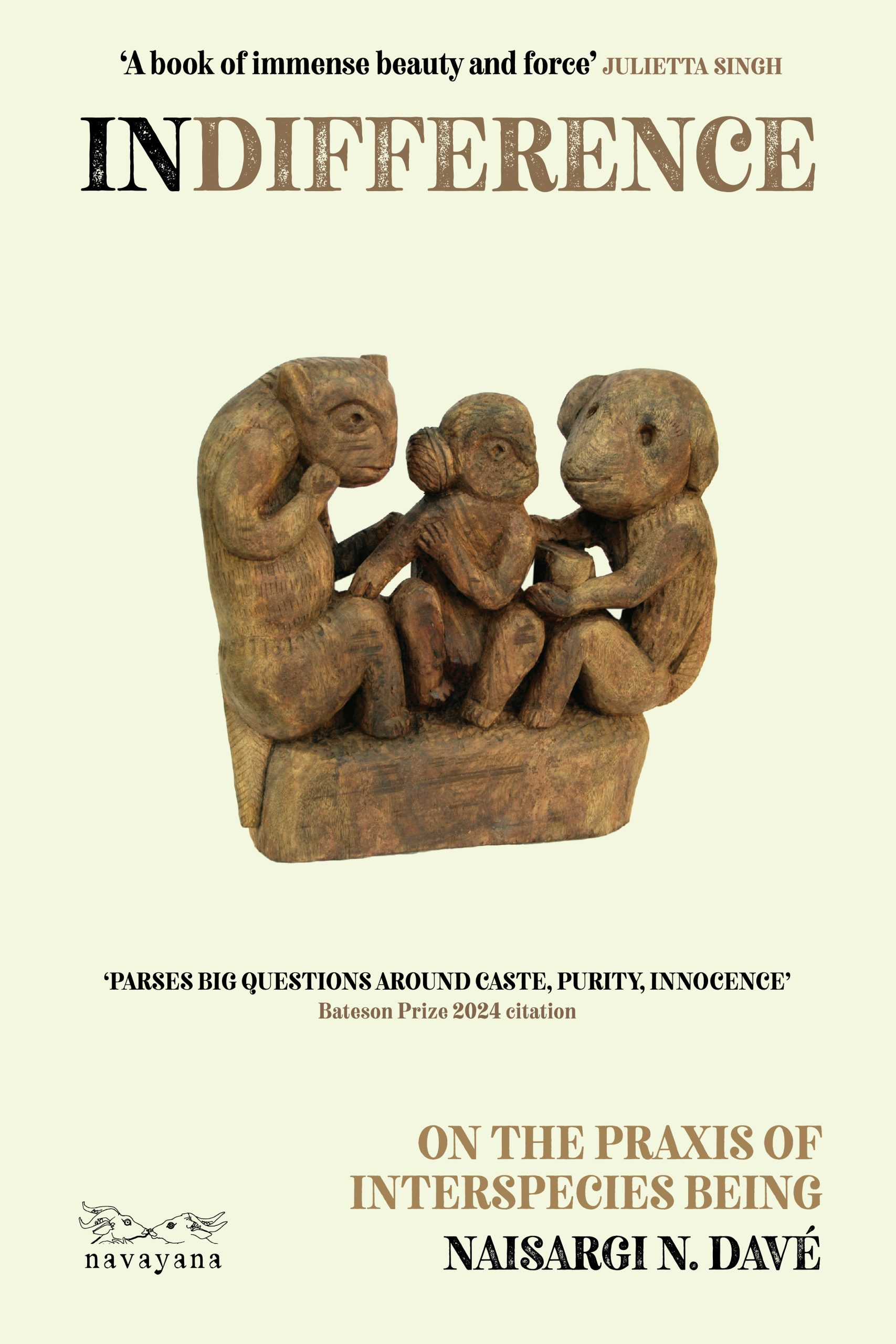
What would a life lived in difference, and perhaps indifferently toward difference, look like? This is the question at the heart of anthropologist Naisargi N. Davé’s latest book, Indifference: On the Praxis of Interspecies Being, published in India last year by Navayana Press (2025). The title could be described as a speculative double entendre: it contemplates the ontological question of how to live among different Others, human and not –in other words, how to live a life in difference. In response, Davé proposes an ethics of indifference, an antidote perhaps to the colonial (and anthropological no less) quest for difference, the all-consuming will to know the Other. Indifference should not be construed as a lack of care; in fact, Davé writes following philosopher Édouard Glissant, “… care is born first of indifference, out of respect for the opaque thatness of the object other” (6). To thus be indifferent toward the Other is to let them be in their difference, to leave them alone. The ethos of indifference demands that, as per Glissant’s imperative, we respect and uphold others’ right to opacity and that we resist the epistemic urge to tackle and tame their difference: we may never get to know them, and that’s okay. Yet the author is clear that indifference is relational and that care can flourish in relations of mutual regard for each other, for difference and in difference.
A few months ago, India’s Supreme Court ordered authorities in New Delhi to remove all stray dogs from the capital’s streets and move them to shelters; the court, after mounting pressure from animal welfare organisations, modified its order, asking that dogs be released after being vaccinated and sterilised. However, the court maintained, feeding stray dogs in public spaces is strictly prohibited. Critics were quickly branded as elites who should promptly adopt the strays they so passionately advocate for, as if the only way to provide for animals is to bring them “home”, however home is imagined here, no middle ground between capture and ownership. Imagine a city devoid of its dogs, a city purified and contained, a contradiction in terms.
In Chapter 2 of Indifference, Davé asks: “Why is moral attention to the animal so repulsive” (31)? I rephrase: What precious truth does care (elite or otherwise) for the animal Other unsettle? To put it (in)differently: why can’t we let the dogs and those who care for them just be? To let animals and their carers be is to abandon many a founding myth of the liberal project. What repulses, the author answers, is “fear for the end of the world” as we know it, that is, natalist, misogynist, speciesist (51). Why care for animals when, really, you should be having (human) babies?
Chapter 7, written together with Alok Gupta, offers an answer of sorts as the spotlight shifts from dogs to cows. Following Yamini Narayanan (2019), the authors trace the contours of a “sphere of permissible violence” demarcated by “Hindu anthropatriarchy” (natalist, misogynist, speciesist, communal). Within that sphere, women and animals are “… construed as innocent but consenting, where refusal is unthinkable. ‘Consent’ is here assumed through the language of sacrifice and ‘patriotic motherhood,’ as well as a biological predisposition to be worked, killed, penetrated, or all three” (135, emphasis in original). Grappling with innocence as a political rather than moral realm, anthropologist Miriam Ticktin argues that its opposite, what repulses, is in fact impurity, the unsettling blurring of boundaries that triggers that fear for the end of the world (2017). It is innocence that construes silence as consent, rather than a politics of refusal.
Many remarkable animals (and their carers) pass through the pages of Indifference. Kamadhenu, the cow that revokes her consent and refuses to “work,” prompting her owner to swear off dairy in response; a fleeting cat or two; an unforgettable dog with maggots in her butt; a goat, being mocked; a helpless, eye-less horse; and chickens, so many chickens, in poultry farms, meat processing plants, fast-food chains. Vegetarian chickens laying vegetarian eggs: to enjoy their meat is inoffensive, “secular,” modern, full of potential: the time of the nation is “the time of the chicken” (147).
Not all animals are created equal, of course, in the time of the nation. While chickens are turned into fast food, cows roam freely, and dogs become scapegoats for very human failures. Animals, meanwhile, have been in the news —and on my mind, too. I think of the Leopard that wandered into a posh colony in Pune, near where I live, videos of it captured on CCTV spreading rapidly on WhatsApp. Perhaps the leopard lost its way through the rapidly disappearing hills at the edge of the city. To my knowledge, the leopard remains at large; perhaps it found its way back through these gutted hills, past construction debris and ever-widening roads snaking through ghostly forest. Last December, the Global Humane Society announced that it would award Vantara, Anant Ambani’s wildlife center, a ‘Global Humanitarian Award for Animal Welfare’, despite allegations that Vantara’s wildlife rescue operations might be fueling, rather than battling, wildlife trafficking networks (https://thewire.in/environment/vantara-to-partner-with-telangana-govt-founder-anant-ambani-wins-international-animal-welfare-award). Then dogs returned to our newsfeeds when the Supreme Court struck back and issued a new, nationwide injunction directing States and Union Territories to remove all stray dogs from public spaces such as campuses, transportation hubs, and hospitals (to be taken where?); a city devoid of its dogs. On the way to my own campus, home to some lovely dogs (for how long?), driving through these newly carved hill roads, I once spotted a cow and a man, perched dangerously at the edge of the vertically cut mountain, tree roots exposed, little waterfalls running down the sliced rock; I wondered if, like Kamadhenu, this cow and her carer, surveying the diminishing landscape, refused to go on working.
I return to the opening question: what does indifference look like? Not like a caged shelter, not like a zoo, not like a hill under construction. Davé is specifically interested in the potential of indifference to outline a praxis for ethical interspecies relations, against the “compulsory intimacy” (6) prescribed by much post-humanist and multi-species literature that valorises curiosity for, and mixing of, selves and others, human and non-human alike. Kamala, a worker and carer of dogs at an animal shelter, tells Davé that humans act with “matlab,” with interest, intention; animals with understanding. The best we humans can do is to listen, “.. without having to understand […] When we listen together differently, we know that the object speaks. With this knowledge, it now becomes possible to respect the chosen silences of the object as the political will not to say. This respect for mass and lonely movements of silent refusal of the proper is expressed through an ethos of being silent alongside, which is to say, to listen with queer tongues” (88-89, emphasis in original). Animals do speak, even if silently. If we, alongside, refuse anthropatriarchy then animal refusal (not consent) becomes thinkable.
Respect for silent refusal is a way to restate Édouard Glissant’s “respect for mutual forms of opacity” (4). I think of Dipesh, a laconic fieldworker for a stray dog welfare organisation, who, in a remarkable passage from the book, removes the maggots from an old dog’s bum, relieves her indifferently yet carefully, then releases her to fate —and near death. Later, Dipesh will also clean the maggots from the scalp of a woman in the terminal stages of AIDS, who, instead of being driven to the hospital, had been thrown out of a taxi. Davé argues that touch (not unlike Dipesh’s) is indifferent to difference, intimate yet respectful of opacity. The author urges us to listen alongside, together, “… with skin if not word” (89), that is, I think, with touch. Because the reverse also holds, Davé cautions: to refuse touch is to refuse becoming undone, to hold on to one’s interest, to not listen to what the silent yet understanding animal has to say.
Here is a tricky question to conclude with: what might an indifferent anthropology look like? An anthropology that repudiates its “… passionate investment in difference …” (68)? How might we practice ethnography with less interest and more understanding, animal-like? Leaning on Dipesh, Davé articulates an immanent ethics “… without future, an ethics shorn of promise, indifferent to the principle of continuity. Dipesh healed the dog because he saw her, and what else could he do?” (56). An immanent ethics reflects a commitment to the moment as “… its own ethical universe …” (60). Might we think of ethnography as the attempt to understand the moment, listen alongside, even in silence? To take refusal seriously, accept contradiction indifferently, and abandon the search for consistency. Then perhaps the task at hand for an indifferent anthropology is to embrace immanence and abandon imminence, the latter “… with an i, the belief that ‘out of this must come that’” (ibid). Out of this (ethnography, the moment) must come that —what?
References:
Davé, N. N. (2023/2025). Indifference: On the praxis of interspecies being. Navayana.
Narayanan, Y. (2019). “Cow is a mother, mothers can do anything for their children!” Gaushalas as landscapes of anthropatriarchy and Hindu patriarchy. Hypatia, 10(10), 1–27.
Ticktin, M. (2017). A world without innocence. American Ethnologist, 44(4), 577–590.
***
Alexios Tsigkas is an Assistant Professor of Sociology at the Department of Social Sciences, School of Liberal Education. He has received an MA & PhD Degrees in Anthropology from The New School for Social Research, New York, USA and a Bachelor’s Degree in Social Anthropology from Panteion University of Social and Political Sciences, Athens, Greece.