
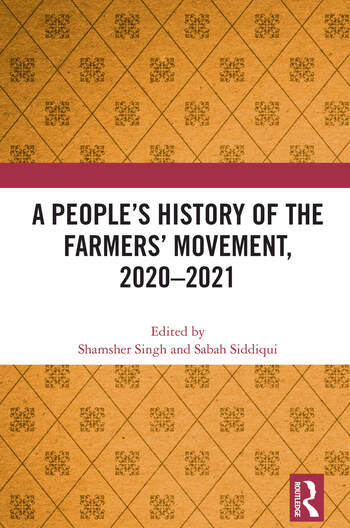
The farmers’ movement of 2020-21 against the three farm laws was one of the most significant and historic sit-in movements in the history of post-liberalisation India. Shamsher Singh and Sabah Siddiqui’s edited book A People’s History of the Farmers’ Movement, 2020-2021 (2025), published by Routledge, illustrates the importance of documenting the farmers’ movement, with the primary purpose of amplifying the voices of those who often remain unheard and whose history is officially not recorded. It makes an essential academic and political advancement in the study of agricultural movements, popular protest, and neoliberal transformation in India. The fundamental theme is that the anti-farm legislation mobilisation was more than just a sector-specific protest by farmers to safeguard their economic interests; it was a broader movement of people that restored democratic practice through unified resistance. Using the methodological approach of people’s history, the book emphasises small processes, daily bargaining, and popular collaboration, which are frequently disregarded in official government documentation.
The introductory chapter Why do we need a people’s history of the farmers’ movement? by the editors provides a historical perspective on the movement, including its origins and the places where it began. It lays the theoretical basis of the movement. Positioning the movement within the broader pattern of neoliberal reforms since the beginning of the 1990s, by asserting that farm laws reflected the intensification of corporate-driven redevelopment of the agricultural sector, followed by the removal of state safety nets. It effectively highlights how previous peasant protests, nationwide farmer collaboration through networks like AIKSCC, and the development of agricultural hardship paved the way for a mass demonstration. Editors underscore that the movements are incomprehensible solely through policy assessment; rather, they must be viewed through the lens of ideology, mobilisation methods, and traditions that have experienced resistance over time.
The chapter by Zoya Hasan interprets the movement to be a legislative manifestation of dictatorial policymaking. She emphasises the lack of parliamentary participation in the approval of farm laws and people’s demand for constitutional processes. Her claim that the movement strengthened democratic participation more than the realm of politics is especially compelling. Hasan positions the Samyukta Kisan Morcha as a model of decentralised governance by demonstrating how decisions were made collaboratively and in accordance with constitutional norms. This chapter is essential for political scientists and democratic theorists because it positions popular protest as a vital element of democratic life instead of a disruption.
The chapter on the agrarian question in today’s India examines the movement’s class composition in light of traditional arguments about the peasantry and agricultural shifts. They refute the accepted view that the movement was controlled by wealthy farmers by highlighting the vital role of marginal and small-scale producers, backed by tenants and trade unions. Despite contradictions within and unequal engagement, the chapter contends that the movement was successful in establishing issue-centred consensus in opposition to neoliberal corporate capitalism. This complicated analysis of classes reinforces the book’s broader thesis and contributes significantly to current arguments about peasant politics and class coalitions.
The chapter, Farmers’ Morcha 2020-2021, Background, Achievement and Challenges by Balwinder Tiwana, situates the analysis of the farmers’ movement within a historical political economy perspective, examining the historical context of past peasant struggles before and after independence. He highlights the achievements of recent farmers’ protests and how organisations like the Bharatiya Kishan Union mobilised the small, middle, & marginal peasantry, agricultural labourers, and landless labourers, along with wealthy and large landholding farmers, in Punjab. According to him, the Samyukta Kisan Morcha need to rearticulate issues like MSP, debt burden, class contradiction, farmers’ suicides, and issues of land, which have remained unresolved. He sees building unity among agricultural labourers, marginal & small peasantry, and wealthy and prominent landlords to face capitalist exploitation as a big challenge.
The chapter on Haryana shows how terrain, cropping structures, and institutional actors, like Khap panchayats, influence the magnitude and spread of demonstrations. The incorporation of maps, agricultural data, and territorial theory provides methodological breadth to the analysis of social movements. Similarly, Vishal and Akram Choudhary’s chapter on Western Uttar Pradesh provides a nuanced examination of the relationship among agrarian mobilisation, communal politics, and electoral tactics. By exploring the longstanding decline of farmer organisations and the subsequent development of Hindutva politics, the contributors demonstrate how the movement has transformed political coalitions while simultaneously highlighting the limits of agrarian cohesiveness in a divisive context.
The chapters on langar and women & local sangeet-making, temporary protest space for counter-mobilisation, protest songs & music, and alternative media provide a stronger interdisciplinary approach to the volume that goes beyond conventional political economy. These chapters effectively highlight cultural and affective dimensions of the farmers’ movement through the langar, local folk music that supports collective action through ordinary participation, the creation of temporary protest settlements at the Tikri border, and the use of social media. Authors of these chapters highlight everyday activities & practices, daily care, communication, & the creativity that helped sustain the movement for a year. These chapters treat the protest sites as lived space rather than temporary encampments/settlements. The volume broadens the scope for research in media, cultural, and architectural studies as well.
The volume is a mix of strong empirical research and qualitative analysis, based on participant observation, interviews with protesters, and contributions from active leaders of farmers’ unions. This clearly shows the closeness of volume to the farmers’ movement. This closeness has its own benefits and limitations. This gives us a rare, rich insider perspective on the movement, while some chapters, such as those on the Sikh diaspora, the Shahjahanpur border, and the Maharashtra farmers’ protest, adopt a sympathetic tone that leaves limited room for sustained critical discussion. One possible reason is that a few co-authors of the chapters hold leadership positions in farm unions and the Samyukta Kisan Morcha (SKM). So, a more direct, straightforward critique of the farmers’ movement is missing. The critique of its leadership structure in SKM and other farmer unions, and of restrictions in addressing the gender, caste, class hierarchies, and labourers’ issues, particularly the Dalit agricultural labourers’ issues, that could have strengthened the analytical balance of the volume, is missing. The editors are not entirely shy about highlighting the contradictions and limitations of the farmers’ movement, and chapters clearly acknowledge the tension within it.
Overall, the book is an important contribution to providing people’s history from the perspectives of those at border sites, in critical agrarian studies, in social movements, and in protecting the democratic space in India. It documents the historical struggle, focusing on theoretical aspects such as how movements emerge, how they sustain, how they interact with the state and power, and the fault lines, issues, actors, methods, and other aspects of the struggle or movement. The volume will help scholars across disciplines and activists to understand the various dynamics and aspects of collective resistance in modern Indian society. The book is a successful attempt to preserve the voices and experiences of the protesters and guarantees that the legacy of the historical farmers’ movement will live on as an essential turning point in the history of democratic India, as well as a historic political triumph over the state.
***
Vikash Kumar is a research scholar in the Department of Humanities and Social Sciences (HSS) at the Indian Institute of Technology (IIT) Roorkee.