
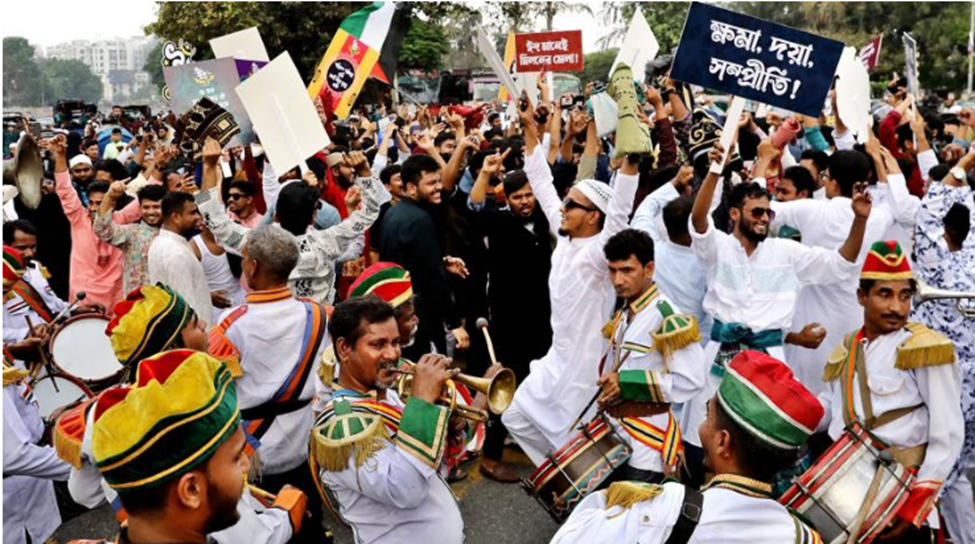
The procession was led by a band party playing festive tunes. Participants carried placards with Eid greetings and awareness messages. Photo: Anisur Rahman (Daily Star—31 March 2025)
Dhaka’s Eid Joy Procession has never been just a religious ritual. To describe it only as a religious observance would miss its deeper social meaning. Historically, it has been one of those rare moments when the city gathers in public space and becomes aware of itself. Streets that are normally filled with everyday routines become places of shared sentiment. “The streets that have been busy with everyday routines become places where some kind of shared emotion is manifest.” The procession has served as devotion, spectacle, memory, and even, at times, subversive resistance.
In nineteenth-century Dhaka, three grand processions controlled the ceremonial pulse of the city: Eid, Muharram, and Janmashtami. These were not separate religious dramas performed behind closed doors. They were publicly seen and shared. They involved interaction amongst different communities, viewing, and communication. From a Durkheimian perspective, such gatherings produce “collective effervescence,” an emotional intensity that arises when people come together and feel themselves as part of something larger (Durkheim, 1912).
During the Eid procession, individuals did not experience themselves as isolated worshippers. They felt part of a collective body. The ritual renewed social bonds in a way that ordinary daily life could not.
According to Habibur Rahman (1995), Dhaka’s social structure reflected elements of the Agra and Iranian orders in the Shia communities. It is significant to note this layering of history because it reminds us that the procession unfolded in the context of wider Islamic urban culture. Ritual authority, artistic expression, and political display were deeply intertwined. Even in the late nineteenth century, these influences shaped how the procession was organised and experienced. It was devotional, certainly, but it was also aesthetic and political, a reflection of the city’s layered identity.
We can imagine its early grandeur through the paintings of Alam Musawwar. In the first half of the nineteenth century, he created thirty-nine watercolours depicting Eid and Muharram processions, now preserved in the Dhaka National Museum. These paintings show decorated elephants and camels, colourful banners, ornate palanquins, and streets filled with spectators. The Naib-Nazims led the procession, followed by elites, ordinary residents, performers, fakirs, and even British officials. The city was not fragmented; it moved together.
At one level, this procession clearly expressed authority. It was likely institutionalised during the residence of the Naib-Nazims at Nimtali Palace in the eighteenth century (Mamoon, 2009). Inspired perhaps by Dhaka’s established Janmashtami procession, the Nawabi rulers appear to have shaped the Eid procession into a display of prestige and legitimacy. Ritual, in this sense, reinforced hierarchy.
Yet ritual does not simply preserve power. Turner (1969) reminds us that rituals create liminal moments, temporary spaces where normal hierarchies loosen. Even if elites organised the ritual, when it got started, they and common people shared the same ground ceremonially. For a few hours, people shared what Turner (1969) identifies as that group feeling beneath the day-to-day divisions, communitas. The hierarchy was still there, but not as blunted. The procession lets the city be re-experienced as a shared field.
With the fading of the Naib-Nazim line in the mid-nineteenth century, the magnificence of the procession diminished. Such large public rituals beckon resources, patronage, and coordination. Without institutional support, spectacle is difficult to maintain. The change signals that collective rituals are sustained by faith, as well as political and economic stability. At the beginning of the twentieth century, the spatial epicentre of the procession had moved toward open grounds near the present stadium. From early morning, people from the Churihatta, Banshal, and Nawabpur neighbourhoods assembled in new clothes. Drums beat. Banners were arranged beyond the enclosure of the Imam. Salimullah Muslim Hall earned a reputation for disciplined participation.
Students and teachers from Dhaka University marched under the leadership of Hasan, dressed in a white sherwani and turban (Ahsan, 2003). The image is striking: a flowing mass of people moving together through the city. The synchronised chanting of “Allahu Akbar” created a shared rhythm. Durkheim (1912) argues that synchronised ritual action produces solidarity because people feel emotionally aligned. In those moments, the city’s ordinary streets were transformed. What was usually secular space became sacred space. Urban geography briefly shifted from functional to symbolic.
What makes the Eid procession especially meaningful is its openness. Hindu and Christian residents often stood along the streets to watch. Foreign visitors took photographs. James Wise observed that Hindu and Muslim landlords supported each other during religious festivals (Ahsan, 2003). This suggests that these processions operated as shared civic events within a plural urban society. Turner’s (1969) idea of communitas helps explain how ritual can soften boundaries, even if only temporarily. Social inequalities remained, but for a moment, collective presence overshadowed difference. Eid did not end with prayers. There were fairs, stick-fighting spectacles, music, and the sharing of food amongst households (Ahsan, 2003). These activities integrated ritual into everyday life. Devotion was syncretic with joy. Social bond was not an abstract but was articulated through shared food, shared space, and shared spectacle. But the social bond was not inevitable. And in 1947, when the political situation around Partition was highly charged, there was a wave of violence in Nawabpur. Things were thrown from rooftops, and police fired tear gas (Hossain, 2017).
According to Mohammad Abdul Qayum, the police used tear gas, likely for the first time in Dhaka. Such disruption reminds us that collective solidarity can be surprisingly fragile. Durkheim (1912) emphasises that social binding is never complete but an ongoing renunciation. Ritual can forge social cohesion, but it cannot silence deeper political passions. The early 1950s introduced another transformation. Neighbourhood akharas began incorporating satire and political commentary into the procession (Dainik Azad, 1952–1953). Decorated elephants carried scenes criticising corruption, inefficiency, and international political issues. Humour became a vehicle for critique. At this stage, the procession began to resemble what Habermas (1989) calls the public sphere—a space where citizens publicly articulate opinion. Although not a formal debating institution, the procession became a visible arena for expressing dissatisfaction. Celebration and critique coexisted.
However, the state retained the power to regulate this space. In 1954, citing communal tensions and security concerns, authorities suspended the procession. For over four decades, it disappeared from Dhaka’s public life. Its absence was significant. When the procession stopped, a shared civic stage vanished with it. Revival began in the early 1990s. In 1994, under the supervision of Nazir Hossain Nazir, the Eid Joy Procession returned with participation from around thirty neighbourhoods (Rahman, 2018). Traditional banners, band parties, and performances reappeared. In 2000, a large-scale procession organised by the Dhaka Association brought thousands (Rahman, 2018). It had a strong nostalgic aspect and a yearning to return to a known past of the city. In 2025, Dhaka North City Corporation organised Eid prayers, joy processions, and cultural programs (BDN24.com, 2025). Institutional involvement has become more structured, yet the emotional core remains similar: people gathering in public space to celebrate together.
Across its many transformations from Nawabi spectacle to political satire to heritage revival, the Eid Joy Procession demonstrates that ritual is dynamic. Through Durkheim (1912), we see how it generates solidarity. Through Turner (1969), we understand its liminal communitas. Through Habermas (1989), we recognise its moments as an urban public sphere. But beyond theory, something more human persists. The procession allows the city to pause, to gather, to assemble, and to see itself. Rich and poor, powerful and powerless, young and old – for a moment, they occupy the same streets and share the same air. The Eid Joy Procession is not only about religious devotion. It is about belonging, visibility, memory, and the fragile but powerful feeling of being part of a shared social world.
References:
Ahsan, S. A. (2003). Shat bochor ager Dhaka. Batayan Prokashona.
Durkheim, É. (1995). The elementary forms of religious life (K. E. Fields, Trans.). Free Press. (Original work published in 1912)
Habermas, J. (1991). The structural transformation of the public sphere: An inquiry into a category of bourgeois society (T. Burger, Trans.). MIT Press.
Hossain, N. H. (2017). Shat doshoker Dhakar smriti.
Mamoon, M. (2009). Dhaka: Smriti bishritir nagori (Vol. 2). Anannya.
Qayum, M. A. (2018). The history of Dhaka: History and culture. Godyaprokash.
Rahman, H. H. (1995). Dhaka panchash bochor age. Oitijhya.
Rahman, S. U. (2018). Uthsober Dhaka oitijjo.
Shahnawaz, A. K. M. (2018). Dhaka: Itihash o oitijjo. Bangla Academy.
Turner, V. (1969). The ritual process: Structure and anti-structure. Aldine Publishing.
***
Anjuman Ara holds an MA in Sociology from South Asian University (SAU), New Delhi. Her research interests include culture, ritual festivals, and urban life in South Asia, with a focus on how public celebrations produce both social solidarity and cultural tensions.