
In India, workers, particularly in the unorganised sector, face various social and work-related issues in their everyday lives. They lack safety equipment, suffer low wage payment, and rarely have any social security benefits. “The Code on Social Security, 2020 (CSS) defines unorganised workers as home-based, self-employed or wage workers in the unorganised sector and includes a worker in the organised sector who is not covered by the Industrial Disputes Act, 1947 (Ministry of Finance, 2026).” People working as construction labourers, autorickshaw drivers, factory workers, cab drivers and gig workers are some of the more visible workers who face major difficulties in accessing basic facilities required to perform their duties in the urban areas.
Among the basic facilities that they have no access to, food at the workplace in India is a vital issue. Yet it is largely missing from discourses on labour rights. People employed in the unorganised sectors spend long hours at their work sites without access to proper lunchtime meals, safe drinking water, and a clean place to just sit and rest. According to the International Labour Organisation (2005), “good nutrition at work is good business leading to gains in productivity and worker morale, prevention of accidents and premature deaths, and reductions in health-care costs.” Every day, informal workers in metropolitan cities of India struggle to get affordable and nutritious lunchtime meals. In this article, I primarily discuss the everyday challenges that informal workers in Delhi face in accessing nutritional lunchtime meals and how it impacts their overall health.
In Delhi, informal roadside eateries, which are commonly called dhabas, are popular among the working-class in the city. From 1 PM to 2 PM in the afternoon, such eateries are crowded with people working on construction sites, platform workers, and autorickshaw and cab drivers. Suresh, a 32-year-old daily wage labourer in Delhi, says, “I don’t have a fixed workplace. I work on a daily wage payment basis. People hire us from the labour chowks for two days, a week or more, depending on the work requirement. The major issue I face daily is getting lunch, since I don’t know where I will be working tomorrow. During lunch time, I often visit nearby dhabas or paratha stalls.”
Suresh is a migrant labourer from Madhya Pradesh who has been having lunchtime meals at such informal roadside eateries for many years. He earns Rs. 10,000 to Rs. 13,000 per month. Therefore, he spends a limited amount on lunchtime meals to save money. “In the city, migrant households mostly engage in temporary work that is characterised by low wages, insecure jobs, harsh recruitment regimes and economic vulnerability, which are known to be typical of informal work environments (Ravindranath et al., 2019).” In Delhi, there are thousands of informal workers, like Suresh, who visit such stalls and dhabas every day during lunch break. These informal roadside eateries provide meals for Rs. 50 to Rs. 70. Such eateries serve as convenient, affordable meals to the informal working-class in the city.
Food, nutrition, and health of workers
Cena and Calder (2020) argue that “A healthy diet is one in which macronutrients are consumed in appropriate proportions to support energetic and physiologic needs without excess intake while also providing sufficient micronutrients and hydration to meet the physiologic needs of the body.” In physically demanding work, the role of lunchtime meals is highly essential, as it provides energy to workers to perform their tasks. Noon-time meals protect workers from various health issues, such as workplace fatigue and chronic illness and help to control the blood sugar levels. Skipping lunchtime meals at the workplace can lead to serious health issues in the long term.
In Delhi, workers get their lunch from informal roadside eateries at affordable prices. However, the question here is not about the accessibility of affordable lunch, but the real question is whether the workers are getting a nutritional lunch thali or not. Do their noon-time meals provide the required calories to perform heavy physical labour? What are the health implications for workers of a poor diet?
In Delhi, the noon-time meals of informal workers contain maida (refined wheat flour) and an excessive amount of refined oil. Consuming such foods provides high energy to workers for a day. However, long-term consumption of maida and refined oils increases the risk of chronic diseases and micronutrient deficiencies among them. The workers reported that they often suffer from weakness, headache, and generally do not feel well. A significant number of informal workers in Delhi do not receive adequate nutrition to perform their tasks, leading to vitamin deficiencies and high chances of heart issues and diabetes. According to the World Health Organisation (2026), “Diverse diets, based on a wide variety of foods, between and within food groups, are associated with a greater likelihood of meeting vitamin and mineral requirements and reduced risk of diet-related noncommunicable diseases.” In Delhi, informal workers primarily consume unvaried diets at lunchtime, which affects their productivity and overall health.
Subsidised meals programme in Delhi
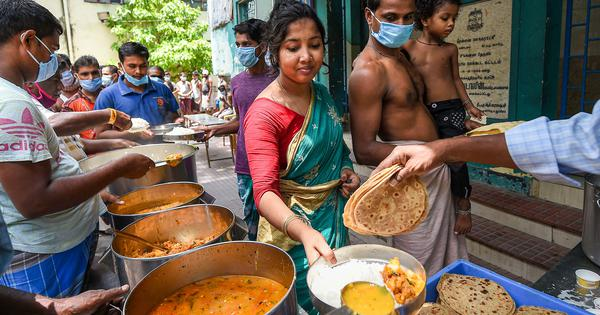
To serve nutritious, high-quality meals to the vulnerable and economically weaker sections of the population, the Delhi Government has established various state-sponsored community kitchens in the city. On 25th December 2025, the Delhi government launched this welfare scheme by establishing 45 canteens, and planned to set up a total of 100 canteens across the city (Ali, 2025). These community kitchens provide subsidised meals at Rs. 5 per plate. The workers noted that such community kitchens serve hot, tasty meals at an affordable cost. However, such canteens are located in certain locations of Delhi, such as nearby slum areas, JJ clusters and high-density residential areas. Construction workers and daily wage labourers say that “We occasionally get a chance to have meals at such canteens because our work sites frequently change. These canteens are not available everywhere.” However, in the field, many migrant informal workers didn’t know about such community kitchens in the city.
Lunch break hours and everyday interaction among informal workers
Informal roadside eateries, paratha stalls, and community kitchens not only serve lunchtime meals but also provide a place for workers to interact with each other during the lunch break hours. Informal workers from different sectors frequently meet at such places and discuss various issues related to their families, personal problems, and work. Kundan, a 28-year-old autorickshaw driver, says, “I have been coming to this place for many years. Most of the people come here for lunch regularly. I sit here for an hour and discuss lots of things with my colleagues.”
Despite being a site of socialisation for workers, these eateries and stalls fail to provide an inclusive space to female informal workers. Such eateries and stalls are male-dominated spaces, where female workers rarely have their lunchtime meals. They prefer takeaway over eating at the dhabas or depend on their male relatives for noon-time meals. Female informal workers not only suffer from a lack of nutritious food but also struggle to afford lunchtime meals every day.
The inaccessibility of nutritional lunchtime meals among the informal workers in Delhi is a major issue that affects their physical, mental, and social well-being. The lack of nutritious food reduces workers’ productivity, which in turn affects their wages and contributes to the high absenteeism. Most of the time, daily wage labourers suffer from memory lapses, dizziness and fainting due to missing their lunchtime meals. Such incidents have often been reported at construction sites, which pose a serious threat to workers’ safety and health.
To improve the accessibility of nutritious lunchtime meals to informal workers in Delhi, the government should increase the number of state-sponsored community kitchens in the city. Similarly, employers should provide safe drinking water and basic nutritional support to informal workers so that they can perform their tasks efficiently.
References:
Ali, S. (2025, December 30). Atal Canteen Scheme. Vikaspedia. https://en.vikaspedia.in/viewcontent/schemesall/state-specific-schemes/welfare-schemes-of-delhi/atal-canteen-scheme?lgn=en
Cena, H. & Calder, P. C. (2020). Defining a Healthy Diet: Evidence for the Role of Contemporary Dietary Patterns in Health and Disease. Nutrients, 12(334), 1-15. doi:10.3390/nu12020334
International Labour Organisation. (2005, July 28). Decent food at work: Raising workers’ productivity and well-being. https://www.ilo.org/resource/article/decent-food-work-raising-workers-productivity-and-well-being
Ministry of Finance. (2026). Economic Survey 2025-26. Government of India. www.indiabudget.gov.in/economicsurvey/doc/echapter.pdf
Ravindranath, D., Trani, J., & Iannotti, L. (2019). Nutrition among children of migrant construction workers in Ahmedabad, India. International Journal for Equity in Health, 18(143), 1-12. https://doi.org/10.1186/s12939-019-1034-y
World Health Organisation. (2026, January 26). Healthy diet. https://www.who.int/news-room/fact-sheets/detail/healthy-diet
***
Sonu Chauhan (sonuchauhan9136@gmail.com) is a PhD. Scholar at the Centre of Social Medicine and Community Health, School of Social Sciences, Jawaharlal Nehru University, New Delhi.