
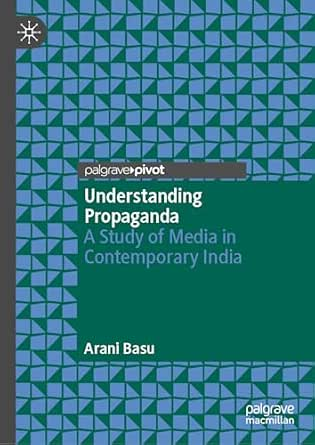
I am sitting on the metro. Instagram shows me a reel with the audio track from Dhurandhar. The middle-aged man beside me is glued to the Zee News broadcast over YouTube on Pakistan’s attack on Afghanistan. A cell phone rings to the tune of Har Ghar Bhagwa Chhaega. I have entered the poly-mediatic world of Hindutva. Reflecting upon the everyday reality of this social landscape, Understanding Propaganda: A Study of Media in Contemporary Indiaby Arani Basu (published by Palgrave Macmillan in 2025) comes as an easy handbook. It propounds the concept of Propaganda Infrastructure, a “systematic liaison between media, advertising industries, global corporations, and the state that facilitates the capture and appropriation of media spaces”. This framework is used to make sense of mediated propaganda, the nature of news dissemination, digitalisation, violence and disinformation in India.
The first chapter examines the nexus between crony capitalism and the state by interrogating the authoritarian state of governance in India since 2014. Basu looks at the limitations of journalistic liberties due to the corporate capture of media houses by the Adani Group and Reliance Industries. The chapter further locates propaganda in global history and in India. It looks at the role of religiosity in media through Gita Press, Kalyan Magazine (1920s), to Ramanand Sagar’s Ramayana( 1990s). The success of Ramayana led to media houses actively funding religious content, blurring the distinction between myth and politics. The chapter reads mostly in a flow, but leaves the reader on its own with theoretical grounding. While scholars are mentioned, their expansion remains limited.
The second chapter interrogates the nature of violence provoked by mainstream news channels. Basu studies the string of fake news concoctions during COVID-19 in relation to the Tablighi Jamaat. Following the framework, he shows that global corporations actively fund hate through media capture. Propaganda myths like the expanding Muslim population and ‘Hindu khatre mein hai’ frenzy create active vilification against Muslims. Narratives that end up legitimising systemic exclusion against minorities. Basu actively reinterprets the symbolism associated with jihad, jamat and masjid to extricate the nature of propaganda manufacturing. Similarly, the final chapter looks at disinformation and fake news from the context of ANI (Asian News International) and follows the same template of vilification for the ‘other’ countries, China and Pakistan. This chapter segues into internet shutdowns in India (Kashmir and Manipur), but the transition seems abrupt. Internet Shutdown is a propaganda mechanism, for it only lets the government have access to the sharing of information, but it doesn’t read smoothly in the context of ANI, a mostly televised media.
The third chapter is significant. It delves into the economy of digitised hate-mongering through the cultural production of Hindutva over the Internet and cinema. Basu’s observations on H-Pop and its production and consumption serve the platter of the neoliberal content generation sharply. It becomes more significant in the light of the latest Centre for the Study of Organised Hate (2026) report on the production of H-Pop and the role of Big-Tech in its dissemination.
Secondly, Basu argues that the blurriness of online-onsite spaces is anchored in a series of simulated realities. He reflects upon the works of Anderson and Longkumer to show the space of neo-Hindutva, where the ideology of the Sangh is reproduced at sites that are “external to the immediate operations of the Parivar”, in this case, digital media. What works for Basu through the study of H-Pop influencers such as Laxmi Dubey is shifting the site of assessment. The writing might make you go and search for Dubey. The visuals are concerning, but with more than fifty lakh views, they must also be provocative for some. Basu investigates the notational framework of the songs and the validity of the visuals, which are meant to normalise anti-minority hate. In the latter half of the chapter, Basu uses Lacanian film theory to assess the production of the anti-hero, the muslim Other. Bollywood, for the longest time, has been, as most cultural industries are, a centre for the production of nationalist sentiments. While jingoism and Hindutva tendencies aren’t new to Bollywood, a post 2014 landscape has legitimised what Basu calls the majoritarian egoism. Basu makes a semiotic analysis of the 2023 film Animal. In recent times, the Dhurandhar Series has performed on similar lines.
The fourth chapter delves into the material impact of the propaganda through cow vigilantism. The chapter focuses on WhatsApp as a site of propaganda, rumour as a method of propagation, and the effectiveness of neoliberal subjectivities. Basu argues that the virality of content makes the presence of oppressors omnipresent. The WhatsApp economy offers a free flow of visuals of violence, which end up sustaining rumours, creating suspicion between social groups, and contributing to a constant sense of fear and imagination of a perceived threat.
Chapter five looks at the project of Diasporic Hindu Nationalism, through the role of Hindutva Networks in Germany, which eliminates voices that do not resonate with them. The merit in Basu’s work lies in its careful borrowing of frameworks from studies outside India, moulding them into the Indian context and producing a framework of analyses for India and transnational propaganda infrastructures.
Admirably, the work is simple and bold with direct and important examples. Acting as a major contribution to the disciplinary fields of media studies, political science, political economy, sociology, digital humanities and diaspora studies, the book opens space for interdisciplinary engagement and lays out the need for an interdisciplinary study of propaganda.
While keeping an eye on contemporary forms of digital transmissions, Basu goes back to “traditional” media outlets: televised news and Bollywood, allowing the reader access to relevant changes and the impact of the propaganda. The pacing between media renders the framework its legitimacy. When the author makes a transnational-transtemporal analysis of propaganda through one framework, it shows the efficiency of the model to locate state action, corporatisation, and authoritarianism over time. Methodologically, the book is empirical and depends on individual interviews for some chapters. It gets into textual and semiotic analysis to uncover the material of propaganda.
Overall, the book is an important contribution to understanding the poly-mediated world around us. It positions not just the state but our own subjectivities within media frameworks. The frameworks are mostly derived from existing works. It allows an Althusserian reading of media by basing the cultural production of propaganda on economic structures of corporatisation. It also borrows from Chomsky and Herman to suggest the structure of political economic analysis. The book is a good start for anyone looking for resources to understand the nuances of authoritarian propaganda or polarisation in India through the media. It is an easy read, but leaves you with thoughts. The work has scope for expansion, in terms of understanding the consumer of the propaganda, the role of resistance against propaganda, the nature of the physical spaces of violence affected by propaganda, and whether there is a possibility of tech-policy mechanisms to control national and transnational propaganda despite state complacency.
References:
Purohit, K., Tavishi, & Meer, H. (2026). Profiting from hate music. Centre for the Study of Organised Hate. https://www.csohate.org/wp-content/uploads/2026/06/profiting_from_hate_music_csoh.pdf
***
Rusha Chatterjee is an independent researcher and writer. She is a former Young India Fellow and holds a Master’s in Political Science from the University of Delhi. She currently works as an educationist.