
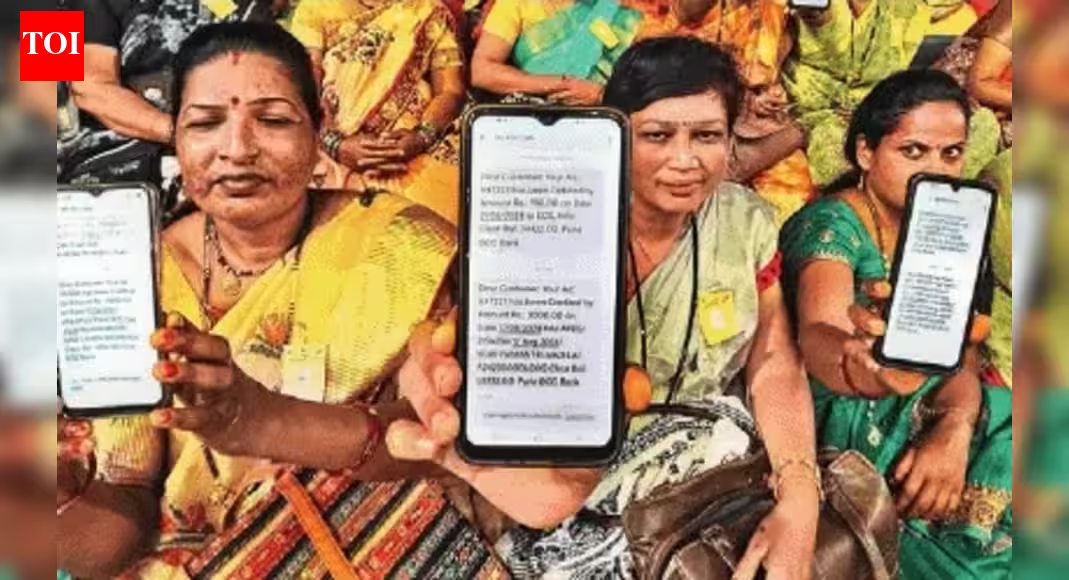
Money from a husband’s purse and money from her own purse are not the same thing, a woman in a Tamil Nadu town told researchers. The former has to be explained; the latter does not (Kotiswaran, 2025). She was talking about ₹1,000 a month from the state, part of a wave of unconditional cash transfers to women that began in 2021. By September 2024, 11 states, governed by parties of different ideologies, were paying roughly 88 million women (Kotiswaran, 2025). Ladli Behna in Madhya Pradesh, Majhi Ladki Bahin in Maharashtra, Gruha Lakshmi in Karnataka and Urimai Thogai in Tamil Nadu are among them.
Public debate usually asks whether these schemes empower women or win votes. This piece asks a smaller question that turns out to matter: what does the state say the money is for? Both things can be true at once. Kotiswaran (2025) notes that parties across the spectrum announced these transfers ostensibly for empowerment but with an eye on elections, and women have become a key electoral group (Aiyar, 2022). The electoral logic is real. But a policy pursued for electoral reasons can have enduring effects on the domestic front, and the reasons lie in their design, as the following analysis demonstrates.
The Value of Work Done
The rationale for such schemes rests on a number. In India’s first national Time Use Survey, women spent an average of 299 minutes a day on unpaid domestic services, while men spent 97 (Ministry of Statistics and Programme Implementation [MoSPI], 2020). The survey authors, Palriwala and Neetha (2011), argue that the social relations within households are gendered familialism, where care is considered a family matter and a woman’s due, and thus not a man’s responsibility; hence neither the market nor the state has a role to play. Marriage, in the words of many of the women interviewed by Kotiswaran (2025), is a contract in which a wife’s domestic service is exchanged for her husband’s maintenance. A woman in such a domestic economic unit has little or no cash at her disposal, and she has to request money. In Kotiswaran (2025), the women speak of the regularity of the instalments, the reminder on the phone and the ability to buy herself a recharge or some biscuits for the children without asking her husband. It is a resource, a first step to empowerment, as Kabeer (1999) would argue.
The Value of Words
Many of the schemes bear names that are rooted in familial terms and even religious ideas – Ladli Behna and Majhi Ladki Bahin are variants of beloved sister, while Gruha Lakshmi brings in the goddess of the home. Kotiswaran (2025) argues that this locates the woman in the home as a wife and mother. Tamil Nadu’s Urimai Thogai means rights grant, and the government’s notification in 2023 about it specifically states that the amount was a recognition of women’s unpaid domestic and care work. Did the difference in the names make a difference? Only 5 out of 121 beneficiaries felt that the amount was a recognition of unpaid care work; the rest explained it away in terms of their needs (Kotiswaran, 2025). However, the women felt that the state acknowledged their unpaid work, and several of them spoke of withholding some money from their husbands. A rights-based name therefore gave them a script to act out in the domestic sphere. It is a sociological finding with ramifications for policy-making; the very language used in a policy affects gender relations within the household.
The Limits of Cash
It is imperative to recognise the limitations of cash transfers. When asked directly, most women in the focus groups preferred employment to transfers, except the elderly and mothers with small children, and they spoke of needing more investment in health, transport, water and education, and linked their husbands’ low wages to the family’s poverty (Kotiswaran, 2025). Control over the payments is also a factor – in one case, a husband transferred his wife’s money to himself through a digital payments app because she did not have access to one (Kotiswaran, 2025). In Assam, a similar scheme called Orunodoi was piloted and found not to have resulted in significant shifts in women’s bargaining capacity within the household (Kotiswaran, 2022). Cash, argues Aiyar (2023), represents a paternalistic approach to welfare by presenting citizens as passive recipients of charity. The women in the focus groups were far from being passive recipients; however, the caution about designing policies with due regard for gender sensitivities remains valid. Care, after all, cannot be substituted by cash.
A Better Question
The question that emerges from this discussion is less about the parties and more about design. The findings suggest three possible areas of intervention. First, explicitly recognise the unpaid care work by announcing the cash transfers as compensation for such work. Second, invest in the specific areas of need identified by the women in the focus groups – jobs closer to home, better transport, and accessible and reliable public services such as healthcare and education. This would allow the cash to be used as an enabling mechanism for achieving transformation. Third, ensure that the women have control over the money – her phone, her account, along with some financial literacy. Any such scheme, by any party, should be judged by these three tests, and that is the merit of such an approach. It is obvious that the amount is important, but the language in which the announcement is made carries equal weight. In other words, the same ₹1,000 will be perceived as a token or as due compensation depending on the formulation and the audience.
References:
Aiyar, Y. (2022, March 10). The female voter has shifted the arc of electoral politics. Hindustan Times.
Aiyar, Y. (2023, December 5). Citizen vs. labharthi? Interrogating the contours of India’s emergent welfare state. The India Forum.
Kabeer, N. (1999). Resources, agency, achievements: Reflections on the measurement of women’s empowerment. Development and Change, 30(3), 435–464.
Kotiswaran, P. (2022). Revaluing unpaid work through unconditional cash transfers: The case of the Orunodoi scheme in Assam. Economic & Political Weekly, 57(26–27), 14–19.
Kotiswaran, P. (2025). Women’s work, never done, now paid: Assessing Tamil Nadu’s Urimai Thogai scheme. World Development, 190, Article 106947.
Ministry of Statistics and Programme Implementation. (2020). Time use in India–2019. Government of India.
Palriwala, R., & Neetha, N. (2011). Stratified familialism: The care regime in India through the lens of childcare. Development and Change, 42(4), 1049–1078.
***
Diva Bhatia is pursuing a Master’s in Political Science at Dr B. R. Ambedkar University Delhi.