
“As students of sociology, our focus is on studying actions that are repetitive, recurrent and purposive” -this line was frequently echoed by one of the professors at the Department of Sociology, Delhi School of Economics (DSE). And it has remained with me, etched into my memory.
I have been a committed student of the discipline from the very beginning. I still recall my school sociology teacher on the first day of grade 11 saying, “You now have three boyfriends who’ll stick with you for life. One French and two German: Durkheim, Marx, and Weber.” And she couldn’t have been more accurate.
By the end of school, I had the option to pursue Psychology – often viewed (now) as an ‘acceptable’ and ‘prestigious’ choice – at Lady Shri Ram College, University of Delhi. But I chose to stay with Sociology, trusting an inner pull I couldn’t ignore (and I’m so glad I did). I continued my undergraduate studies at LSR, followed by a postgraduate degree from the Delhi School of Economics. And it’s safe to say that the last five years have been incredible, opening vistas of learning and broadening one’s horizons.
With time, it became increasingly clear to me what I truly wanted to pursue. Unlike many who take sociology as an easier path to cracking the UPSC, I had no desire to follow that route. Sociology, for me, provided the space to think, question, and critique. Combined with the dynamic environment at LSR – home to so many strong, opinionated, and passionate young women – I knew I wanted to delve deeper into the space of Gender and Women’s Studies.
As soon as I completed my final Masters exams last year, I was fortunate to step into the very field I had aspired to – women and health. For the past ten months, I’ve been working at Ipas Development Foundation, a non-profit dedicated to advancing sexual and reproductive health and rights for women in India for over two decades. As a newcomer, what stood out most was seeing women at the heart of the organization, leading the way and welcoming others. One can’t help but admire these women, like my supervisor – strong, decisive, intelligent, and supportive. For a budding sociologist, the journey from theory to practice has been far more enriching than I could have imagined.
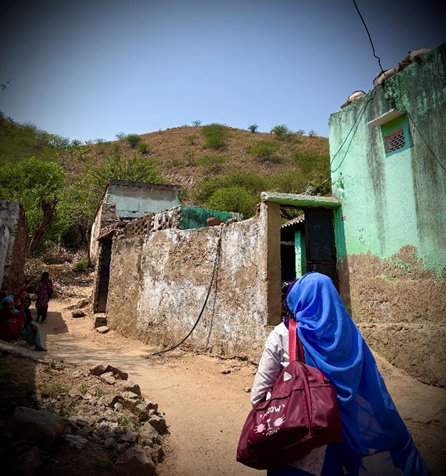
Each field visit – whether to districts of Diamond Harbor, Alwar or Jodhpur – has led to a new observation in its way. What began as site visits to understand health systems or community attitudes soon began revealing something deeper: the quiet codes and symbolic structures that govern everyday life.
Doing sociology, especially while working in the field of reproductive health and gender justice, involves moving between data and experience, observation and embodiment. It is a practice of noticing what goes unsaid and yet deeply felt. And often, it requires me to occupy two roles at once: the one who listens, and the one who cannot unsee what she has just witnessed. The work is professional, but the questions it provokes are profoundly personal.
On my most recent trip to Laxmangarh, Alwar, I visited a home where four generations lived under one roof. It was a warm afternoon, and we sat in a circle – the ASHA (Accredited Social Health Activist), community mobilizers, the older women of the house, and their daughters-in-law. But while the older women took the chairs offered, the young daughters-in-law instinctively sat on the floor. No one asked them to. No one needed to. Their place had already been scripted. They were married young, undernourished, and some recently postpartum. And yet, their silence and posture conveyed more than a survey form ever could.
The floor, here, was not simply material – it was symbolic. To sit on it was to occupy a space of deference, of containment, of being present but not centred. In Durkheimian terms, the chair became a marker of the Sacred – reserved, guarded, legitimised – while the floor became a site of the Profane: every day, unspoken, yet loaded with meaning. These women’s bodies, their locations in space, their distance from the conversation – all spoke to an internalised order that was not enforced by threat, but by repetition and socialisation.
What became clear then, as one moved from one household to another, was the growing relevance of the signifier. In fact, for thinkers like Jacques Lacan, it is the signifier that determines the signified – not the other way around. Any symbol is not merely an object, but a conception of the ideal; thus, it is both doing and saying something. Over time, the signifier is reshaped by other signifiers – whispers, gazes, rituals – and this, in turn, reconfigures the meaning of the signified. Culture and society are not in a hierarchy but in a constant dialogue.
The reproduction of deeply entrenched societal norms within health-related interactions was particularly striking. The enduring binary of ‘Domestic vs. Public,’ as articulated by Sherry Ortner in Is Female to Nature as Male Is to Culture? (1972), found renewed relevance – gender roles were not only visible but actively reinforced. Women remained closely associated with the private sphere and with nature, while men were linked to the public and the culture.
During the home visits, this dynamic played out in unexpected yet telling ways. One of my male colleagues often had to stay back and avoid entering the homes, as the daughters-in-law, upon seeing him, refused to lift their ghoonghat – the veil. In contrast, the mothers-in-law welcomed him, gave him noticeably more attention, and appeared to listen to him more openly than they did to us, the female team members.
To make sense of such encounters, then, is to move beyond appearance. Culture, far from being an accessory to the social, has its resistance, its logic. Sometimes, the symbolic gains more power than the real. We forget the difference. And soon, to question the symbol – be it the chair, the veil, or the role – is to risk challenging the very structure that holds the community together.
This is the delicate dance of doing sociology: not just to observe, but to sit with discomfort, to ask what feels off, to notice who isn’t speaking and who always sits on the floor. It is about listening with your eyes, reading the grammar of everyday routines, decoding the structure within the anti-structure, and often questioning the very frameworks we were taught Without this critical perspective, no policy can truly be implemented successfully.
Much like Durkheim’s assertion that religion is society worshipping itself, these small enactments – who speaks, who sits, who listens and who responds – mirror the community’s foundation. The young daughter-in-law, quietly on the floor, is not only a subject of the health system – but she also becomes a symbol of it.
And so, doing sociology, especially in gendered spaces like these, becomes a practice of seeing – carefully, curiously, and sometimes critically. Not all data is textual or numeric. Some of it is spatial. Some of it is gestural. And often, the most telling truths are the ones no one is explicitly naming.
This is simply the beginning for me, and there is a long path ahead. By studying gender through the lens of sociology, one seeks to turn the gaze both inward and outward, sparking conversations that demand change and forge new pathways for equality. The goal is to balance the ability to generalize broad propositions while delving into the unique particularities that shape lived experiences. As I continue this journey, I hope to contribute meaningfully to the discipline, giving overdue recognition to its female theorists and remaining open to learning from the complexities of the world around me.
References
Durkheim, Emile. 1995. (1912). The Elementary Forms of Religious Life, New York: The Free Press, translated by Karen E. Fields.
Lukes, Steven. 1985. (1973). Emile Durkheim: His Life and Work, A Historical and Critical Study, Stanford: Stanford University Press.
Ortner, Sherry B. (1972). Is Female to Nature as Male is to Culture? In M. Z. Rosaldo & L. Lamphere (eds.) Woman, Culture, and Society (pp. 67-87). Stanford University Press.
***
Ami Sahgal is a 23-year-old female working at a non-profit organisation dedicated to sexual and reproductive health rights in India. She holds a bachelor’s degree in Sociology from Lady Shri Ram College for Women (2022), where she was awarded the university medal, and recently completed her master’s degree from the Department of Sociology at Delhi School of Economics (2024), University of Delhi. A passionate advocate for women’s issues, Ami is committed to addressing concerns related to health, education, violence, and justice. She aspires to specialise in Gender Studies.
great
[…] Sahgal, A. (2025, May 5). Doing sociology: Holding space for the (in)visible. Doing Sociology. https://doingsociology.org/2025/05/05/doing-sociology-holding-space-for-the-invisible-ami-sahgal/ […]