
Migration is often discussed in statistics, policies, and large-scale trends. But for me, it is deeply personal. It lives in my family’s choices, the cities we moved through, and the identity I carry today. My understanding of migration goes beyond borders and passports, it begins with my mother.
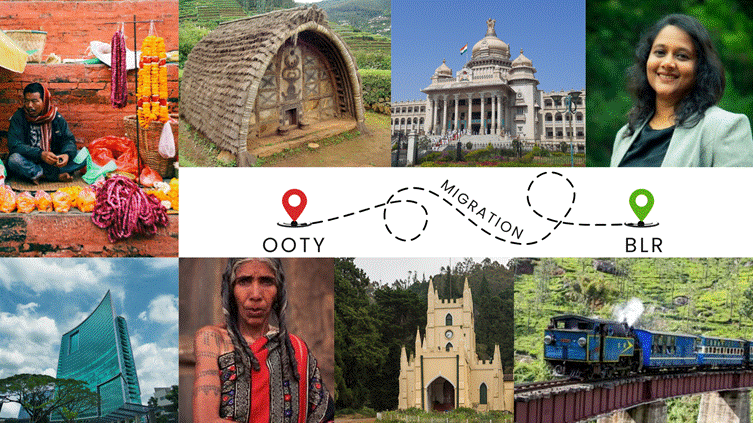
She was born and raised in Ooty, a small hill town in Tamil Nadu. She left home to pursue her higher studies in Coimbatore and later moved to Bangalore to continue her academic journey. Her acceptance into the Indian Institute of Science for post-doctoral research was not only a professional milestone but a turning point for our entire family. With that one decision, we stepped into a new city, full of unfamiliar sounds, languages, and rhythms.
In many ways, our move to Bangalore was like the migrations to global cities described in the book I’ve been reading. Cities like London, New York, and Hong Kong attract people in search of better opportunities. Bangalore was our version of that dream. Our migration was voluntary, and as Professor Khalid Koser explains, most voluntary migrations are motivated by economic or educational goals. Ours certainly was.
But moving is never just about shifting places. It is about adapting, rebuilding routines, and learning to belong. I still remember our early days in Bangalore. Language barriers made even basic tasks difficult. Buying vegetables or taking an auto-rickshaw often meant struggling to communicate. Though some people spoke Tamil, many didn’t, and we had to learn to adjust, slowly finding comfort in a new space.
This migration had a deep impact on my mother. In a society where women are often expected to stay within boundaries, moving to a city like Bangalore allowed her to grow into a more confident, independent person. Unlike many women who migrate for marriage or family, my mother moved to pursue her own path. This shift gave her the strength to make bold decisions. Eventually, my parents separated. It was painful, but in many ways, it allowed us to rebuild with clarity and strength.
I followed a similar path, carrying the spirit of change with me. After school, I moved to Maharashtra to study at the Tata Institute of Social Sciences. Now, I am in Kerala for a month-long internship. Each move has been about learning not just through books, but through experiences, people, and places. It has been about shaping my own journey toward a better future.
Even my language tells a story of migration. My mother tongue, Dakhni, is a blend of Tamil, Telugu, Marathi, Gujarati, and Kannada. This mix reflects generations of movement and cultural blending. It shows that migration is not a new idea in my family, it is part of who we are.
So how has migration shaped us? It has brought change, opportunity, and new perspectives. While Tamil Nadu may have lost a bright academic mind, Karnataka gained one. I gained courage, independence, and broader horizons. At the same time, we faced emotional struggles, uncertainty, and the challenge of starting over. Migration does not offer simple answers, it changes people in ways that are often hard to put into words.
Migration, I have come to believe, is neither good nor bad. It’s not black and white. It’s a mosaic of moments, some hard, some joyful, all shaping us in small, profound ways. It transforms people, families, and entire nations. And in a world where movement is only increasing, our stories as migrants will matter more than ever.
Thank you for reading. If this story resonates with your own journey, I’d love to hear about it. Drop a comment or share it with someone navigating change. Let’s keep the conversation going.
References
Koser, K. (2016). International migration: A very short introduction (2nd ed.). Oxford University Press.
***
Sadaf N is a Social Sciences undergraduate at Tata Institute of Social Sciences (TISS) Tuljapur, where she has come to realize that learning becomes far more powerful when it is creative, personal, and rooted in real life. She enjoys making complex ideas relatable by moving beyond just academic theory to connect with people in ways that feel meaningful and human.
Hi Sadaf,
Wow, like your mom you are creative and bold. It was nice to read about the migrations personally. So much of hardships and more of joy you experienced that must have shaped beyond your expectations. Wonderful writing. Keep reading and visiting places, people and make reports like this for a compilation later. Best wishes.
Dr. P. Ravichandran.
Thank you so much, sir. That really means a lot to me. It was a very personal piece to write, so I’m glad it connected. And yes, that’s the plan, meeting new people, travelling, and learning along the way. Home plays such a big role in shaping us, so all credit to my mom. Grateful for your words.
Hey Sadaf! Soo proud of you.. profound message put in a simple way with lot of clarity..This will resonate with many people I’m sure, it’s like you put in words what many people felt in thier heart🥰
I’m so glad it resonated with you. It means a lot that you could feel what I was trying to say…that’s exactly what I hoped for. Thank you so much.❤️