
‘…this work delineates how these public intellectuals were creating sites for the purpose of ‘transforming power’…wherein ‘power over was being remade as power with and power to’ (p. 186 emphasis original).
Published in 2025 by Palgrave Macmillan, Indu Jain’s bookis an exhaustive exploration of the pedagogy and performance art of four theatre practitioners, Anamika Haksar, Anuradha Kapur, Kirti Jain, and Tripurari Sharma. Although the author claims that her book is an analysis of contemporary Indian feminist theatre, written to disrupt the malestream historiography of the Indian theatre landscape, the book concentrates mainly on the documentation and criticism of the productions and performance pedagogy of Anamika Haksar, Anuradha Kapur, Kirti Jain, and Tripurari Sharma, who also held positions of institutional directors and pedagogues at the National School of Drama (NSD), Delhi during the period between the mid-1980s and 2013. The documentation begins in parallel with the women’s movement of the early 1980s, when street theatre was used as an awareness-raising tool, and its gradual shift to proscenium theatre, when many of these street theatre artists joined educational institutes as faculty members. Incidentally, Kirti Jain was appointed as the director of NSD from 1988 to 1995, and Anuradha Kapur held the directorial position from 2007 to 2013. During their appointments as heads and pedagogues, all four of these practitioners introduced a systemic overhaul of the institute’s untouched syllabus and policies, originally designed by Ebrahim Alkazi, by preferring a collaborative feminist model. In comparison to the Alkazian model, which was patriarchal, unidimensional, realism-oriented, and aimed towards the perfection of end spectacle, the performance pedagogy introduced by these women theatre practitioners promoted processual knowledge as it was collaborative and oriented towards debunking author-director hierarchies by integrating the voices of the student-actors as equals, allowing fluidity and liminality within the rigid spaces of the establishment. Therefore, to qualitatively and empirically assess the political feminist imagination adopted by these practitioners in their pedagogy, the author integrates insights from semi-structured interviews conducted with both the practitioners-pedagogues and their student-actors. Alongside incorporating data from national newspapers, theatre reviews, testimonials, archival material, performance notes, unpublished scripts, and participation in practitioner-led workshops, engaging with their theatrical processes, acting modalities, and examination of the official documents related to NSD, the author examines their feminist venture aimed at engendering a more democratic space and bringing forth change from within.
At the outset, the author makes it clear that though these practitioners were from a privileged background, given their education and training from various institutes of national and international repute, such as the Russian Academy of Theatre Arts (Anamika Haksar’s alma mater), and Radical Theatre at Leeds (Anuradha Kapur’s alma mater), they deftly undertook their roles as public intellectuals and recalcitrant ‘troublemakers’ (p. 185) to generate a culture of resistance within the establishment. However, to avoid a homogenising account, the author explores the craft of these director-pedagogues alongside insights into their family background, productions, work processes, and employed pedagogical lexicon, ending with an analysis of their recent ventures into theatre, such as Kapur’s Nale Wali Ladki and Dark Things, and docudrama like Haskar’s Taking the Horse to Eat Jalebis. Furthermore, to examine the efficacy of their pedagogic models, the author also discusses the works of some of their students, namely Abhilash Pillai, Aditee Biswas, and Punj Prakash.
The first three chapters of the book situate these director-pedagogues in the sociopolitical milieu of Indian theatre. The fourth chapter delves into their experimentations with engendering feminist scenography. The fifth chapter appraises their feminist pedagogy by examining the unconventional classroom interactions. The sixth chapter delves into an analysis of independent projects by students and post-NSD works created by the pedagogues in collaboration with NSD graduates.
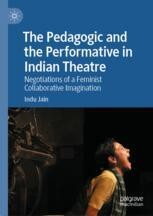
For those interested in a synoptic delineation of the feminist collaborative pedagogy explored in depth by the author in this book, they may refer to Anuradha Kapur’s interview (2019), wherein she shares her insights on making the play titled Nale Wali Ladki, which was brought into fruition by the collaborative efforts of the final-year students of NSD. Incidentally, the cover image of the book, which presents a still from Kapur’s Nale Wali Ladki, alludes not only to the feminist politics of the concerned play, both technically and thematically, as it underscores “movement from the spoken word to the written one and thereafter to the body” (165), but also to the authorial intention of engendering space for these women theatre practitioners largely marginalised in the landscape of mainstream Indian theatre historiography.
References
Kapur, Anuradha. 2019. “रंगमंच की दुनिया में स्त्री: अनुराधा कपूर से ख़ास मुलाकात.” Filmed September 13, 2019. NewsClickin, 00:16:35, https://youtu.be/JIRkOiY_Ves?si=x-HVQxFWgQoCM30C.
***
Sushmita Dey is a PhD Candidate at the Indian Institute of Technology (Indian School of Mines), Dhanbad.