
Isn’t it striking that, although Rabindranath Tagore harboured strong reservations about the very idea of nationalism, two South Asian countries—India and Bangladesh—adopted national songs written by him after his death, as they emerged as independent nations at different points in time? Rudrangshu Mukherjee’s study of the Indian national anthem, Song of India: A Study of the National Anthem, is particularly intriguing in this context, as it invites deeper reflection on Tagore’s understanding of history, society, and the Indian past during the colonial period, as well as on his vision for India’s future as an independent state.
After independence, when the Indian Constituent Assembly was finalising the national anthem, they decided to adopt Jana Gana Mana as the national anthem of India. However, Prime Minister Jawaharlal Nehru recalled in 1961 that during his last meeting with Tagore, he had requested the poet to compose a new song that could serve as the anthem of independent India. Tagore had partially agreed, but he passed away soon afterwards, and the idea never materialised. Interestingly, this suggests that at that moment, neither Nehru nor Tagore considered Jana Gana Mana—originally written in 1911—as the obvious choice for the national anthem.
The main contender to Jana Gana Mana was Vande Mataram by Bankim Chandra Chattopadhyay, written in 1875 as filler in Bangadarshan, and later included in the novel Anandamath (1882). Its music, notably, had been set by Tagore himself. As Rudrangshu Mukherjee notes, while the then Premier of West Bengal strongly supported Vande Mataram, the Constituent Assembly ultimately chose Jana Gana Mana as the national anthem, formally adopting it in 1950. At the same time, Vande Mataram was accorded a place of honour as the national song, as declared by India’s first President, Rajendra Prasad. Although this song was embraced as a virtual national anthem during much of the colonial period, from the 1930s onwards it began to attract controversy, as sections of the Muslim community in Bengal grew cautious and raised concerns about alleged elements of idolatry in its lyrics.
In Bangladesh, the closest contender to Amar Sonar Bangla was D.L. Roy’s Dhanadhanya Puspabhara. Both songs were composed against the backdrop of the 1905 Bengal Partition; however, Sheikh Mujibur Rahman and his associates ultimately chose Amar Sonar Bangla as the national anthem.
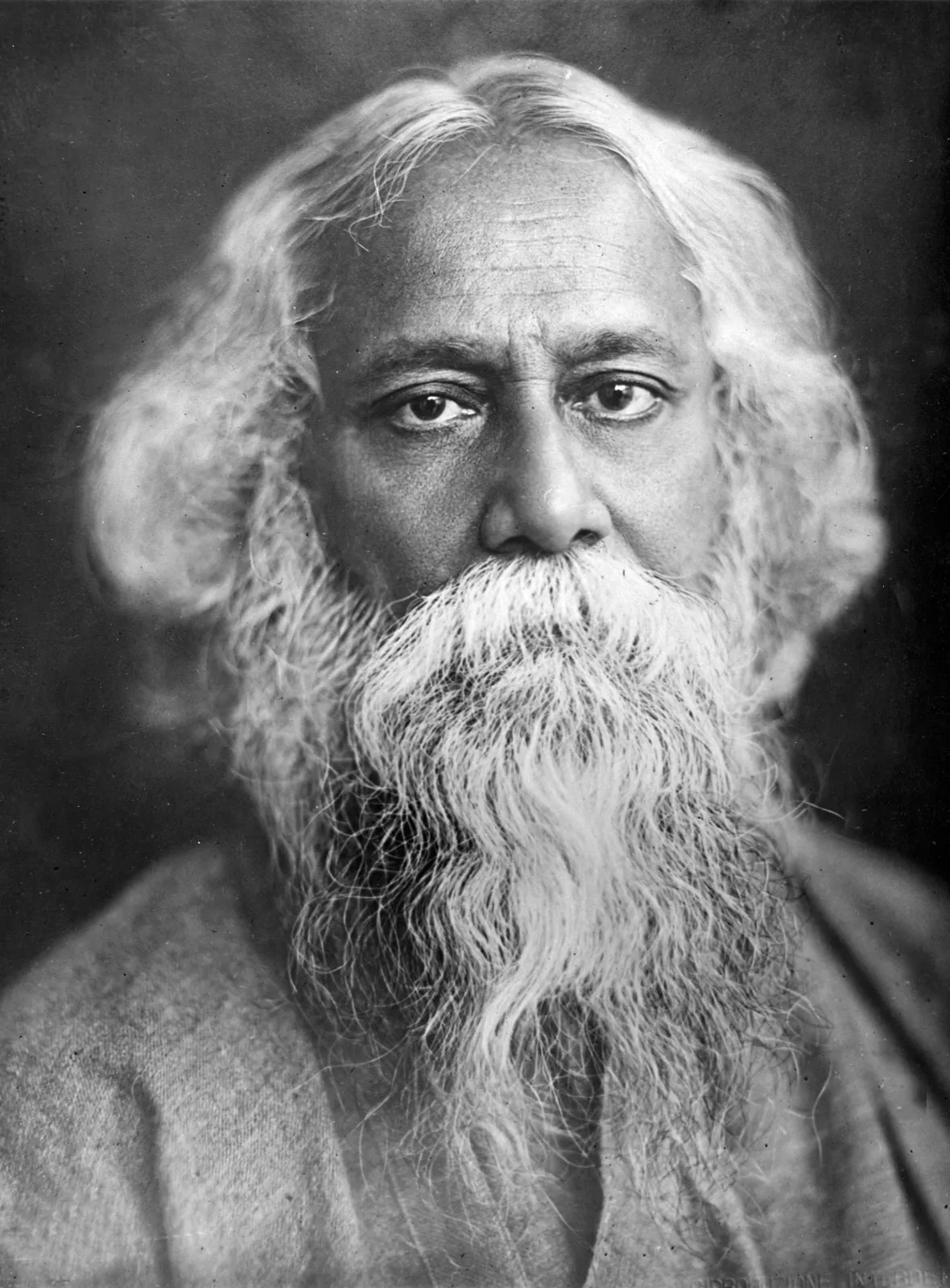
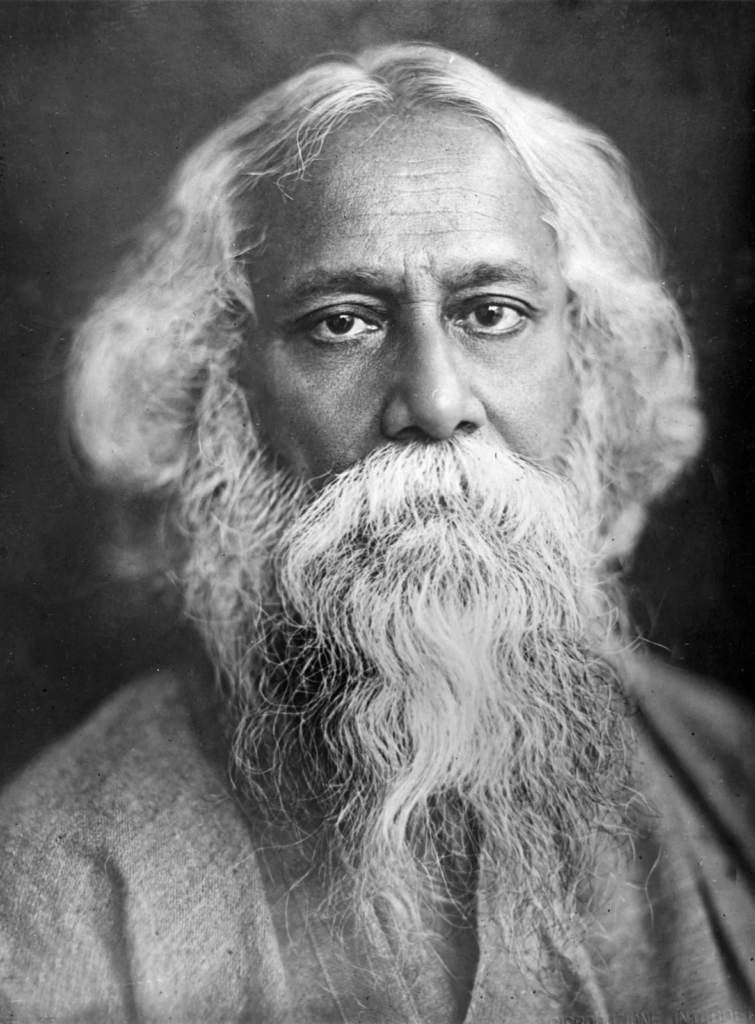
Mukherjee provides a concise yet insightful account of Tagore’s life in his book, covering his upbringing in Calcutta, his family’s decline from a higher Brahminical status and subsequent rise as entrepreneurs, his early emergence as a Bengali poet, and his responsibilities as a young defender of the family estate. He describes how Tagore, while sailing by moonlight, was first captivated by the beauty of nature and the landscape, and then drawn into the struggles of its people in East Bengal. At the same time, he highlights how Tagore, despite not having formal schooling, developed a distinctive worldview and ultimately became the first Nobel laureate from outside Europe.
Tagore composed Jana Gana Mana in the years following the Swadeshi movement—the first politically organised struggle against British colonial rule—set against the backdrop of Bengal’s partition in 1905. Although officially presented as an act of ‘administrative expediency,’ the partition in reality deepened the Hindu–Muslim divide, with consequences that proved decisive in the years to come.
While Tagore initially threw himself into the movement against the partition of Bengal, he soon withdrew after realising that the aggressive boycott of foreign goods was not equally practical for all, given the stark economic disparities in society. After distancing himself from the movement, he redirected his energies toward establishing educational institutions and promoting village reconstruction, envisioning an Indian society as Swadeshi Samaj—self-reliant and not dependent on the mechanisms of the state.
When the partition of Bengal was annulled, and the King of Empire visited India—at a time when the capital was being shifted from Calcutta to Delhi—Tagore composed this song at the request of a friend. This later sparked controversy, with some alleging that the song was written in praise of the King. Yet no clear evidence supports this claim. On the contrary, a closer, line-by-line reading of the text weakens such interpretations, showing instead that Tagore was grappling with deeper, more reflective ideas rather than composing a mere eulogy for an individual.
Mukherjee notes that Tagore did not compose the song in praise of King George V. In fact, Jana Gana Mana was first sung on December 27, 1911, during the second day of the Indian National Congress session held in Calcutta. Later, it was published in Tattvabodhini Patrika in January 1912, where Tagore described it as a Brahmo song. Dinendranath Tagore created the musical notation (swaralipi) for this song. Later, Tagore himself translated this song as The Morning Song of India in 1919.
The song is carefully crafted: it begins by delineating the geography of India, moves on to evoke the country’s major religious traditions and their harmony, and then reflects on the nation’s history—its past and present—while uniting the cultural currents of both East and West. Through its imagery of diversity and resilience across centuries, the song carries a profound sense of hope amid crisis and despair, ultimately envisioning a charioteer—the eternal guide, dispenser of destiny—who remains ever awake and unwavering.
The dream that Tagore manifested in Jana Gana Mana, as Mukherjee observes in Tagore’s other writings as well, is broadly a vision of India as “a place of pilgrimage—a site to come to with head bowed and bound in humility. Bharat was not a place for the display of arrogance. Unity was anchored in compassion.” This was conceived as a civilizational process, transcending the narrow confines of nationalism. Yet the reality diverged from this vision: the long anti-colonial struggle gave way to a period of latency that ultimately culminated in the violent Partition, claiming countless lives—including that of Mahatma Gandhi, who remarked that this song is “not only a song but… also like a devotional song.”
The wounds of that rupture, both then and now, remain largely unhealed, as the violence of society repeatedly resurfaces and cannot be easily repressed—etched deep into the very unconscious of history. Yet the anthem carries within it a profound sense of hope and tranquillity, embodying the idea of Bharat not as a parochial nation-state but as a broader, inclusive vision. Song of India offers fresh insights that invite us to reflect on this vision anew.
***
Priyam Pritim Paul is pursuing his PhD at Ashoka University. He previously completed his MPhil at South Asian University (SAU) with a thesis on Maijbhandari Sufism in Chattogram, Bangladesh, and earned his MA from Jawaharlal Nehru University (JNU).