
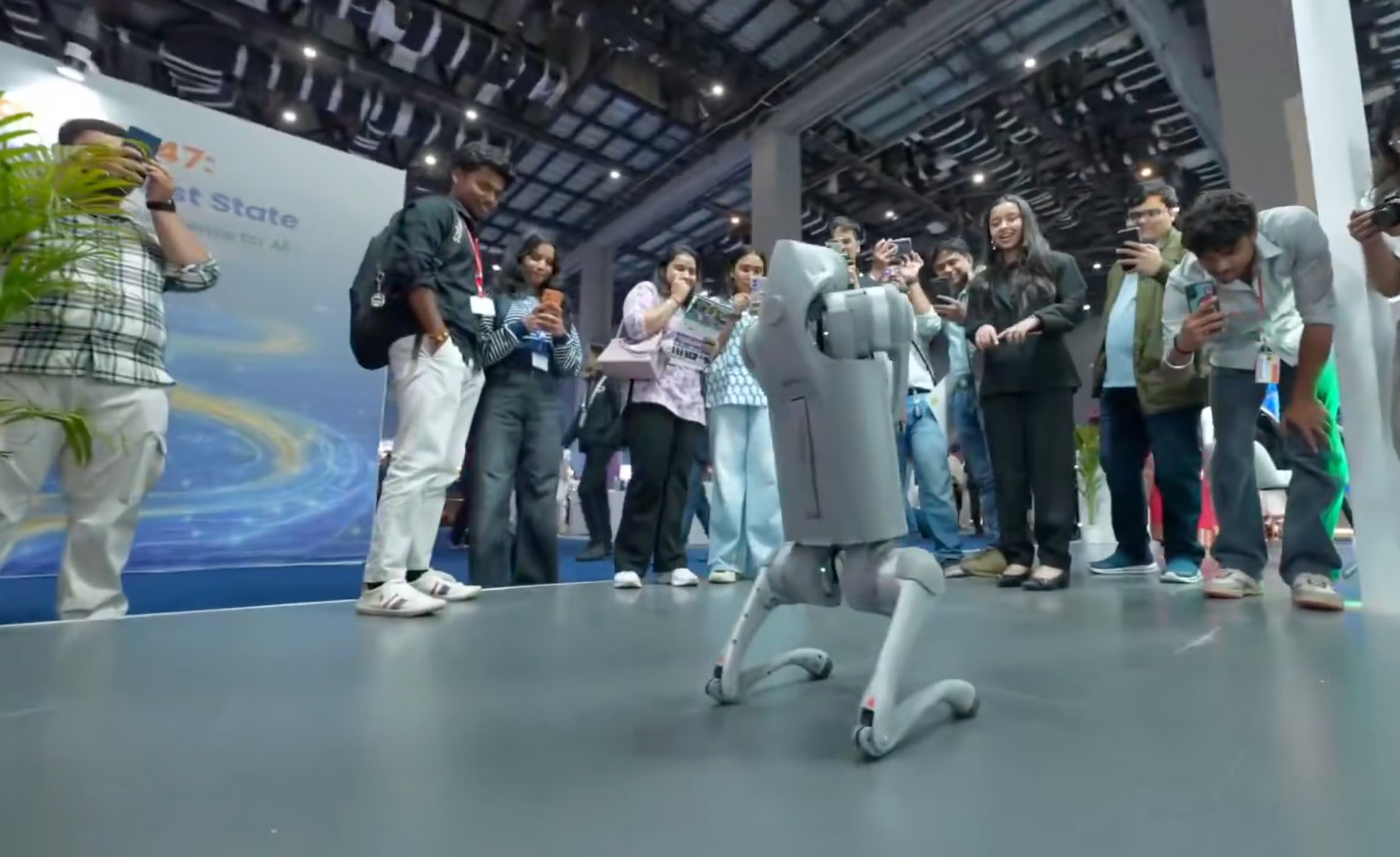
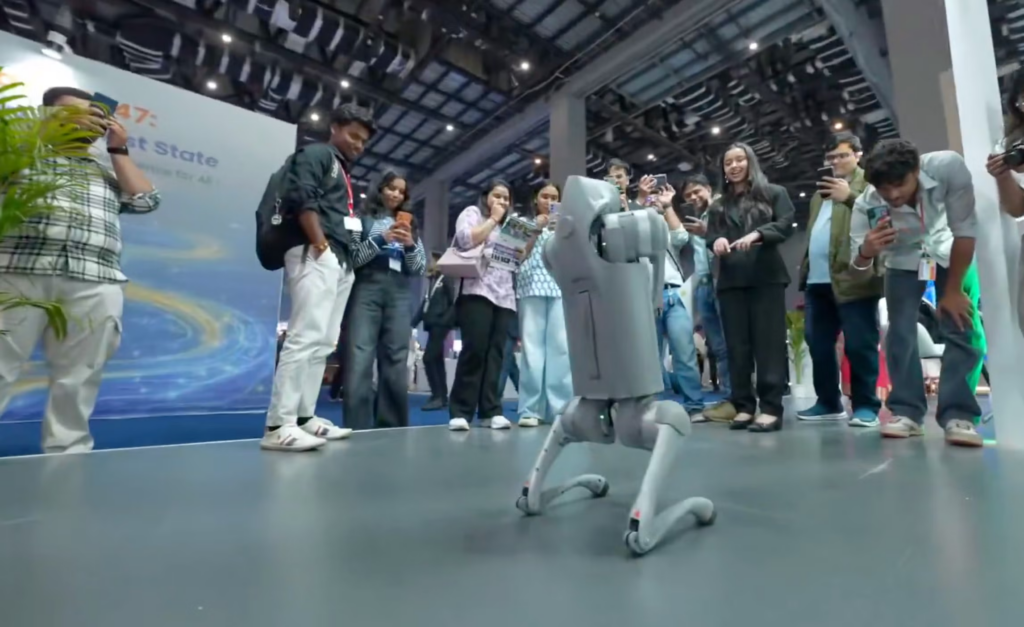
The AI Impact Summit 2026, held in India, which was promoted as the world’s ‘largest and most historic’ AI summit, captured the headlines for unforeseen reasons. The summit was held in the Global South for the first time, and as the host country, it was a crucial opportunity for India to garner global attention towards the Indian AI scenario. Instead, the only two things that were being talked about by the end of the four-day event were a Chinese robot and a ‘shirtless’ protest.
The first controversy happened at the India AI Impact Expo. A private university in Greater Noida, Galgotias University, showcased an AI robo-dog ‘Orion’ that was supposedly developed in their Centre of Excellence. However, it later turned out to be a commercially available Chinese robot. The University was forced to vacate its stall and had to issue a public apology after the incident went viral. The incident inspired a range of memes and reels on social media ridiculing the standard of education in the University. Interestingly, a significant portion of these memes included videos of female students of the University dancing to item songs during different cultural events, hinting at these sexualised videos being evidence/cause of the low standard of education in the University campus.
The second controversy took place on the last day of the summit. A group of workers from the Indian Youth Congress staged a ‘shirtless’ protest against the government inside the venue of the AI Summit. These workers opened their jackets and held up their t-shirts printed with slogans that criticised the Prime Minister for the newly proposed India-US trade deal, and issues like unemployment and inflation. This ‘shirtless’ protest in front of international delegates was seen as a breach of protocol, and the workers were arrested later.
In both cases, the central issue was the female/male body being exposed. However, that exposure of the body was treated very differently depending on the gender of the individuals. The exposed female body was seen as a distraction/disruption in the ‘intellectual pursuit’ of an educational environment, whereas the exposed male body was perceived as a security threat. Feminist scholars, for a long time, have been pointing out this gendered difference in how the body is perceived by society. In the sections below, we will analyse both cases to show how the body, when it comes to females, is often sexualised and objectified, whereas the male body is perceived as a security threat. This distinction is critical for understanding how bodies are viewed, constructed and reproduced in the public sphere.
Sexualisation of the Female Body
Women’ s bodies, throughout history, have been regulated through notions like Madonna-Whore binary, where ‘Madonna’ refers to pure, divine women, whereas ‘whores’ are seen as morally corrupt. The morally corrupt woman is viewed as a temptress who repeatedly instigates sexual desires in men. By doing so, they are able to sway the man away from the intellectual path to the ‘perverted’ path of beauty and sexuality. In a phallocentric hierarchy, the intellectual path is the higher path that only males are capable of, whereas women are caged within the limits of beauty and domesticity. Beauty and the brain are seen as mutually exclusive in nature and cannot coincide, a notion heavily criticised in feminist literature. Women become mere objects of sexual pleasure and beauty, whereas men become the minds capable of producing global innovations.
When one analyses the Galgotias incident, it becomes evident that it was nothing but a lapse on the part of the University authorities, and probably a good starting point to discuss the state of education in the rapidly emerging private educational institutes in the country or the AI scenario of the country. Instead, the digital conversation shifted its focus to a few old video clips of young female students of the university enjoying a Freshers’ event. The dance performances of these students were sexualised on social media and criticised for the campus culture it promotes. While engaging with the videos, users often used sexualised and objectifying terms like ‘bar dancer’, ‘nachaniya’ for the students and ‘kotha’, ‘ra***ikhana’ for the university.
This shows how the intellectual failure of the university was directly connected to the performance of bodily autonomy of the female students on campus, and the dance performance was made the culprit of the intellectual failure. The female students were portrayed as the problem or the tempting force that led to the institutional failure. Rather than blaming the structural failure of the institutions, women’s performance of bodily autonomy became the centre of moral regulation. The institution space was compared to a red light area that is only capable of producing sexualised students who are incapable of intellectual integrity and innovation. The digital public here reinstated how spaces with autonomous women’s bodies performing their sexuality and desire cannot have intellectual pursuit of the highest order. One can juxtapose this with narratives of having fewer girls in engineering spaces like IITs, which are deemed as spaces of the highest intellectual order in India. Such narratives often conform to the gender binary that perceives females as incapable of achieving intellectual greatness.
Male Body as a ‘Security’ Threat
Unlike the female body, the perception of the male body is not threatening as a morally corrupting force, but as a physical security threat. The incident of the ‘shirtless’ protest in the AI Summit was called ‘a breach of security’ by the news articles that reported it. The protestors were condemned by the ruling party for embarrassing the country on an international platform. However, this ‘embarrassment’ was completely political and devoid of any sexual connotation, although it included individuals stripping off their jackets and shirts in front of the camera and a huge crowd that was physically present at the venue. The whole incident was purely seen as a political fiasco. Even when the videos of the incident went viral on social media, the comment sections remained filled with political debates. The exposed bodies of the protestors were largely deemed as a security threat in a high-profile international event, according to the internet. The protesters were detained for the same act.
In a patriarchal order, male bodies are seen as bearers of hegemonic masculinity. One of the most distinctive forms of it is seen in the military, where the male soldier is portrayed as a hero and a warrior. The male body is perceived as a war machine whose primary task is to fight wars. This attaches an angle of disposability to the male body. The notion of the ‘male warrior’, constructed in the heteronormative, patriarchal structure, acts in two ways: first, it allows the male body to be perceived as a threat if it belongs to the opposing camp, and second, it imagines the male body as a protective warrior-hero if it is one of their own. This is also the reason why people with biologically male body parts are often forced to endanger their lives and health in times of crisis. Another form of this can be seen in West Africa, where young men are turned into ‘war-machines’ who are ‘available for violent labour both on the battlefields and in the diamond mines, rubber plantations, and other unregulated industries’.
By attaching the notion of threat and security to the IYC protesters, their bodies were located in the discourse of male bodies as ‘war-machines’, which allowed for the transformation of the peaceful protest into a security threat. However, these bodies, despite being undressed, were not sexualised as the hegemonic masculine discourse will not allow it. Only female bodies can be sexualised and moralised in the patriarchal world order. The male body is regulated through force, and their acts are seen as a demonstration of political agency, whereas the female bodies are morally regulated through tags of indecency. This differentiated treatment of bodies in the AI summit, whether as ‘temptress’ or ‘war-machine’, exposes the deeply rooted patriarchal ways in which narratives and discourses function in India and calls for closer attention to their formation and circulation.
***
Rishiraj Sen is an independent researcher. He was previously a researcher at IIM Ahmedabad and a Margaret Basu scholar at LSE (2022-23).
Dibyashree Mahanta is a doctoral scholar in the Department of Indian Languages and Literary Studies at the University of Delhi.