
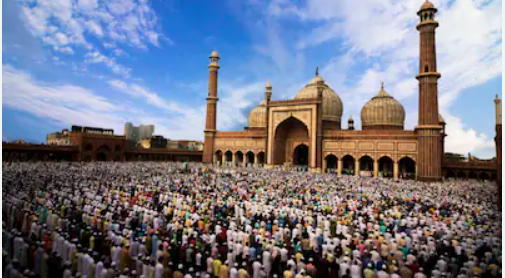
The morning of Eid used to arrive before I even opened my eyes. It lived in the sounds, the quiet clatter of dishes in the kitchen, the soft rustle of new clothes, the familiar voices calling out reminders as if the whole house shared one heartbeat. But on the first morning after waking up in a different country on Eid, I did not find that. There was no noise, no laughter, no signs of a shared anticipation of the day. For a moment, it did not seem like Eid. It seemed like the day had simply passed over me. Instead of seeing Eid as a religious event, the article explores the ways in which it is reinterpreted and transformed in a multicultural society, where religious practices are shaped through everyday lived experiences and shifting social contexts (McGuire, 2008; Hall, 1990).
Ritual Displacement and the Loss of Collective Rhythm
Eid, in its usual context, is a very collective ritual. The day progresses in a series of collective actions, prayers, greetings, meals, and visits, which evoke a sense of collective unity and belonging. However, in a different country, this collective rhythm is disrupted. The absence of family, neighbourhood interactions, and cultural embeddedness evokes a sense of dislocation.
This shift can be understood through Emile Durkheim’s concept of collective effervescence (Durkheim, 1912), which refers to the emotional energy generated through shared rituals. Back in the homeland, Eid is full of this kind of energy, and it’s nearly impossible to feel alone in the midst of it. However, in a foreign land, even when one is part of communal prayer or congregations, it feels incomplete, as if it’s missing a level of history and familiarity. In this sense, Eid becomes a “displaced ritual,” one that is no longer embedded in its original social context. The ritual continues, but its emotional and social intensity is altered.
Everyday Multiculturalism: Negotiating Difference
One of the most visible aspects of celebrating Eid outside is dealing with people of diverse religious and cultural affiliations. This is because dealing with people in day-to-day life reveals how cultural traditions are perceived, misunderstood, and redefined in new environments. For instance, when I wished people around me “Eid Mubarak” while outside, they replied kindly with “Happy Eid” instead. Although their response differed from the customary greeting, it demonstrated that they were willing to participate in a tradition that was not originally theirs. These small actions are important. it. They reflect how people from different cultures try to relate to one another. However, they also reflect that this understanding is not always complete. People may not fully understand what Eid is all about, but they still try to recognise it. Such interactions illustrate what scholars describe as everyday multiculturalism, where cultural differences are negotiated through routine encounters.
Performing Identity in a Foreign Context
The celebration of Eid in a non-Muslim majority country also brings to mind the question of identity. Back home, we do not need to clarify what Eid is. It is part of us. But outside, Eid is something that is expressed and sometimes defined. This aligns with Erving Goffman’s concept of the presentation of self (Goffman, 1959). Identity is not fixed; it is performed in interaction with others. Saying “Eid Mubarak,” wearing traditional clothing, or requesting time off becomes a way of asserting one’s identity in a context where it is not the norm. At times, this performance feels empowering as a way of maintaining cultural continuity. At other times, it feels burdensome, as if one is responsible for representing an entire tradition. This duality reflects the complexity of identity in diasporic settings.
Imagined Communities in a Digital Age
Despite physical distance, the sense of belonging does not disappear. Instead, it is reconfigured through what Benedict Anderson terms imagined communities (Anderson, 1983). On Eid, this imagined connection becomes particularly vivid. Phone calls, video calls, and messages establish a common temporal experience. Despite being in a different country, I was aware that my family would be celebrating the event at the same time and would offer prayers, have meals, and exchange greetings. Nevertheless, the experience of being together through the digital media is also accompanied by the experience of absence. It is the screen that becomes the medium of connection and disconnection between people while reminding them of their distance and absence. The warmth of the voice is not the same as the warmth of the person.
Recreating Eid in a New Cultural Context
Over time, celebrating Eid abroad leads to the emergence of new practices. Traditional rituals are adapted to fit the constraints and possibilities of the new environment. Meals are improvised, gatherings are smaller, and schedules are adjusted. This process reflects the formation of a diasporic identity, where elements of the home culture are maintained while also being transformed. Eid, in this context, becomes a hybrid ritual, neither entirely traditional nor entirely new, shaped by the movement of culture across different social and geographical contexts (Hall, 1990). For example, celebrating with friends from different countries introduces variations in food, language, and customs. A single gathering may include multiple interpretations of Eid, each shaped by a different cultural background. These hybrid spaces challenge the idea of a singular, “authentic” way of celebrating.
Loneliness, Reflection, and Emotional Transformation
Amid these sociological processes, there remains an emotional core that is difficult to ignore. Celebrating Eid away from home often involves quiet loneliness, not just the absence of people, but the absence of a shared emotional landscape. It is the feeling of celebrating something deeply meaningful in a space that does not fully recognise its significance. It is the subtle dissonance of joy and longing coexisting at the same time. Yet, this loneliness also creates space for reflection. Without the overwhelming structure of home, Eid becomes more introspective. It shifts from being a purely social event to a personal experience of meaning, gratitude, and connection.
Conclusion: Reimagining Eid Beyond Place
Celebrating Eid in a different country reveals that rituals are not static; they are shaped by context, interaction, and experience. While the absence of home creates a sense of loss, it also opens possibilities for new forms of belonging. Eid, under a different sky, does feel different. It is quieter, less certain, sometimes incomplete. But it also becomes more intentional, more reflective, and, in some ways, more deeply understood. In this ethnographic reflection, Eid emerges not just as a religious festival but as a site of sociological inquiry where questions of identity, community, and belonging are lived and experienced in everyday life. It shows that while traditions may originate in specific places, they are ultimately carried by people, continuously reshaped as they move across borders. And perhaps that is the most profound realisation: even in unfamiliar surroundings, even in moments of distance, Eid does not disappear. It changes, it adapts, it softens, but it remains, carried quietly within.
References:
Anderson, B. (1983). Imagined communities: Reflections on the origin and spread of nationalism. Verso.
Durkheim, E. (1995). The elementary forms of religious life (K. E. Fields, Trans.). Free Press. (Original work published 1912)
Goffman, E. (1959). The presentation of self in everyday life. Anchor Books.
Hall, S. (1990). Cultural identity and diaspora. In J. Rutherford (Ed.), Identity: Community, culture, difference (pp. 222–237). Lawrence & Wishart.
McGuire, M. B. (2008). Lived religion: Faith and practice in everyday life. Oxford University Press.
***
Sanjida Tamanna Oishee is an international student from Bangladesh pursuing a master’s degree in Sociology at South Asian University (SAU), New Delhi. Her research interests lie in gender, culture, diaspora, and institutional power, with an emphasis on ethnographic and reflexive approaches in South Asian contexts.