
Introduction: Domestic Workers at the Margins of Labour Law
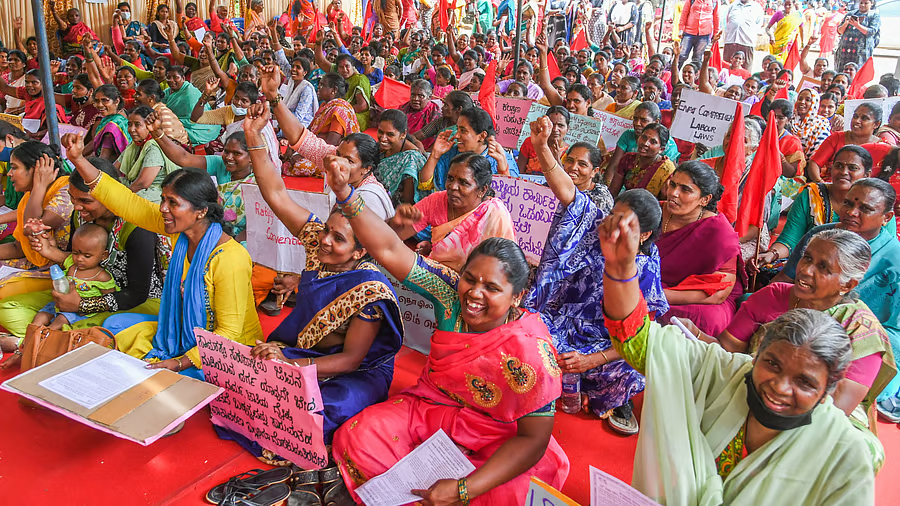
Every year, Jantar Mantar becomes the centre of domestic worker mobilisations demanding inclusion under national labour laws and a comprehensive legislative framework for their rights. Thousands of domestic workers across states have signed petitions and submitted memorandums urging formal recognition of their work. Despite these sustained efforts, the government has largely remained indifferent, and domestic work continues to be excluded from formal labour protections (Pal, 2021).
The recently formed Labour Codes – the Code on Wages, the Code on Social Security, the Code on Occupational Safety and Health, and the Code on Industrial Relations claim to universalise labour protection but fail to include domestic workers (Government of India, 2019, 2020). This exclusion underscores the gendered and spatial assumptions embedded in India’s labour policy that work performed in another person’s private households is not “productive” labour (Gothoskar, 2013). The struggle for recognition, therefore, reveals fundamental questions about the political identity of domestic workers, and the underlying mechanisms through which certain forms of labour are rendered invisible by the State.
Historical Context: Domestic Work in Post-Independence India
Domestic work has historically remained at the periphery of India’s labour law framework, as the post‑independence State directed its regulatory and developmental energies toward industrial growth and the consolidation of formal employment structures, thereby systematically excluding from its ambit those forms of labour performed within the intimate and privatized spaces of other people’s households- spaces that, precisely because they are conceived as private rather than public or productive, have rendered the labour of domestic workers invisible, unregulated, and undervalued in policy discourse. The first legislative attempt to recognise domestic workers- a private member’s bill introduced in 1959, called for their representation in decision-making bodies and protection under labour laws. Despite generating parliamentary debate, the bill was rejected because domestic workers were treated as “members” or “children” of the employing families rather than as employees.
This discourse of familialism continues to shape the socio-legal perception of domestic work. Within this logic, domestic workers are not seen as contributors to economic productivity but as extensions of the household. Consequently, multiple labour laws enacted over subsequent decades, the Minimum Wages Act, Employees’ State Insurance Act, and Contract Labour Regulation Act, excluded domestic workers. The “private” sphere of the home was effectively insulated from labour regulation, creating a dual economy where millions of workers remained unprotected and unseen.
Pierre Bourdieu’s theoretical lens illuminates how the State’s power of classification governs recognition, visibility, and legitimacy (Bourdieu, 1985). Classification, according to Bourdieu, is not a neutral act; it is a mechanism of symbolic power through which the State names, defines, and orders social reality (Bourdieu, 1984). The categories recognised by the State acquire not only identity but also access to material and social privileges; those excluded, conversely, are denied legitimacy.
In the context of domestic work, this classification manifests through omission. Domestic workers are not formally named as “workers” within labour codes, and their workplaces and the private household are not recognised as “establishments.” This lack of nomenclatural recognition perpetuates symbolic violence by legitimising exclusion as neutrality. Through this framework, the State’s non-recognition becomes an active form of governance that controls who is visible as a worker and who remains confined within the shadows of informality.
The Unmaking of Domestic Workers: Exclusion, Criminalisation, and Symbolic Violence
The unmaking of domestic workers occurs through multifaceted processes of misrecognition. Domestic work, primarily performed by women, has been culturally and socially framed as care, obligation, or service rather than remunerated labour. Parliamentary records analysed by Sharma (2022) show that since the 1950s, domestic work has often been described as a familial duty. This rhetoric erases the wage relationship and replaces it with moral and emotional narratives, an ideological manoeuvre that sustains dependency and invisibility.
As labour markets were feminised after the 1970s, domestic work became synonymous with low-skilled and low-status labour. The shift from male to female workers reinforced the gendered nature of this trade, and domestic workers began to be viewed as socially inferior dependents. More disturbingly, the middle-class gaze increasingly constructed domestic workers as potential criminals and sources of threat. The National Crime Records Bureau (NCRB), which maintains a dedicated section titled “Crimes by Domestic Helpers,” institutionalised this perception long before the State collected any data on their employment status.
Until the introduction of the E-Shram[i] portal in 2021, the government had no official statistics on domestic workers’ numbers or conditions. Yet it possessed detailed crime records. This contradiction exemplifies the State’s classificatory bias: domestic workers entered official registers as subjects of suspicion rather than of economic contribution. The common requirement of police verification further entrenches social surveillance, reinforcing symbolic violence through bureaucratic control and moral panic.
The Gendered Nature of Domestic Work
Domestic work stands at the intersection of gendered, caste-based, and class-based subordination (Gothoskar, 2013). The home, as a site of labour, is simultaneously intimate and hierarchical. Women workers employed within private households face exploitation that ranges from underpayment and long hours to physical and sexual harassment. Unlike factory labour, domestic work lacks structural boundaries such as work hours or employer accountability.
Most domestic workers belong to marginalised castes and migrant communities. Their labour thus lies at the confluence of patriarchy, caste stratification, and urban informality. The historical perception of domestic work as “low” or “polluting” continues to mark these workers with stigma. Recognition within labour codes would therefore signify not only an economic inclusion but also a profound social transformation challenging inherited hierarchies embedded in household service relations.
The Making of Domestic Workers: Collective Organisation and Political Assertion
The making of domestic workers as a political category has relied heavily on collective action. Organisations like the National Platform for Domestic Workers[ii] have spearheaded nationwide campaigns urging the government to enact comprehensive legislation. These movements aim to shift domestic workers from invisibility to agency, reframing them as skilled labourers whose contribution sustains the urban economy. As domestic worker Deepali Haldar articulates, “If construction and beedi workers have their welfare boards, why can’t domestic workers? The employers earn because we work.” Her statement encapsulates the moral paradox of the labour hierarchy: formal sector workers depend on informal domestic workers to maintain their productivity, yet those enabling this process remain without rights.
This tension gained renewed visibility in January when, following the Ajay Malik case[iii], the Supreme Court directed the formation of a committee to examine the conditions of domestic workers and assess whether a sector-specific legislation is necessary. By mandating a structured inquiry, the Court acknowledged the longstanding demands of domestic worker unions and placed their struggle within a formal policy and legal framework. The ruling signals a shift from incremental administrative measures toward a potential reconfiguration of domestic work as a legally recognised category of labour.
The International Labour Organisation (ILO) recognises domestic work through Convention No. 189, defining it as “work performed in or for one or more households” (International Labour Organisation, 2011). Tasks such as cleaning, cooking, caring for children, or tending to elderly family members are legitimate forms of productive labour. India, however, has yet to ratify this convention, reflecting how the State’s domestic policies lag behind international standards. The Supreme Court’s directive, therefore, becomes particularly significant, aligning national jurisprudence with global discourses on decent work and pushing the State to evaluate its persistent legislative hesitation.
The domestic worker movement has gradually redefined its agenda from demanding wage-based inclusion to advocating for recognition as part of the wider care economy. This re-conceptualisation situates domestic work at the heart of capitalism’s reproductive structure, challenging the false divide between productive and unproductive labour.
Data, Representation, and the Politics of Visibility
The politics of representation determines whose labour becomes legible to the State. Data functions as a form of recognition, and its absence signals deliberate invisibility. The E-Shram database represents a step forward in documenting domestic workers. Yet registration without legal protection risks reproducing bureaucratic tokenism rather than transformative inclusion. Representation in policy must accompany representation in law. Without sector-specific legislation, the data collected will remain inert. To transform data into rights, domestic workers must be included within welfare schemes, minimum wage frameworks, and social security mechanisms. Such measures would transform recognition from symbolic to substantive.
An intersectional approach reveals that domestic workers’ vulnerability arises not from informality alone, but from the confluence of caste, class, migration, and gender (Sharma, 2022). Migrant domestic workers, predominantly women from states like Bihar, Jharkhand, and West Bengal, occupy precarious positions in metropolitan labour markets. Their daily labour sustains the lives of middle-class employers, yet their own citizenship remains fragile and often transient. The domestic worker movement has evolved from issue-centric advocacy focused on wages and working conditions to identity-based mobilisation grounded in feminist and socialist frameworks. By foregrounding intersectionality, the movement highlights the layered violence of invisibility and the politics of recognition that shape the State’s response.
The codification of 29 existing labour laws into four comprehensive Labour Codes was touted as a milestone in universalising labour protections. Yet this apparent consolidation has reinforced existing exclusions. Domestic workers remain outside definitions of “establishment” and “employee,” as the household fails to qualify as a registered workplace. The Code on Wages removed schedules for determining minimum wages and provisions against gender discrimination, directly undermining informal sector workers. This structural exclusion reveals how universality becomes a rhetorical device masking selective recognition. By defining the “worker” through formal parameters, the State perpetuates the invisibility of household labour, even as its policies rhetorically claim to cover all workers. The tension between promise and practice epitomises the unmaking of domestic workers through definitional omission.
Civil Society and Transnational Dimensions
Domestic workers’ movements in India have increasingly been connected to global discourses on decent work and care economies (International Labour Organisation, 2011). Transnational solidarity networks have helped articulate domestic work as part of global labour justice initiatives. Although India has refrained from ratifying ILO Convention 189, several states, such as Kerala and Tamil Nadu, have introduced policy frameworks that offer limited protections through registration and welfare boards.
Civil society organisations play a crucial role in documenting abuses, supporting collective bargaining, and bridging the gap between informal workers and formal institutions. The proliferation of membership-based organisations (MBOs) and NGOs has strengthened the representational voice of domestic workers in both national and international forums.
Conclusion: Reclassification and the Future of Recognition
The formation of domestic worker identity in India has a long history, dating back to the Bharatiya Mazdoor Sangh strike in Mumbai during the 1950s, which mobilised thousands, mostly men, demanding fair wages and recognition. Over decades, the movement has transformed into a women-led struggle that now intersects with feminist claims to dignity, equality, and citizenship.
The contradictory ways the State classifies domestic workers, simultaneously invisible in labour statistics yet visible in crime data, reveal how recognition can operate through exclusion. The State’s power to classify, as Bourdieu posits (1984, 1985), is ultimately the power to create reality. When domestic workers are denied recognition as workers, their absence becomes an institutional truth.
To counter this, classification must shift from symbolic violence to emancipatory practice. Domestic work needs to be reclassified through deliberate legislation, welfare provisioning, and inclusion within formal definitions of labour. Such reclassification would not only secure material rights but also dismantle the moral hierarchies that have long devalued domestic work. The demand for recognition extends beyond economics- it is a claim to social citizenship and political agency. The making and unmaking of domestic workers thus reflect the larger struggle over how the State imagines work, identity, and equality. Recognising domestic workers as formal workers is not simply an act of inclusion. It is an act of justice.
References:
Althusser, L. (1971). Ideology and ideological state apparatuses: Notes towards an investigation. In Lenin and philosophy and other essays (pp. 85–126). Monthly Review Press.
Bourdieu, P. (1984). Distinction: A social critique of the judgement of taste. Harvard University Press.
Bourdieu, P. (1985). The social space and the genesis of groups. Theory and Society, 14(6), 723–744.
Ghosh, J. (2022, January 20). Poor country with affluent elite, India is going nowhere. The Wire. https://thewire.in/economy/india-world-inequality-report-poor-affluent-elite-progress
Gothoskar, S. (2013). The plight of domestic workers: Confluence of gender, class, and caste hierarchies. Economic and Political Weekly, 48(22), 63–75.
Government of India. (2019). The Code on Wages, 2019. https://egazette.nic.in/WriteReadData/2019/210356.pdf
Government of India. (2020). The Code on Social Security, 2020. https://labour.gov.in/sites/default/files/ss_code_as_introduced_in_lok_sabha.pdf
International Labour Organization. (2011a). Convention No. 189: Decent work for domestic workers. https://www.ilo.org/dyn/normlex/en/f?p=NORMLEXPUB:12100:0::NO::P12100_ILO_CODE:C189
International Labour Organization. (2011b). Decent work for domestic workers (Report No. 15). https://www.ilo.org/wcmsp5/groups/public/@ed_protect/@protrav/@travail/documents/publication/wcms_161104.pdf
National Platform for Domestic Workers. (n.d.). Facebook page. Retrieved April 29, 2026, from https://www.facebook.com/NationalPlatformForDomesticWorkers
Pal, S. (2021, September 15). In unregulated spaces: Domestic workers renew protests against labour codes. NewsClick. https://www.newsclick.in/in-unregulated-spaces-domestic-workers-renew-protests-labour-codes
Rajalakshmi, T. K. (2019, August 9). Amendments to labour laws under the Modi government: No love for labour. Frontline. https://frontline.thehindu.com/the-nation/article28757774.ece
Sharma, S. (2015). Of rasoi ka kaam/bathroom ka kaam. Economic and Political Weekly, 50(7). (Please verify volume/issue/page numbers.)
Sharma, S. (2022). Domestic workers, class-hegemony, and the Indian state: A sociological perspective on ideology. South Asian History and Culture, 13(4), 528–545.
Thompson, E. P. (1963). The making of the English working class. Victor Gollancz.
Ajay Malik v. State of Uttarakhand, (2025). Supreme Court of India.
[i] E‑Shram is a national portal launched by the Ministry of Labour and Employment, Government of India, on 26 August 2021 to create a comprehensive National Database of Unorganised Workers. Launched to register workers in the informal sector by linking their information with Aadhaar. The portal claims to facilitate access to social security schemes, welfare benefits, and employment opportunities.
[ii] The National Platform for Domestic Workers is a national coalition of trade unions, membership-based organisations, working to secure legal recognition and rights for domestic workers in India. Formed in 2012 to unify fragmented regional efforts, it leads campaigns for comprehensive central legislation for Domestic Workers and ratification of C-189 of the ILO.
[iii] Ajay Malik v. State of Uttarakhand (2025), Supreme Court case, while addressing allegations concerning the treatment of a domestic worker, the Court highlighted the absence of comprehensive legal protections for domestic workers in India. It directed the Union government to constitute an expert committee to examine whether a sector-specific law for domestic workers is necessary, marking a significant step toward potential legislative recognition and reform.
***
Aditi Yajnik is a development professional working on women’s economic and social empowerment. With over seven years of experience in advocacy and policy engagement with issues pertaining to informality and gender, she has worked with several state governments and urban local bodies. She has worked extensively with informal economy women workers across India. She has managed programmes across eight states and has designed capacity-building initiatives and awareness campaigns reaching over five lakh women workers.