
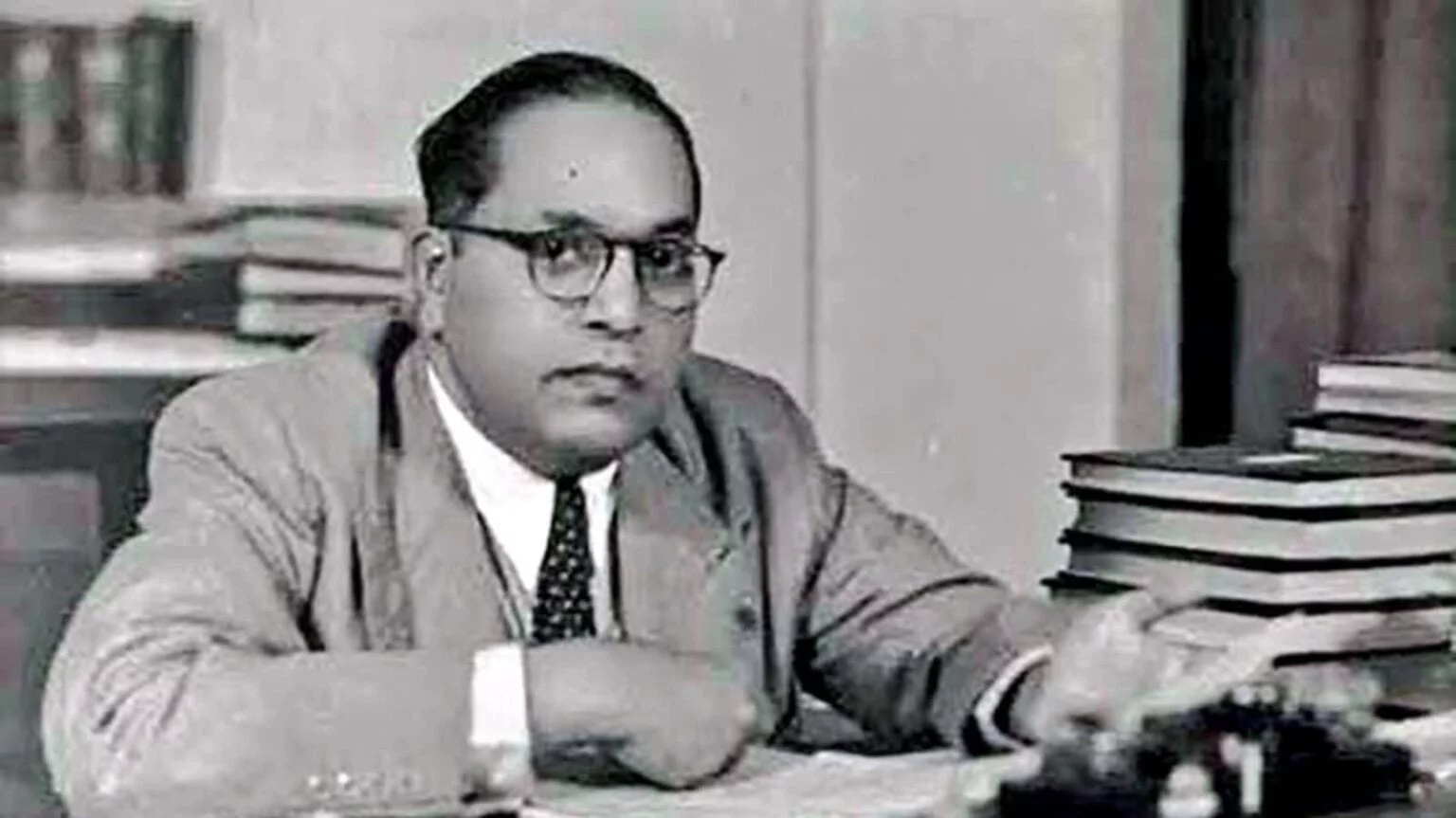
While several scholars in India have engaged with Dr B.R Ambedkar’s political and philosophical ideas, sociologists in India have long neglected the social dimensions of his thought. Even when he does appear within sociological discourse, Dr Ambedkar is often treated as a constitutionalist or a moral critic of caste, as opposed to being reckoned as a formidable sociologist in his own right. The present article suggests that the failure to engage with Ambedkar’s social thought is not simply an innocent omission, but rather a symptom of a deeper limitation within Indian sociology.
Part of this marginalisation may be traced to the social composition of Indian academia itself. Early sociology departments were dominated by upper-caste scholars whose understanding of caste emerged largely from observation rather than lived experience. Dr Ambedkar, by contrast, wrote both as a theorist and a subject of caste oppression. Through his work, he challenged not only caste, but also the epistemic assumptions through which it was conceptualised. The reluctance to canonise Ambedkar, therefore, reflects more than mere disciplinary oversight. Rather, it subtly points to broader hierarchies of knowledge production within Indian academia.
An Absent Presence
Indian sociology began with an absence that was never fully named, even as it quietly structured the field’s deepest assumptions. In not taking Dr Ambedkar seriously as a central theorist of the Hindu social order and the origins and mechanisms of caste and untouchability, the discipline privileged frameworks that looked at caste either merely as a structure or as a process. Consequently, it paid insufficient attention to frameworks that understood it as a system of enduring inequality and domination. Reconsidering this rather conspicuous absence, the present article proposes a different way of thinking about what ‘foundational’ contributions mean in the context of sociology in India. From this standpoint, I suggest that Dr Ambedkar must be seen not as supplementary to Indian sociology, but as one of its most important thinkers; a theorist to be reckoned with, whose marginalisation within Indian sociology has shaped the limits of the discipline itself.
Ghurye, Srinivas and a Historical Hangover
Early Indian sociology was to a large extent shaped by the work of G.S. Ghurye and M.N. Srinivas. Consequently, it developed a disciplinary imagination that sanitised the violent realities of caste. Ghurye (1932) identified endogamy as a core feature of the caste system. In framing it as a necessary division of labour and also as a vital glue that preserved socio-cultural order in Hindu society, his perspective normalised the institution of caste. Similarly, Srinivas (1972) romanticised the Indian village as a harmonious, interdependent entity. However, in doing so, it effectively erased the systemic violence, forced segregation, and relentless exploitation endured by Dalits. Furthermore, Srinivas’s idea of Sanskritization exemplifies this tendency by reducing lower-caste liberation to the imitation of upper-caste norms. In doing so, it sidesteps any possibility of dismantling caste itself.
Importantly, Dr Ambedkar illustrated both the centrality of endogamy to caste and the imitation of high-caste behaviours by lower castes in his 1916 essay on the genesis, mechanisms and development of caste. Why, then, is Dr Ambedkar not seen as a foundational figure in Indian sociology, even when he discussed in detail the institution of caste decades before either Ghurye or Srinivas? Further, in his seminal intellectual biography on Dr Ambedkar, Ashok Gopal notes that both Ghurye and Irawati Karve, both Brahmins who wrote a lot on caste, not only never cited Dr Ambedkar, but “appear not to have read him at all” (Gopal, 2023, p. 155). Here, while the present article notes the contributions of both Ghurye and Srinivas to the disciplinary foundations of Indian sociology, it simultaneously submits that these foundations were themselves built on unequal and exclusionary grounds.
Between Sanskritization and Annihilation
While Srinivas viewed caste through the lens of Sanskritization, Dr Ambedkar (1979) offered a fundamentally different understanding of the institution. For Srinivas, lower castes could improve their social standing by adopting the customs, rituals and practices of higher castes. Implicit within Srinivas’s sociology was the assumption that social change occurred through imitation and gradual incorporation into the existing social order. Dr Ambedkar rejected this premise entirely. In his monumental Annihilation of Caste, he argued that the problem with caste was not merely inequality in status, but the very organisation of the Indian social order around the principle of hierarchy.
Dr Ambedkar’s concept of graded inequality remains one of the most powerful sociological explanations of caste. Rather than dividing society into simple categories of oppressor and oppressed, it reveals a hierarchy in which each group is positioned above some and below others, thereby reproducing domination while fragmenting resistance. This distinction is significant because it reveals two competing sociological imaginations: one sought to understand how caste reproduces itself and adapts to change, while the other sought to understand how caste persists and why it must be dismantled. Whereas Srinivas was content with explaining mobility in caste society, Ambedkar theorised the possibility of a society beyond caste itself.
Ambedkar’s Warning and the Discipline’s Silence
The present article contends that Dr Ambedkar’s significance to sociology extends beyond his critique of caste. He wrote with a wide range of themes concerning sociological inquiry, including but not limited to untouchability, religion, labour, democracy, exclusion and justice. His corpus of writings collectively constitutes a sophisticated analysis – almost nothing concerning Indian society escaped his keen eye. His methodological approach was unique and intuitive, comprising historical depth with comparative analysis. Yet, his contributions do not occupy the same canonical status that the works of Ghurye or Srinivas do within sociological discourse and curricula. I argue that this absence has had important consequences.
By limiting itself to approaches that treated caste primarily as a functional institution, Indian sociology struggled to confront caste as a system of power. Instead, the discipline became adept at documenting caste relations, while remaining less attentive to the lived experiences of humiliation, exclusion and violence that structure them. In this sense, Dr Ambedkar’s marginalisation within the discipline shaped the questions sociology itself considered legitimate – the exclusion of Dr Ambedkar consequently meant the exclusion of questions about domination, humiliation and social justice. Seen in this light, the present article conceptualises Dr Ambedkar as one of the discipline’s possible alternative founders.
An Ambedkarian Turn: The Task of Indian Sociology Today
This Ambedkarian indictment of Indian sociology argues that the discipline became adept at mapping caste while remaining hesitant to theorise the structural violence it enabled. As such, taking Dr Ambedkar seriously requires more than adding him to reading lists – it demands a reconsideration of the intellectual foundations of Indian sociology itself. This shift involves moving beyond descriptions of social order to examine the underlying power relations that continue to sustain it. It would also require centring the experiences and knowledge of those historically marginalised within both society and academia.
An Ambedkarian sociology must ask not how social institutions function, but whom they serve, whom they exclude and how they might be transformed. It must treat caste not as a residual feature of tradition, but as a living structure that continues to shape contemporary social life. Revisiting Dr Ambedkar must therefore not be an act of retrospective or decorative inclusion – it must be seen as an opportunity to reconfigure the discipline’s assumptions themselves. If Indian sociology is to understand caste in all its complexity, then it must move beyond Sanskritization, and engage with Dr Ambedkar’s challenge: not the reformation of caste, but its annihilation.
References:
Ambedkar, B. R. (1979). Castes in India. In Moon, V. (Ed.), Writings & Speeches of Dr Babasaheb Ambedkar (Vol. 1). pp. 3-22. Government of Maharashtra. Mumbai.
Ghurye, G. S. (1932). Caste and Race in India. London: Kegan Paul, Trench, Trübner & Co.
Gopal, Ashok. (2023). A Part Apart: The Life and Thought of B.R. Ambedkar. New Delhi: Navayana.
Srinivas, M. N. (1972). Social Change in Modern India. Hyderabad: Orient BlackSwan.
***
Abhijay Rambabu is currently pursuing his Integrated M.A. in Sociology from the University of Hyderabad, of which he is in his final year. His work has appeared on platforms including The Polis Project, Maktoob Media, Feminism in India, The Ambedkarian Chronicle and Doing Sociology.
Woah
Amazing writing
Thank you 🙂
Can I get your mail id?