
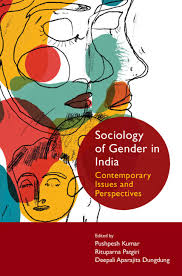
Feminist sociology in South Asia has long traversed a difficult epistemological terrain, often swinging between structural determinism and uncritical eulogies of individual autonomy. Classical paradigms often represented patriarchal formations as monolithic, totalising systems of oppression, while early liberal interventions tended to romanticise resistance as unmediated, radical subversion. The scholarship curated in Sociology of Gender in India: Contemporary Issues and Perspectives (Cambridge University Press, 2026), edited by Pushpesh Kumar, Rituparna Patgiri and Deepali Aparajita Dungdung, makes an important conceptual intervention at this very theoretical fault line. The volume suggests that gendered power functions as an adaptive, multiscale matrix rather than as a static apparatus of patriarchy. The text explores how patriarchal hegemony is constantly reproduced, lived and negotiated across a variety of ethnographic sites, histories, digital spaces and archives.
A key strength of the volume is the critical deconstruction of the domestic sphere as a benign, co-residential unit. Focusing on the micro-spatial and economic arrangements of family life, the contributors demonstrate how kinship remains a crucial site where property relations, majoritarian nationalism and caste boundaries are actively reproduced and contested. Aleena Sebastian looks at how shifting historical conditions, including colonial legal reforms, Indian Ocean trade routes, and contemporary Gulf remittance economies, have impacted the matrilineal joint houses (tharavad) of Koya Muslims in coastal Malabar. The physical division of family homes into bhagangal, or partitioned units under one roof with separate kitchens and individual electric meters, demonstrates how women carve out residential autonomy and secure property entitlements (strisothu) in the midst of wider macroeconomic restructuring. In rural Bihar, Vandana Rai uses the ideas of ethical self-formation developed by Saba Mahmood and Michel Foucault to examine how upper-caste Bhumihar women negotiate the question of public mobility. Instead of directly challenging patriarchal authority, women surveil spatial codes (purdah, chaukhat and duwar) and ritual purity strategically to build respectable identities and to gain legitimate mobility through state development projects like JEEViKA. Anagha Tambe investigates how middle-class urban Maharashtrian families use ideas of ‘our culture’ (amchi sanskruti) and subtle discursive distinctions (amchyat versus aplyat) to normalise Brahminical practices, police youth endogamy, and marginalise religious and caste minorities.
Aardra Surendran brings this critique into political economy and cultural labour, linking Marxist Social Reproduction Theory (SRT) and Labour Process Theory (LPT) to show how globalised supply chains and task-based production blur the boundaries between residence and workplace. Based on empirical realities such as export garment manufacturing and agrarian labour, Surendran shows how the extraction of capitalist value is directly contingent on the unpaid domestic labour and biological depletion of female workers. At the same time, Sabiha Mazid uses Erving Goffman’s dramaturgy and Judith Butler’s performativity to decode children’s televised music reality shows (Sa Re Ga Ma Pa Li’l Champs, Indian Idol Junior). Mazid exposes how television networks commodify young performers for adult viewers by reiterating traditional archetypes such as the dutiful male breadwinner (Shravan Kumar) and the self-sacrificing female child (adarsh beti). By transforming the domestic sphere and familial surveillance into instruments of political citizenship, Swati Dyahadroy, in contrast, examines how regional right-wing women ideologues actively mobilise women into majoritarian political agendas through the rhetoric of seva (service) and stree dharma.
The contemporary turn in the volume critically engages the ways in which modern digital technologies impose new forms of bodily surveillance and datafication under the rhetoric of empowerment. Using Foucauldian biopolitics and Shoshana Zuboff’s surveillance capitalism, the authors show how mobile applications produce a “digitised reproductive citizen.” Here, these platforms serve as sites of bodily self-tracking for individualised health management, even as they standardise reproductive physiology into a rigid, 28-day heteronormative cycle. This algorithmic homogenisation is particularly troubling for users with conditions such as polycystic ovarian syndrome (PCOS), endometriosis, or trauma from a miscarriage. In addition, the intimate biological metrics are commodified into proprietary data commodities, which in turn encourages users to adopt defensive counter-tactics like entering dummy inputs, omitting sexual health details, or reverting to analogue paper logs. On a related note of economics, Gayatri Nair talks about the rising platform and gig economy that pushes women workers to the precarious margins, while structural mobility is reserved for male workers.
Sreeparna Chattopadhyay uses digital ethnography and Janet Shim’s concept of “cultural health capital” to critique the market-driven medicalisation of childbirth among privileged urban women. Sherin Sabu shows the usefulness of quantitative instruments in capturing phenomenological narratives of menstruation. Anurekha Chari-Wagh writes further on autoethnography as a self-critical pedagogical tool to interrogate caste, class and cis-gender privilege in academia.
Sociology of Gender in India offers a timely and theoretically sophisticated re-assessment of gender relations in contemporary South Asia. By linking macroeconomic restructuring to the lived experiences of the domestic threshold, the factory floor, the digital health application, and the university hostel, the volume shows that gender is not a discrete demographic variable, but a basic axis around which South Asian modernity is organised.
***
Nalini Bhattar is a Research Scholar at the Advanced Centre for Women’s Studies, Aligarh Muslim University.
