
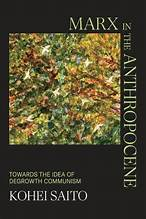
The contemporary sixth mass extinction has necessitated an increasingly urgent question for critical theory: how might the conceptual categories developed to critique capitalism simultaneously enable us to engage critically and ethically with the planetary degradation that capitalism has engendered in its wake? Kohei Saito’s Marx in the Anthropocene: Towards the Idea of Degrowth Communism (published by Cambridge University Press in 2023) approaches this question by undertaking a significant rereading of Karl Marx’s unfinished ecological work. Rather than treating Marx as an unequivocally productivist thinker whose political economy is rendered obsolete by the climate crisis, Saito resurrects a later Marx preoccupied with the material limits of primitive accumulation, the depletion of ecological commons, and the possibilities of a post-capitalist social metabolism. Saito’s reappraisal of Marx is consequently both a work of intellectual history as well as a political intervention, exploring the implications of Marx’s ecological imagination for the Anthropocene, while reviving the thinker from the disciplinary and methodological paralyses of institutionalised Marxist thought.
Marx in the Anthropocene argues that Marx’s ecological thought cannot be adequately understood solely through his published texts or the extrapolated corpus of concepts that he is best known for. Instead, Saito’s adopts a twofold methodological approach– a rigorous archaeology on the one hand of the process of knowledge production through an examination of the conditions of academic partnership, cultural positioning, and discursive afterlives of Marx’s work, and an extensive textual engagement on the other, with Marx’s scientific notebooks, particularly his previously overlooked research on geology, chemistry, agronomy, physiology, and anthropology of pre-capitalist social formations, including non-western agrarian societies and “their vitality for building a more egalitarian and sustainable society beyond capitalism.” (Saito 2023, 68) This allows Saito to trace a development in Marx’s intellectual trajectory that complicates the received notion– solidified through Engels’s mediation, and postcolonial critique of Marx as an Orientalist supporter of colonial intervention– of Marx as an advocate of the unrestricted development of productive forces. Based on this premise, Saito’s argument is organised into three broad movements: an examination of Marx’s ecological critique and its subsequent neglect, a critique of productive forces under conditions of planetary ecological crisis, and an elaboration of the concept of “degrowth communism” by committing to “revisit the unfinished project of Capital retrospectively, from the perspective of degrowth communism, to update its contents. This is an attempt to go beyond Capital to concretise his final vision of post-capitalism.” (217)
The significance of Saito’s argument lies partly in its challenge to a familiar dichotomy within twentieth-century intellectual history. Marxism has often been represented as insufficiently attentive to ecological limits, while contemporary environmental discourse has regarded Marx’s focus on production, labour, and industrial transformation with suspicion as being informed by an intrinsic anthropocentric bias. Saito seeks to unsettle this binary by salvaging Marx from theoretical (mis)appropriation and repositioning him as neither an environmental romantic nor a technophilic modernist. Instead, Marx emerges in Saito’s assessment as a nuanced theorist of the historically specific metabolic relations through which capitalist society mediates its relationship with the natural world.
At the centre of this reconstruction is the concept of the metabolic rift, most prominently developed in contemporary ecological Marxism by John Bellamy Foster. Foster’s influential 1999 essay demonstrated how Marx’s engagement with nineteenth-century agricultural science, particularly the work of Justus von Liebig, allowed him to conceptualise capitalism as producing a rupture in the material exchange between human societies and the natural world (Foster 1999). Saito extends this interpretation by insisting that the metabolic rift is not merely a metaphor for environmental degradation, but more significantly, a structural contradiction constitutive of capitalist accumulation. Marx observed that capitalist agriculture intensified the extraction of nutrients from the soil while simultaneously disrupting the social and spatial relations through which those nutrients could be returned. The spatial division between town and country therefore became a metabolic division as well: food and raw materials flowed towards urban-industrial centres, while the regenerative nutrients contained in organic waste were prevented from returning to the land. Capitalism could attempt to compensate for this rupture through technological manoeuvres such as fertilisers and implements of mechanised agriculture, but such cosmetically imposed solutions risked relocating rather than resolving the contradiction. Contextualised in the light of this historical remapping of capitalism as not just a socioeconomic organisation of relations between labour and means of production, but also a system of terraforming that alters foundational relations between the species and the planet, ecological crisis consequently is no longer an accidental externality of capitalism. Instead, environmental depletion itself serves as an expression of a systemic mode of organising production. As Saito observes: “Metabolic rift is nothing but a manifestation of the degradation of ‘natural vitality’ through the capitalist destruction of communal production and property. In this sense, class formation and environmental degradation have the same root cause.” (204)
The metabolic rift thus becomes a framework for understanding the temporal, spatial and technological contradictions of contemporary capitalism. Capital demands acceleration, circulation and accumulation, whereas ecological processes operate according to radically different temporalities. The geological time required for the formation of fossil fuels, for example, is violently compressed by a capitalist economy organised around their rapid extraction and combustion. Similarly, ecological costs are spatially displaced. As Rob Nixon (2011) and Max Liboiron (2019), in their studies of the ongoing ecocidal underpinnings of imperial and settler colonial processes, have demonstrated, the environmental consequences of extraction and production can be exported to peripheral regions while wealth accumulates in the industrial centres. Saito therefore connects Marx’s ecological thought to the contemporary problem of planetary inequality.
Marx in the Anthropocene implicitly challenges the abstraction of “humanity” as a homogeneous species whose historical depredations have left an enduring mark on the matter of planetary strata, which can accompany the concept of the Anthropocene in its cultural circulation. To say that humanity has emerged as a geological force risks obscuring the profoundly unequal historical distribution of responsibility, harm, vulnerability and benefit that underlies the organisation of human society and the shaping of global colonial and neoliberal geopolitics. Jason Moore’s theorisation of the “Capitalocene” seeks to revise and problematise the unqualified category of anthropogenic influence by refusing to attribute planetary transformation to an undifferentiated human species as a collective. Moore identifies fossil capitalism as a necropolitical apparatus of power, profit, precarity, and reproduction that inserts itself into and reconfigures, often with accompanying violence, the web of life (Moore 2017) to transform the latter into a site of ceaseless metabolisation and extraction of value. Saito’s Marxist analysis evolves in a comparable direction, although he retains the Anthropocene as a crucial conceptual horizon.
A familiar interpretation of Marx assumes that socialism inherits capitalism’s commitment to expanding productive capacity and merely changes the ownership of the means of production. From this perspective, the ecological problem would be solved by socialising production as a communally owned enterprise, and deploying technological rationality more democratically. Saito argues that while Marx of the Grundrisse inspired by Hegelian dialectics adopted a less ecologically conscious approach in advocating for a continued expansion of production under a decentralised, collectively owned and cooeratively administered structure, his vision of revolutionary change also entailed (a somewhat uncritical) faith in the self-correcting, homoestatic properties of the biosphere and the latter’s intrinsic connection with transformations in human activity. Thus once society was freed of the capitalist urge to produce competitively and exorbitantly, it would restructure people’s relationship with resources, including with time, their bodies, sensory and intellectual capacities, allowing for alternative conceptions of productivity that would involve leisure, art, education, community praxes, and pleasure, hence alleviating the pressure on nature to continually metabolise to generate growth. If production remains oriented towards endless quantitative expansion, changing ownership alone cannot overcome the ecological contradiction. However, the socialist reconfiguration of productivity and growth to encompass domains of activity considered unproductive under the regime of value-extraction and profit-expansion liberates the restorative, interconnected, and symbiotic functions of nature, thus suturing the phenomenological rupture between the subject and their environment.
Saito’s argument performs a reconsideration of Marx’s concept of wealth as substantially broader, philosophically and ethically grounded, than the Capitalist logic of commodity ownership with its attendant valorisation of private property and exclusivist appropriation or enclosure of productive resources. Moreover Saito’s reading of Marx’s neglected corpus demonstrates his view of political economy as informed by a material-epistemological-idelogical rationale which takes into cognisance the links between the matter of planetary commons, dominant ideologies of production, and the regime of meaning and intelligibility that determines the domain of productivity and value. Capitalism, particularly the logic of the commodity form as a dominant economic rationale and paradigm of social reproduction, reduces social wealth to the accumulation of exchange value, while the material conditions of human and nonhuman flourishing are treated as ancillary. Yet as Marx’s use of the German word for wealth reichtum underscores, the conception of abundance in Marx’s philosophy in its very departure from and incompatibility with the capitalist imperative to harness productive forces in the service of metabolisation to generate greater quantities of commodities, implies a recognition of ecological equillibrium and relational flourishing as key to the generation of wealth as richness or abundance:
Marx considered the richness of culture, skills, free time and knowledge as the wealth of societies. In other words, the wealth or richness of societies cannot be measured by an ever-greater quantity of commodities produced and their monetary expressions, but rather by the full and constant development and realisation of the potentialities of human beings. The full and all-round development of human capacities and creative potentialities is, however, heavily constrained under capitalism because they are always measured on a ‘predetermined yardstick’, namely, how much use they can be for profit-making. (Saito, 222)
This alternative expansive model of wealth would thus include increased leisure, access to social goods, collective infrastructures, ecological restoration, care, education and the flourishing of cultural life. Saito notes that wealth as abundance in Marx is not limited to social wealth but includes “the essential contribution of nature to the production process” which is both subjected to unmitigated exploitation by being posited as a freely available substance even as its contribution is cancelled from regimes of valorisation and representation “as it is not a product of labour” (223) — a contradiction in Capital’s treatment of nature that can be mapped to the “metabolic rift” between humans and the environment.
Degrowth, in this formulation, does not imply a mandate of impoverishment or austerity. As Saito describes: “Marx’s degrowth communism aims to repair the ‘irreparable’ metabolic rift and to rehabilitate the non-consumerist ‘abundance’ of the social and natural wealth”. (226) Degrowth socialism is premised on the deliberate reduction of socially and ecologically destructive forms of production alongside the expansion of forms of wealth that are presently subordinated to commodity accumulation, including the accumulation undertaken by the datafied noopolitics of algorithmic modernity. The economic model of degrowth socialism does not advocate an indiscriminate reduction in material production. Rather, the economic trajectory of degrowth politics potentially implies reduction of fossil-fuel extraction, consumerist excess, planned obsolescence, and ecologically destructive industries while expanding public transportation, healthcare, education, renewable infrastructure, care work and collective cultural resources.
Such a programme radically redefines the relationship between abundance and accumulation. Saito’s argument intersects with the broader literature on degrowth, but also attempts to distinguish degrowth communism from approaches that treat degrowth primarily as a matter of individual ethical restraint. The latter runs the risk of becoming politically regressive or ethically vacuous. Asking populations to consume less without transforming the structures that produce inequality risks transferring the burden of ecological transition onto those who have contributed least to the crisis. Saito instead insists that degrowth requires a transformation of property relations, labour, production and social provisioning, and in a broader structural and ethical sense aligns with Marxist imperatives.
Nevertheless, Saito’s reconstruction is not without problems. One of the most important concerns is the degree to which he constructs a developmental narrative within Marx’s intellectual trajectory. Saito argues that Marx’s later notebooks demonstrate a significant movement away from productivism and towards an ecological critique of capitalist development. While this trajectory is intellectually compelling, Saito’s reconstruction tends to appear at times to be too teleological in the way in which the later Marx becomes, retrospectively, unproblematically compatible with contemporary degrowth theory. While the textual evidence built by Saito in conjunction with Foster’s work has established the ecological significance of Marx’s engagement with natural science, and while Saito’s research in Marx in the Anthropocene considerably expands the archive through which that significance can be understood, Marx’s writings contain tensions that preclude easy resolution: between productive development and the planetary boundaries of the earth system, sustainable economics and anthropocentric metaphysics, and a liberal humanist telos of universal emancipation and historically specific social forms. Saito argues that aspects of Marx’s ecological complexity were subsequently obscured by editorial and intellectual developments associated with Engels. While an important historiographical intervention, particularly given the uneven publication history of Marx’s notebooks, such a perspective risks becoming overly dependent upon establishing a contrast between an ecologically sophisticated Marx and a more productivist Engels. Such a binary would underestimate Engels’s own engagement with environmental questions, particularly in The Condition of the Working Class in England and Dialectics of Nature.
A second difficulty concerns the political specificity of degrowth communism. Saito is persuasive in demonstrating why endless growth is incompatible with ecological stability, but the transition from critique to political programme is less fully developed. What institutional mechanisms could enable societies to determine democratically which forms of production should decline? How would existing global inequalities exacerbated by algorithmic neoliberalism, between industrialised and historically exploited regions, be addressed? What would constitute a just distribution of the remaining ecological space? And how might degrowth coexist with the legitimate developmental aspirations of communities that continue to lack adequate housing, healthcare, energy access and infrastructure? A universal discourse of degrowth could inadvertently reproduce the asymmetries of global political economy if it asks the Global South to accept developmental limits that the Global North reached through centuries of fossil-fuel-intensive accumulation. Saito’s critique of capitalism provides the conceptual resources for avoiding this problem, but the political implications seem to demand further elaboration.
Moore’s critique of the Anthropocene emphasises capitalism’s longue durée and its production of a “web of life” in which nature and society cannot be neatly separated. Saito’s metabolic approach, by contrast, retains a stronger emphasis on the material mediation between human production and ecological processes. The debate between these positions is theoretically valuable and raises a fundamental question for the environmental humanities: should ecological crisis be conceptualised primarily as a problem of the capitalist organisation of metabolism, or should capitalism itself be understood as an ecological regime constituted within the web of life? Saito’s framework is particularly productive because it refuses both extreme positions. Nature is neither a passive externality awaiting capitalist exploitation nor merely a discursive construction. Ecological processes possess material temporalities and limits, but their historical significance is mediated through social relations.
Degrowth communism becomes, at its most compelling, a project of decommodification: freeing essential dimensions of human existence from the imperatives of accumulation. Saito transforms degrowth from a predominantly ecological-economic proposition into a question of social and, by extension, cognitive, affective, and libidinal emancipation. If capitalism produces ecological crisis because it subordinates material life to abstract accumulation, then ecological politics cannot be separated from struggles over labour, time, property and value. As climate change, biodiversity loss, deglaciation and sea-level rise, soil degradation, ocean acidification and other planetary disruptions intensify, technological innovation alone cannot resolve the contradiction between infinite accumulation and finite ecological conditions. Saito’s intervention demonstrates that Marx’s critique of capital may acquire renewed explanatory power precisely because planetary boundaries and anthropogenic encroachment have become impossible to ignore. The book’s central proposition that capitalism’s crisis is simultaneously social and ecological places environmental destruction within the same analytical field as exploitation, alienation and commodification.
Marx in the Anthropocene demonstrates the significance of reading Marx as an unfinished thinker against the canonisation of Marx as representing a closed theoretical system, revealing a thinker continually revising his categories in response to new scientific knowledge and historical developments. Such a Marx is particularly valuable for academic inquiry in the Anthropocene, where the objects of inquiry: climate, toxicity, extinction, energy, waste, infrastructure and planetary change, demand interdisciplinary forms of analysis. Saito does not offer a technocratic blueprint for surviving the Anthropocene, and insists instead that ecological survival requires a transformation in the social relations through which humans organise their metabolism with the more-than-human world, thus refusing to separate the fate of the planet from the organisation of social life. To confront the urgent issue of sustainable planetary futures therefore requires not only potentially sustainable legislation, policies, strategies, and technologies of decarbonisation, just energy transition, waste management, and biodiversity conservation but more significantly a simultaneous systemic, structural, conceptual, and epistemological overhaul at the heart of which is a reimagining of wealth itself. Marx in the Anthropocene makes a compelling case that such a reimagining may begin with the unfinished ecological Marx.
References:
Foster, J. B. (1999). Marx’s theory of metabolic rift: Classical foundations for environmental sociology. American Journal of Sociology, 105(2), 366–405.
Foster, J. B. (2000). Marx’s ecology: Materialism and nature. Monthly Review Press.
Liboiron, M. (2021). Pollution is colonialism. Duke University Press.
Marx, K. (1976). Capital: A critique of political economy, Volume I (B. Fowkes, Trans.). Penguin.
Moore, J. W. (2017). The Capitalocene, Part I: On the nature and origins of our ecological crisis. The Journal of Peasant Studies, 44(3), 594–630.
Nixon, R. (2011). Slow violence and the environmentalism of the poor. Harvard University Press.
Saito, K. (2023). Marx in the Anthropocene: Towards the idea of degrowth communism. Cambridge University Press.
***
Paromita Patranobish is an Assistant Professor at the Department of Communication Studies, Mount Carmel (Deemed to be University), Bangalore.
Thank You