
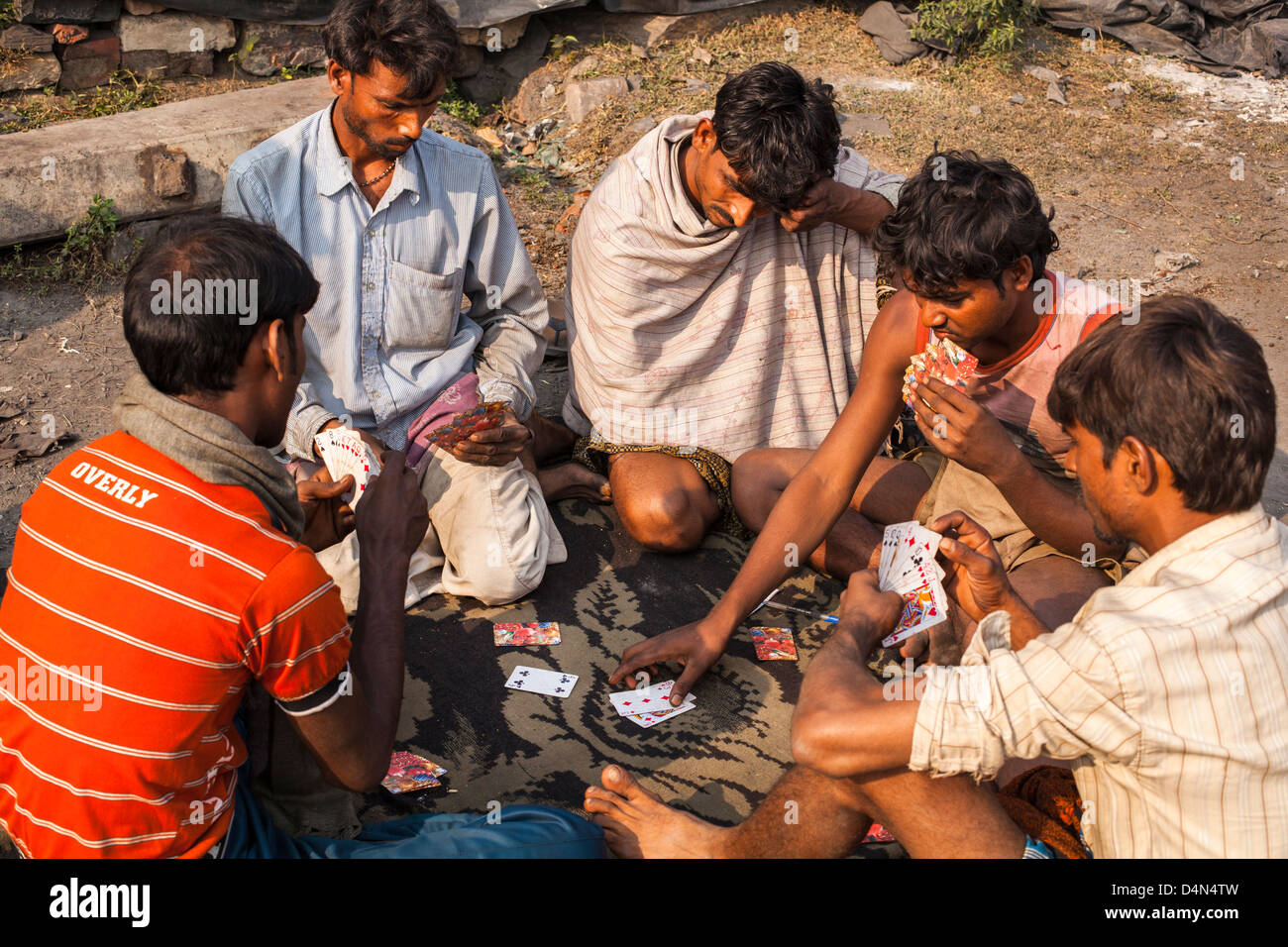
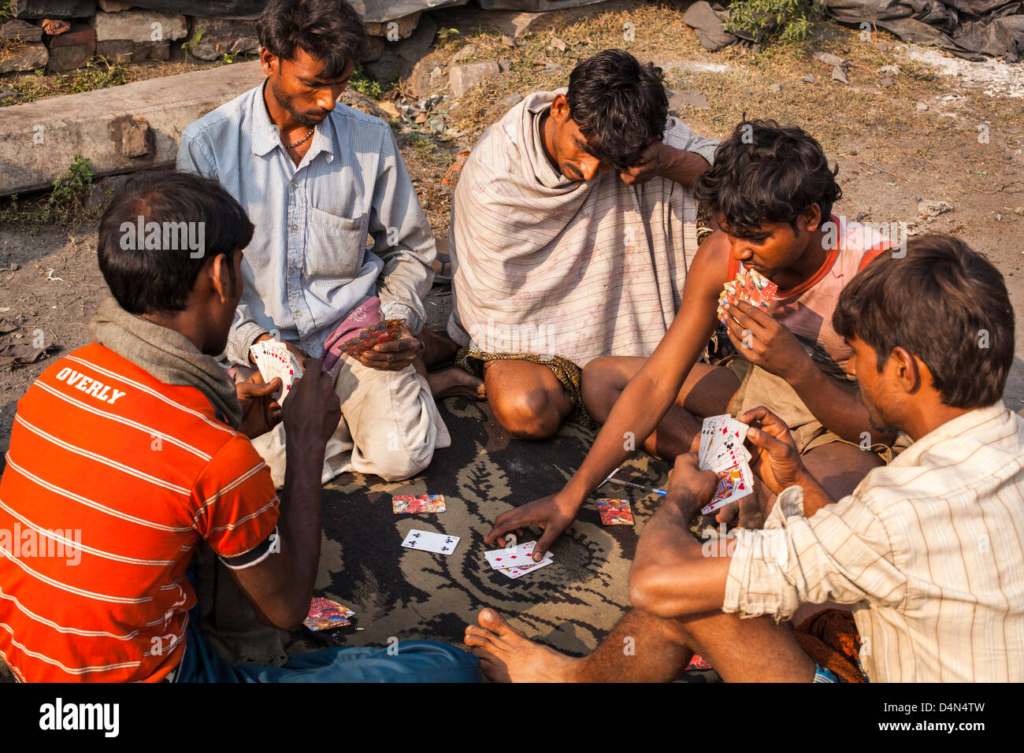
It was during the usual evening bike rides along the road adjacent to the Arabian Sea, shortly after I had relocated to the coastal stretch of the northernmost border of Kollam district, Kerala, that the card-playing circles of men during the slow hours of afternoons and evenings first started to demand my attention. My journey, which took place almost every other day, significantly along the beachside, revealed the ubiquity of these card circles in the evenings. The local population, mainly consisting of fishermen community, participates in these card games.
Leisure and the Use of Space
For me, the area between the Sea (technically the sea wall) and the main road is represented through the scattered circles created by different card-players’ groups. Distributed in different numbers, as per the rules of the game they follow, these circles, either seated on the sandy ground or on chairs, are invested with focus within the game, separating it from the larger space into a private space that belongs to the players alone. Lefebvre, in The Production of Space (Lefebvre, 1991), articulates how space is socially produced. These spaces between the sea and the road, as a continuous strip of land, consist of houses, shops, beaches, football and volleyball courts; not just empty spaces. These spaces have their own meanings, but the formation of evening social gatherings for playing cards, which is not just an opportunity to show one’s tactics in the game, but a platform for everyday socialisation and the development of social bonds, creates another layer of meaning to the existing space.
If we take the words from Crespi,
The great majority of card players play cards because they have discovered it to be an enjoyable and relaxing way of being together with friends and families, and one which results in the strengthening of groups. Another inducement to play cards is that the individual can hope to achieve acceptance into groups which will enhance his social position (1956, p. 721)
The pattern of these spaces, if we see from a gender perspective, is often dominated by men. Public space and gender have been widely discussed (Beebeejaun, 2017; Gqola et al., 2024; Mehan, 2024; Paul, 2017). Although the beaches are accessed by people irrespective of their gender, the spaces in discussion have been dominated by men, giving a glimpse of how playing in public as an everyday leisure activity is a gendered concept, deemed appropriate for men. For fishermen whose labour is associated with night fishing, evenings are the time when they relax, entertain, and connect with people. This connection is built through sharing space in the form of playing cards, inadvertently transforming the space into a leisure zone frequented by men.
The Leaf-Crowns: Private Play and Public Meaning
These circled groups engage in various card games, including Rummy[i], Irupatthiyettu,[ii] also known as Gulan Parishu, Kazhutha Kali,[iii] and Munnooti irupathu point game/320point game[iv]. Each game has its own number of players and unique rules. Some games are played solely for entertainment, while others involve betting a small amount of money. A particularly interesting factor associated with these games, especially with Kazhutha Kali, is the penalty for the loser: they are required to wear a crown made of leaves and sometimes an ear hook known as Kunukku, crafted from tiny unripe baby coconuts and coconut leaf splinters. This punishment draws attention from those outside the game. While the leafy crowns may not be present in every group, they serve to extend the game from the players to the onlookers or anyone in the vicinity, considering the fact that they are familiar with the rules of the game.
Crown and ear hooks symbolise losing the game. The loser must wear them, as a mark of their inability to prevent their loss. By donning these symbols, the individual not only faces humiliation/mockery from the group but also from others outside the game. This penalty, where outsiders can draw attention to a private play, blurs the boundaries, heightening the spirit to avoid losing rather than focusing on becoming the first winner.
The adornment part of the symbols serves primarily as a peer-imposed marker of one’s rank and position within the game. The group collectively assigns the loser-identity to the individual, which expands the rigid space of the private game to a broader public acknowledgement. According to Garfinkel, “Any communicative work between persons, whereby the public identity of an actor is transformed into something looked on as lower in the local scheme of social types, will be called a ‘status degradation ceremony ‘”(1956, p. 420). It is worth observing that this occurs mostly in a playful manner. The crown has its own temporality in producing the meaning within the game-context. Hence, the ‘shame’ is not permanent but always ‘shifting’ based on the transference of victory. The crown functions as a miniature form of self-cancelling degradation in the card-playing, rather than a permanent degradation of the individual and his overall worth. Once the game concludes, the crown does not remain with the loser; however, the teasing and mockery that may occur can linger longer. The visual symbols dissipate with the end of a game, whereas the verbal ones may not be. Both the verbal mockery and symbolic mockery stem from the same moment of play, yet they persist differently and communicate differently to those inside and outside the game. Holding all the aces, these circles of men playing cards are distributed throughout the everyday life of the locality, thus marking it as a space of leisure, connections, and a space that calls for sociological enquiry.
[i] Rummy is a draw-and-discard card game in which players compete to arrange their cards into sequences and sets. On each turn, a player draws one card and discards one; the first to arrange a complete, valid hand declares and wins.
[ii] Irupathiyettu (28) or Gulanparishu: where Gulan (Jack) is the highest-valued card. It is a trick-taking game played by four players in two fixed groups with a 32-card deck.
[iii] Kazhutha Kali is a shedding-type game in which “kazhutha” translates to “donkey”; it is the game where the last player holding cards becomes the donkey. It is played with a 52-card deck and usually comprises three to six players. All the cards will be equally distributed clockwise, and the player who has the ace of spades throws the card face-up to begin the round. The players follow the led suit, and when they fail to follow the led suit, it leads to vettu (cut) by a player with an alternate suit, which is the penalty rule where the highest bidder of the round must have to pick up all the cards from the table and add them to their pile of cards. The last player ends up with the cards, loses, and becomes the donkey.
[iv]The first person/team bringing the total to 320 points wins the game. (It uses 32 cards where the point value of Jacks,9s, Aces, and 10s add up to 240 points, and winning the final trick gives a bonus of 80 points).
References:
Beebeejaun, Y. (2017). Gender, urban space, and the right to everyday life. Journal of Urban Affairs, 39(3), 323–334.
Crespi, I. (1956). The Social Significance of Card Playing as a Leisure Time Activity. American Sociological Review, 21(6), 717.
Garfinkel, H. (1956). Conditions of Successful Degradation Ceremonies. American Journal of Sociology, 61(5), 420–424.
Gqola, P. D., Perera, I., Phadke, S., Shahrokni, N., Zaragocin, S., Satija, S., & Ghosh, A. (2024). Gender and public space. Gender & Development, 32(1–2), 1–25.
Lefebvre, H. (1991). The production of space (D. Nicholson-Smith, Trans.). Basil Blackwell.
Mehan, A. (2024). Informal feminist placemaking: A new perspective on urban activism and gender equality. Journal of Urbanism: International Research on Placemaking and Urban Sustainability, 17(2), 225–236.
Paul, T. (2017). Mapping gendered spatialities in leisure: The case of new consumption spaces in the city of Kolkata. Contemporary South Asia, 25(4), 380–398.
***
Athira Dhara is a PhD scholar at the Centre for Studies in Social Sciences (CSSS), Kolkata.