
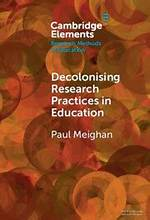
What is research? Why do people research? Who benefits from it? And how does it reshape society? These are seemingly mundane questions, but they remain unanswered in the research methods discourse. While literature on different ways to decolonise research methods exists, it seldom focuses on actually benefiting indigenous communities. Paul Meighan has attempted to do this in his book ‘Decolonising Research Practices in Education: Kincentric and Relational Methodologies’, published by the Cambridge University Press in 2026. Employing Dùthchas, a Gaelic concept focusing on kinship, the interdependence of humans and nature, and land-based relations, as a kincentric-relational methodology, the author engages in projects aimed at decolonising educational practices among his native Gaelic community in Scotland and the Anishinaabe community in Canada (p. 10). Alongside this, Bizindam (deep listening) and Two-Eyed Seeing (bridging indigenous and dominant knowledge systems) are also applied as key methods in the research. The work primarily serves as a critique of dominant research methods, including positivism and post-positivism. It also critically addresses their reliance on objective standards and anthropocentric values, which led to epistemicide (the killing of subordinated or colonised culture and knowledge) (p. 15).
Questioning the colonial-capitalist dominant methods, the book introduces the idea of ‘relationality’, which holds that knowledge can be produced through relationships such as land, kinship, and more-than-human kin, and that such knowledge is epistemically valid. This ensures that knowledge is produced within the communities and ultimately benefits them. Drawing on examples from the two projects in Scotland and Canada, the author argues that knowledge is derived from relationships rather than from quantification and standardisation. This idea ensures that research planning is centred on the communities and places indigenous knowledge on a similar epistemic pedestal to Western knowledge. Based on this framework, the dominant methods of ‘data collection, data analysis and findings’ have been transformed into ‘knowledge gathering, knowledge generation and knowledge sharing’, respectively.
The author formulates the concept of knowledge gathering as resting on the five principles of ‘Respect, Relevance, Reciprocity, Responsibility, and Relationship’ (p. 21). This is premised on the fact that indigenous communities possess knowledge and are not mere data subjects. To do this, an essential component is the researcher’s self-decolonising process. That is precisely the reason why the author adopts the practice of Biskaabiyang in the TEK-nology project in Canada, which requires reflection on one’s positionality within colonial systems. Instances include the author’s participation in ceremonies, practising Bizindam, taking an Anishinaabemowin language course in Canada, and engaging with Ceilidhs (traditional story- and song-gathering events) in the Gaelic project. This actually helps engage in meaningful praxis and ensure epistemic justice (p. 40). Practical tools such as reflexive journaling, community feedback, and relational rigour also ensure that the knowledge stays with the community and is used to co-create educational resources.
Knowledge generation as a method is also extended to knowledge gathering. The author argues that knowledge is generated within the scope of relational accountability. Here, the author introduces the Two-Eyed Seeing approach, which facilitates interaction between indigenous and dominant knowledge systems to serve both indigenous and academic communities. It is reflected in the author’s use of Anishinaabek data analysis alongside Reflexive Thematic Analysis (RTA) in Canada. The idea behind this is to ensure that knowledge is not extracted. In other words, it should emerge from community conversations (p. 47). Therefore, the quantitative approach to data analysis shifts toward a method grounded in epistemic pluralism. An important component which runs throughout is the researcher’s reflexivity. That is, if the researcher is not engaging in sustained self-reflection, the research would be vulnerable to the same extractive practices (p. 58). Therefore, the language revitalisation committees (LRCs), audit trails and community feedback serve as essential practices in the kincentric-relational methodology. This ensures reflexivity by helping mitigate the researcher’s subjectivity and addressing power dynamics between the researcher and the community.
Subsequently, the author also reframes ‘findings’ as knowledge sharing, ensuring that communities possess and control the knowledge. The example of LRC is relevant here, as the Anishinaabe community effectively controlled the process from the creation of the videos to their public outreach. Similarly, in the Gaelic context, paywalls were removed, and resources were made open access. This rebuts the ‘extractive logic of colonial resource mining’ prevalent in dominant academic practices, and transforms knowledge into a living entity that resides with the communities (p.66). Furthermore, this process ensures that the research does not end with the project’s conclusion but continues to benefit the community on an ongoing basis. This framework is a unique contribution of this book, which establishes kincentric-relational research as a pedagogy in itself.
The aforementioned discussion captures the book’s thrust and novel contributions. However, reading it also raised certain contradictions. For example, when the author uses the Two-Eyed Seeing framework to bridge indigenous and Western knowledge, it is unclear whether it would actually challenge the capitalist-colonial rationales of academia, which the author previously rejects (p. 14). On this line, it is also tempting to question whether the dominant idea of ‘publish or perish’, which the author later rebuts, can actually be seen through the Two-Eyed Seeing framework (p. 81). The author himself raises another issue, where there could be potential conflicts between a kincentric-relational researcher and journals, institutions, and so forth. Though negotiation is deemed necessary, it is difficult for researchers to bridge the unequal power relations with these conventional academic stewards. Nonetheless, the book stands as a compelling contribution for researchers willing to work with indigenous communities. The curated kincentric-relational methodology transforms research into praxis. The lucidity, interactive diagrams, and a chronological structure also make it extremely readable. It is certainly an important contribution to the existing literature on decolonising methodologies.
***
Swarnava Hati (he/him) is an Independent Researcher based in West Bengal. A recent Master of Laws (LL.M.) graduate from the Faculty of Legal Studies, South Asian University (SAU), New Delhi.
Great post. Thank you