
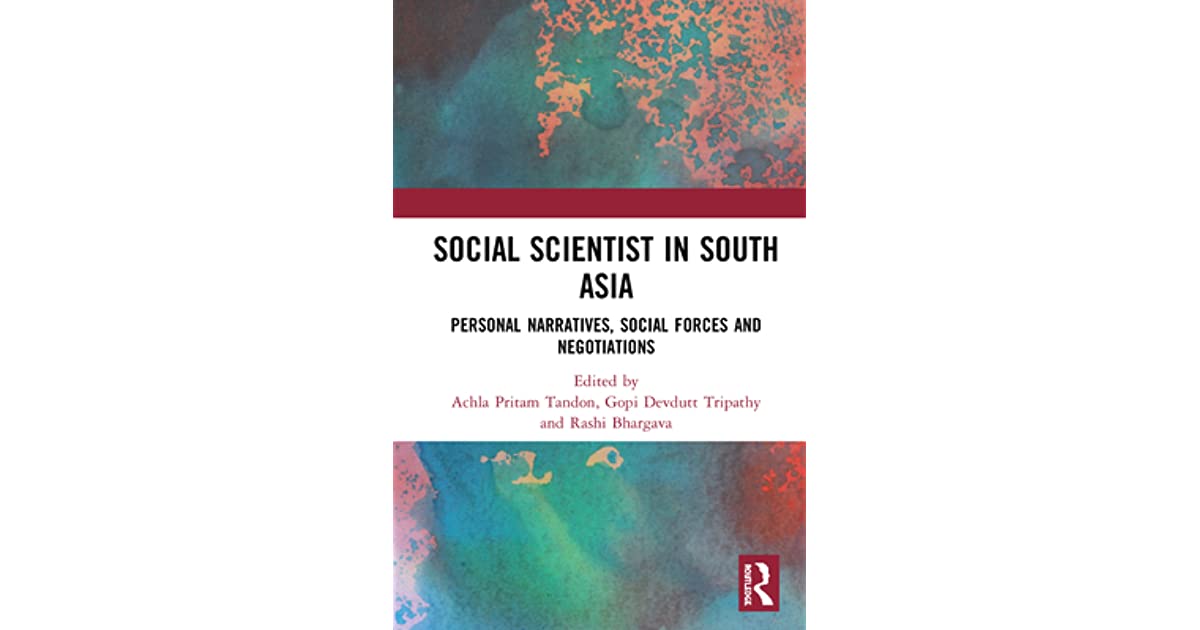
It is a happy coincidence that I completed reading the edited volume titled Social Scientist in South Asia: Personal Narratives, Social Forces and Negotiations edited by Achla Pritam Tandon, Gopi Devdutt Tripathy and Rashi Bhargava (published by Routledge) at 2020 at a time when I am teaching Research Methods to a batch of undergraduate students at the University of Delhi. As we discuss questions of objectivity and reflexivity in the classroom, my students often ask me if it is possible to achieve complete objectivity as a sociologist? And after reading this book, perhaps I can answer this question better.
Social scientists are mostly seen as ‘objective’ seekers of truth, exploring social reality in different forms. In one of the essays in this volume, Nida Karmani writes:
As social scientists, our work often directly grows out of our personal journeys – journeys that are physical, emotional, intellectual, and political. However, this is rarely acknowledged (Karmani in Tandon et al. 2021: 220).
Not much is spoken about their own biographies and social locations. How is the social scientist created? Tandon et al.’s edited book seek to bridge this gap by looking at the role the personal plays in making the social scientist.
The book is divided into two parts. While the first part is titled Engagement with Disciplinary Prisms: Expanding Horizons, the second part is named Reflections on Disciplinary Practices: Pedagogy and Research. There are ten essays in the first section, whereas the second consists of eight pieces.
Contributors in the first part look at the interconnections between the ‘self’ and their disciplinary practices. For instance, Imrana Qadeer’s essay looks at her journey of becoming a public health expert from a doctor through her encounter with social science. She writes how ‘her own empiricist biomedical training rooted in scientific objectivity was not sufficient to deal with public health issues’ (pp. 35). Only when she started understanding public health issues as social issues could they be better explained. This was spurred by her interaction with social sciences at a university like Jawaharlal Nehru University (JNU).
Similarly, Maitrayee Chaudhuri’s essay explores the relationship between the personal and the social. Looking back at her career, she writes how struggling with academic texts as a student shaped her research interests in teaching and pedagogy (pp. 98). The ‘self’ is a part of the disciplinary practice of a social scientist.
Another essay in the section – Embodied Memories: A Journey with Ambedkar by N. Sukumar looks at Ambedkar’s works to understand his own position within the social sciences. Despite getting a job at the University of Delhi (DU), a premier institute in India, the author experiences a ‘disconnect’ with his workplace. Issues of social justice and marginalization of Dalits only find a place in the DU syllabi fringes (pp. 143). He is often seen as the ‘quota appointee’ and/or the ‘activist’. Thus, Sukumar’s journey is devoted to finding the ‘self’ through everyday encounters in the university.
In the second part of the book, the contributors focus on how social sciences are practised in university campuses and classrooms. They adopt a reflexive approach in looking at their personal experiences with social science pedagogy and research.
Chandan Kumar Sharma’s article reflects on his personal journey of becoming a sociologist and its role in helping him establish Sociology as a new department in Assam. He argues that ‘institution building requires dedication and sacrifice’ (pp. 172) and can often lead to working with people across the ideological spectrum. It can be challenging to negotiate one’s way in such circumstances. At the same time, practising academic knowledge in universities that are distant from metropolitan cities has its own specific challenges. Many of the concepts and categories used to understand Indian society need to be adapted to local contexts. Thus, the social scientist is required to be reflexive and inclusive.
Vinay Kumar Srivastava’s essay is an analytical and biographical exploration of teaching sociological theory to undergraduate students at the University of Delhi. Sociology in India is closely connected with Social Anthropology. The boundaries between the two disciplines are blurred with practitioners as similar. Srivastava argues that teaching theory to Sociology students made him reflect on the relationship between Sociology and Social Anthropology. In his teaching, he was able to integrate his learnings from both disciplines and reflect on their heterogeneity (pp. 251).
Nida Karmani’s piece looks at the dilemma of the insider/outsider that she faces as a Muslim researcher having roots in India and Pakistan and as a migrant to the USA. In India, she was seen as far too ‘Westernized’ to be considered a Muslim. In the US and the West, on the other India, she is seen as a ‘someone who is not Western enough’. The social position of the researcher is interpreted differently by respondents according to their locations. For Indians and Pakistanis, her Western identity is visible, but for people in the West, her ethnic identity is more important. Thus, her experience of doing research at ‘home’ differs from a South Asian researcher who lives in the region. Hence, her essay argues that although reflexivity has been well theorized in social sciences, a lot remains to be done. It is essential to connect the personal, the political and the professional to explore the different dynamics of knowledge production.
This collection of essays is a welcome addition to debates on questions of the researcher as a member of society and as a social scientist. Perhaps whether such a clear distinction can be made is a moot question. The book is an important addition to such issues, particularly in the context of South Asia.
While the book is comprehensive, one or two more essays that look at the practice of social sciences in regions like North-East India and Kashmir would have added new and importantly contested perspectives. These regions have historically shared a complex relationship with ‘mainstream’ India, and essays on how social science is taught and practised in these states would have offered fresh vantage points to dwell on the matter of selfhoods, societies and social science. An essay on how identities like gender shape a social scientist would have been an enriching addition to the volume. This book, however, is a good read for students cutting across disciplines of Sociology, Social Anthropology, Cultural Studies, Gender Studies and South Asian Studies.