
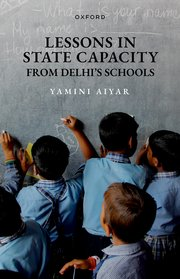
Yamini Aiyar’s Lessons in State Capacity from Delhi’s Schools (published by Oxford University Press in 2024) represents a significant contribution to the literature on public administration and education reform in India. This ethnographic study challenges conventional wisdom about state capacity building and offers fresh insights into the complex dynamics of implementing large-scale educational reforms.
The authors’ core argument fundamentally reimagines how scholars and policymakers should approach the challenge of weak state capacity in India, rather than dismissing frontline bureaucrats as corrupt, apathetic, or incompetent, a dominant narrative in public administration discourse. The book advocates for listening to and learning from their voices. Through what she terms “constructive engagement with the perspectives at the frontlines of the state,” Aiyar contends that building state capacity requires more than techno-managerial solutions; it demands a deep understanding of organisational culture, norms, rules, and hierarchies that shape frontline behaviour.
The book’s methodological rigour is particularly noteworthy. Aiyar and her research team conducted three years of ethnographic research, embedding themselves within a cluster of Delhi government schools. This immersive approach allowed them to observe firsthand the “trials and tribulations of teachers, heads of schools, bureaucrats, and reformers as they struggled to implement reforms”. The ethnographic methodology enables the book to move beyond surface-level policy analysis to examine the “sites of resistance, distortion, and adoption of reform ideas”.
The book examines the ambitious education reforms undertaken by the Aam Aadmi Party (AAP) government in Delhi, which came to power in 2015 with promises to transform government schools. The reforms focused particularly on improving foundational literacy and numeracy skills, addressing a critical challenge where students across various grades operated at vastly different learning levels despite being expected to follow age-appropriate curricula. The author contextualises these reforms within India’s broader educational challenges, where government schools have historically suffered from poor infrastructure, low teacher morale, and inadequate learning outcomes. The Delhi model represented an attempt to address these systemic issues through increased budget allocations, infrastructure improvements, teacher training programs, and pedagogical innovations focused on learning outcomes rather than mere syllabus completion.
One of the book’s most significant contributions lies in its analysis of bureaucratic culture and professional identity formation. The author demonstrates how organisational systems, rather than individual character flaws, shape behaviour within the education bureaucracy. Her research reveals how teachers construct their professional identities within existing institutional frameworks and how these identities, in turn, influence their classroom practices and responses to reform initiatives.
The book introduces the concept of “rewriting the grammar of the education system,” suggesting that meaningful reform requires fundamental changes to the underlying organisational logic rather than superficial modifications. This involves shifting from what political scientist Akshay Mangla terms “legalistic” bureaucratic norms (which prioritise rule-following and hierarchy) toward more “deliberative” approaches that encourage collective problem-solving and local adaptation.
Through detailed ethnographic accounts, Aiyar illuminates the complex ways in which reform ideas are interpreted, contested, and modified as they move from policy conception to classroom implementation. The book reveals how frontline actors (teachers, headmasters, and local administrators) become active agents in shaping reform outcomes, rather than passive recipients of top-down directives. The study documents various forms of “creative resistance and creative disruption” that emerge during the implementation process. These findings challenge simplistic narratives of policy failure that typically blame frontline incompetence, instead revealing the sophisticated ways in which educational personnel navigate competing demands and constraints within their organisational environment.
Aiyar’s work makes important theoretical contributions to understanding state capacity in federal, democratic contexts, such as India. She argues that effective state capacity building requires moving beyond the “disciplining-plumbing framework” that has dominated reform thinking, where technology, monitoring, and punishment are seen as primary tools for improving performance, to approaches that invest in and empower frontline personnel. It emphasises the importance of “relational contracts” and relationship-building as fundamental components of organisational change. This perspective aligns with broader scholarly work on trust and governance, suggesting that high-performing public institutions emerge from cultures of trust and collaboration rather than surveillance and control.
While the book’s ethnographic approach offers rich insights into implementation dynamics, it questions the generalizability of its findings beyond Delhi. Delhi’s unique political and administrative traits, including its status as a Union Territory with direct central oversight and the AAP’s specific political path, may limit broader relevance to other Indian states or education systems. The book could have been better had the author compared education reforms across different states or international settings. Although Aiyar critiques current approaches to state capacity building effectively, it provides fewer concrete recommendations for scalable reform strategies.
Yamini Aiyar’s Lessons in State Capacity from Delhi’s Schools offers a nuanced view of India’s state capacity building. Using ethnographic research and theory, it challenges ideas about bureaucratic reform and sheds light on how organisations influence policy implementation. Its strength is humanising the process by showing how frontline actors manage demands and constraints. While questions about its broader use remain, it shifts the debate from technocratic fixes to holistic approaches, emphasising organisational culture and professional identity in institutional performance.
For scholars of public administration, education policy, and Indian governance, this book is essential reading that could influence research and policy. Aiyar’s work shows the value of ethnographic approaches to policy analysis, arguing for a new way to understand building effective public institutions in democratic, developing countries.
***
Pallavi Sanil is a Doctoral Fellow in Sociology at the Central University of Punjab.