
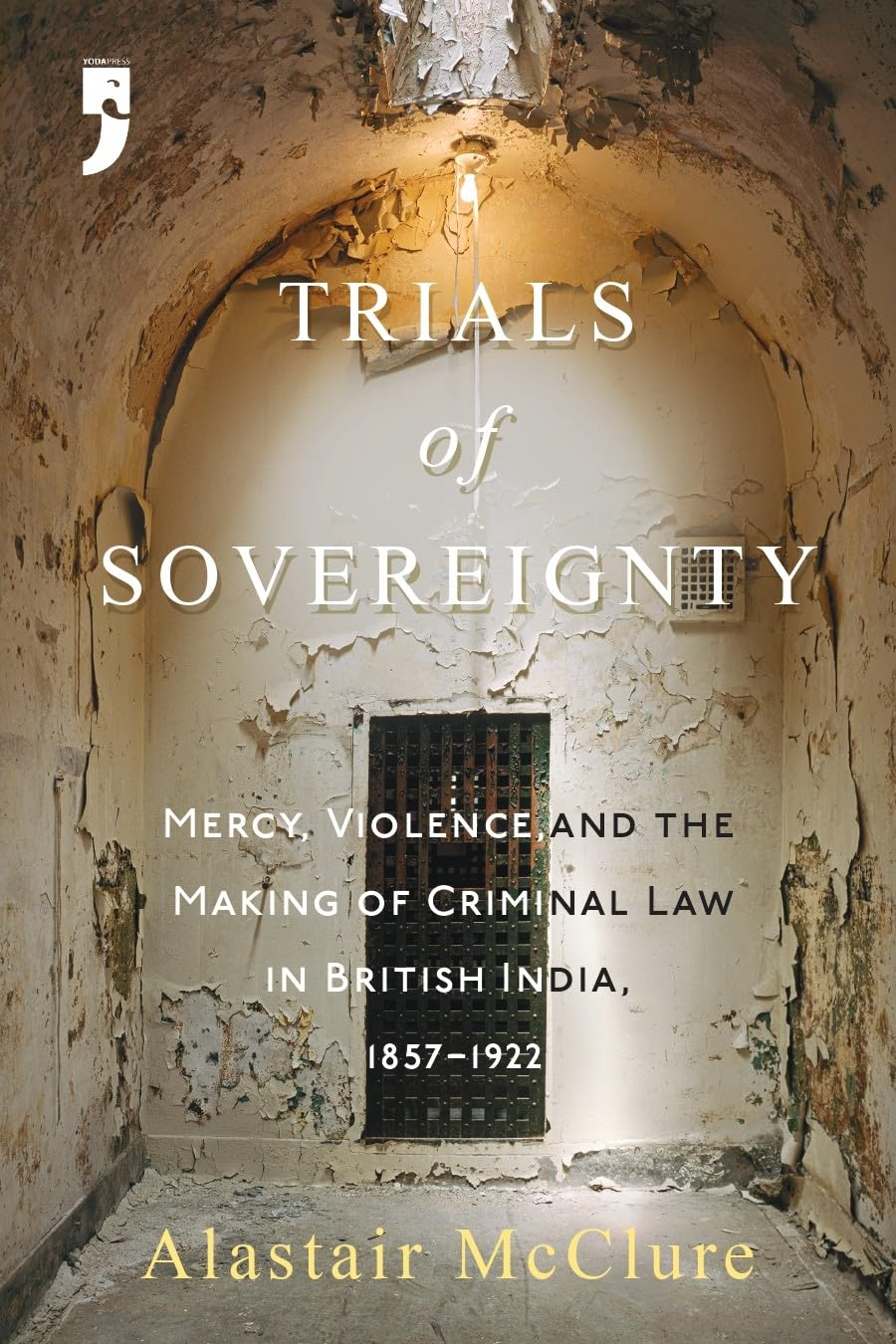
Alastair McClure’s Trials of Sovereignty: Mercy, Violence, and the Making of Criminal Law in British India, 1857-1922, published by Yoda Press in 2025, is a deeply researched and thought-provoking study that reconfigures our understanding of colonial law in British India by highlighting the interaction between violence and mercy as twin instruments of governance. Rather than treating clemency as a peripheral act of benevolence, McClure persuasively argues that mercy was central to the legitimacy of imperial authority, shaping the political landscape from the aftermath of the 1857 Uprising through the early twentieth century.
The book opens with two emblematic trials: Bahadur Shah Zafar in 1858 and Mahatma Gandhi in 1922. McClure argues that the trials of Zafar and Gandhi beckoned a transformation in colonial power—from its establishment through mercy to its rejection through moral resistance—revealing how the criminal trial became a stage for negotiating imperial legitimacy and nationalist defiance. Queen Victoria’s Proclamation of conditional amnesty after the rebellion bound subjects to the Crown through forgiveness, whereas Gandhi’s categorical rejection of clemency reframed nationalist politics as a moral and political rupture from imperial subjecthood. These episodes anchor McClure’s argument that mercy, no less than violence, was a deliberate strategy of the colonial administration.
Organised thematically rather than chronologically, the study situates India’s colonial legal order within global histories of discretion and pardon. McClure draws on comparisons with England’s eighteenth-century ‘Bloody Code’[i], transportation regimes in Australia, and ‘savage mercy’[ii] in Canada and Africa. He highlights a central paradox: while the metropole[iii] curtailed executions as representative politics expanded, colonial India combined a restricted franchise with sustained—and often public—penal violence.
One of the book’s key contributions lies in showing how mercy reinforced the ‘rule of colonial difference.’[iv] Clemency was dispensed selectively, mediated by caste, class, religion, and gender, and often served to cultivate loyalty among elites, reinforce patriarchal norms, or accommodate religious sensitivities. Case studies of royal amnesties, commutations during politically sensitive trials, and mass pardons around events such as the Montagu–Chelmsford reforms reveal how discretion worked as a stabilising force for an unstable imperial order.
He also offers a piercing analysis of the Criminal Tribes Act (CTA) of 1871, framing it as a cornerstone of colonial governance through legal categorisation and discretionary violence. Drawing on foundational scholarly works and recent studies, McClure shows how the CTA institutionalised the idea of ‘criminals by birth,’ enabling the British state to surveil, discipline, and marginalise entire communities under the excuse of law. Far from being an artefact of colonial suspicion, the Act is presented as a calculated tool to reproduce internal social hierarchies—especially caste, tribe, and gender—while reinforcing imperial authority.
By weaving the CTA into his broader argument about mercy and punishment, McClure reveals how colonial justice operated not only through terror but also through selective leniency, deepening the asymmetries of power that continue to echo in postcolonial legal systems. The CTA disproportionately targeted nomadic, low-caste, and tribal communities, branding them as ‘hereditary criminals. The CTA weaponised legal categorisation to suppress dissent and marginalise communities whose mobility, resistance, or cultural practices threatened colonial control.
Equally significant is McClure’s exploration of political criminality. While ordinary criminals are subject to public punishment, nationalist leaders are often dealt with in secrecy to avoid creating martyrs. Strategically timed mass pardons reintegrated dissidents into the political fold without dismantling the repressive legal framework.
McClure’s archival depth is impressive. He draws on records from the National Archives of India, provincial archives, the British Library, and personal writings such as V.D. Savarkar’s diaries. These sources illuminate both the bureaucratic machinery of mercy and the political calculations that underpinned it. His work engages with major scholars, notably Partha Chatterjee on the ‘rule of colonial difference’ and Durba Ghosh on ‘political amnesties’, while offering fresh insights into the discretionary dimensions of colonial justice (Chatterjee, 1993; Ghosh, 2017).
The prose strikes a balance between scholarly rigour and accessibility. Intense descriptions of courtroom trials and moments of anticipation before imperial jubilees bring legal abstractions to life. The book also reflects on the continuing legacies of this culture of mercy and violence: the Indian Penal Code and judicial practices forged under the British Raj continued to shape independent India’s criminal justice system, embedding colonial logics long after 1947.
If one were to point out a limitation, it lies in the Anglocentric comparative frame. Greater engagement with French, Dutch, or Portuguese colonial legal traditions might have broadened the global resonance of the argument. Nevertheless, this is a minor shortcoming in a work that is otherwise rich in empirical evidence and analytical clarity.
In summary, Trials of Sovereignty makes a significant contribution to legal history, South Asian studies, and broader scholarly work on the British Empire. By demonstrating that clemency was not a benign counterpart to violence but rather a strategic political instrument, McClure challenges binary understandings of colonial governance. The book will be essential for historians, legal scholars, political theorists, and anyone interested in the complex relationship between law, sovereignty, and power during the age of empire.
[i] Bloody Code (Australia): Refers to Britain’s 18th-century penal regime, where over 200 crimes—many minor—were punishable by death. In Australia, this translated into mass transportation of convicts as a form of conditional pardon, blending terror with labour exploitation.
[ii] Savage Mercy (Canada & Africa): A term used by historians like Tina Loo and Stacey Hynd to describe how colonial judges mitigated sentences for Indigenous or African defendants—not out of equality, but because they were seen as culturally incapable of full legal responsibility. Mercy thus reinforced racial hierarchies while appearing benevolent.
[iii] Metropole: The imperial homeland (e.g., Britain or France) that governed colonies. It is the centre of power and law, contrasted with the colonial periphery.
[iv] This rule pertains to the legal and political rationale that justified the unequal treatment of colonised individuals based on an assumed inferiority in terms of race, culture, or civilisation. This reasoning allowed colonial law to function differently in the colony compared to the metropole. It legitimised the use of violence, surveillance, and exceptional laws—such as martial law and preventive detention—by depicting colonised people as unprepared for modern legal standards.
References:
Chatterjee, P. (1993). The Nation and Its Fragments: Colonial and Postcolonial Histories. Princeton University Press.
Ghosh, D. (2017). Gentlemanly Terrorists: Political Violence and the Colonial State in India, 1919–1947. Cambridge University Press.
***
Ranjan Chatterjee is a Junior Research Fellow at the Southern Regional Centre, Mysuru (Mysore) of the Anthropological Survey of India, Ministry of Culture, Government of India.
Acknowledgment
I express my sincere gratitude to Dr. Koel Mukherjee and Dr. Abir Lal Mazumder for their insightful comments that significantly improved the quality of this book review, as well as for their constant encouragement to pursue this work. I also extend my heartfelt thanks to the Doing Sociology Team for providing me the opportunity to contribute and for their consistent follow-ups throughout the process.