
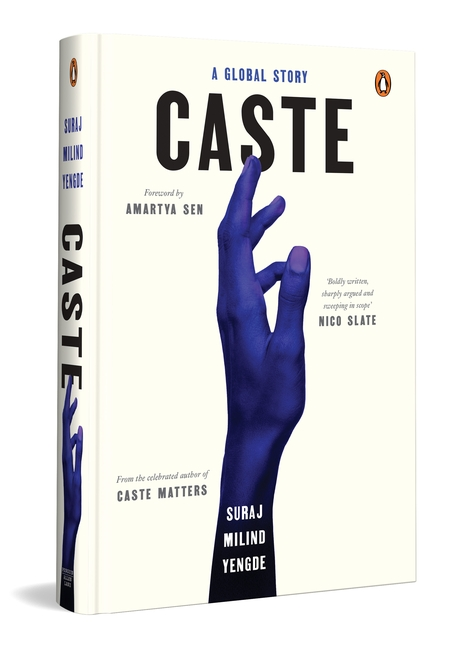
Caste has long been treated as India’s distinctive social formation, bound within its history, religion, and politics. Suraj Milind Yengde’s Caste: A Global Story (Penguin, 2025) challenges this assumption with an ambitious reframing: caste is not only India’s internal hierarchy but a global phenomenon whose afterlives persist in diasporic communities, racial politics, and transnational solidarities. The book is as much a theoretical intervention as it is a narrative of personal engagement, placing caste at the heart of global debates on justice, identity, and human freedom.
Suraj Yengde situates his project within a wider conversation inaugurated by B.R. Ambedkar, who argued that caste can only be understood from the standpoint of the oppressed (Ambedkar 1948). He also extends the insight of Nicholas Dirks, who showed how colonial administrations reified caste as a rigid system through enumeration and ethnography (Dirks 2001). Yet Yengde refuses to remain within the frame of colonialism or Indology; his ambition is to demonstrate that caste, like race, has global travels and resonances. His earlier Caste Matters (2019) established caste as central to Indian democracy and modernity, but this new book extends that insight to show how caste persists and transforms globally. As Amartya Sen notes in his Foreword, Yengde’s work compels us to recognise caste not as an insular Indian institution but as a social form with global ramifications (Sen 2025). This framing underlines the book’s ambition: to move caste out of its regional confines and insert it into the comparative grammar of inequality.
The opening chapters establish the conceptual frame. In Colonial Dalitality, Yengde demonstrates how colonial ethnography reduced complex caste relations into fixed categories, silencing Dalit religiosities and practices. This complements but also complicates Louis Dumont’s structuralist interpretation of caste as a hierarchy of ritual purity (Dumont 1980). Susan Bayly has further demonstrated how caste evolved dynamically through politics, economy, and regional transformation (Bayly 1999). Yengde departs from both by foregrounding caste’s persistence across diasporas and solidarities. He insists that colonialism did not simply “record” caste but actively restructured it. He goes further to trace how these structures were transported by indentured labourers across the oceans, making caste a diasporic inheritance.
The book is at its strongest when connecting Dalit struggles to global movements. Affairs of Letters reconstructs dialogues between Dalit and African American writers, while Race and Caste: In the Age of Dalit–Black Lives Matter situates Dalit activism alongside racial justice campaigns in the United States. Here, Yengde draws a compelling analogy between caste and race, without collapsing their differences. The resonance of George Floyd’s murder in Dalit activism illustrates how global solidarities can illuminate shared structures of oppression. The case study of Trinidad in The Dalit Republic of Diaspora is equally original, showing how caste reshaped itself in Caribbean contexts.
The intellectual genealogy traced in this work is wide-ranging. By bringing Dalit thought into dialogue with Black radicalism, Caribbean traditions, and Buddhist universalism, Yengde expands the scope of caste studies far beyond India. This comparative move enriches the field by demonstrating that anti-caste struggles are not isolated but participate in a global grammar of emancipation. For students of sociology, this alone marks the book as a landmark contribution.
At the same time, reading Yengde also invites reflection on how his global frame intersects with debates on Varna and Jāti. In my own work, I have argued that caste is best understood as a layered interplay of Varna ideals and Jāti practices that precede colonial interventions (Kumar 2015). In a later study, we revisited how these interconnections undergirded the resilience of caste (Kumar, Ajaz & Tripathi 2015). A subsequent analysis further stressed the inherent complexity of these categories across regions and histories (Kumar 2018). Yengde’s contribution lies in extending this analysis outward: where I have emphasised the internal complexity of Varna–Jāti in India, he demonstrates how caste persists globally and acquires new forms in diaspora. His work does not replace genealogical accounts but supplements them with a global sociology of caste.
The book’s contribution can be seen as threefold. First, it globalizes caste studies by shifting the lens from village ethnographies and Indian politics to diasporic mobilizations and transnational solidarities. Second, it deepens the intellectual genealogy of Dalit thought by situating it within diverse global traditions of critique, ranging from Black radicalism to Buddhist thought and Caribbean currents. Third, it exemplifies an interdisciplinary methodology, combining sociology, history, anthropology, and political theory with autobiography and activism.
Yet the book is not without limitations. Some comparative contexts remain underdeveloped. The discussion of caste in the Middle East, for example, is cursory; yet Gulf migrant labour hierarchies offer a crucial site for understanding how caste travels through economic structures of globalisation. The analogy between caste and race, while provocative, sometimes risks flattening the distinct histories of these systems. A more sustained engagement with Dalit feminist scholarship and critical race theory would have further sharpened this discussion. Gender, in particular, is an underexplored analytic. Women appear in the narrative, but the specific ways in which caste and patriarchy intersect across transnational contexts are not fully developed, despite the richness of Dalit feminist interventions.
There are also stylistic risks. The autobiographical tone, while compelling, occasionally overshadows sustained theoretical dialogue with wider sociological debates. Foundational scholars such as Dumont and Bayly, alongside Dalit thinkers like Gail Omvedt and Anand Teltumbde, appear frequently in the text, but Yengde’s narrative tends to move quickly from these references to global case studies. This stylistic choice reflects not a neglect of theory but a deliberate prioritisation of contemporary solidarities and lived experience. One might argue that the urgency of Yengde’s project justifies this approach: his aim is not to rehearse older debates but to reframe the question of caste in the present. In this sense, the text privileges innovation over consolidation, an approach consistent with Yengde’s activist–scholar orientation.
If the book departs from the conventions of detached sociology, it does so deliberately. Yengde writes with an activist’s passion and a Dalit scholar’s situated voice. His style is accessible without being simplistic, rigorous without being weighed down by jargon. Photographs, anecdotes, and field encounters enliven the text, bridging the distance between scholarly analysis and lived experience. In this, he echoes Ambedkar’s insistence that caste is not a puzzle of social order but a lived violence that must be understood from below (Ambedkar 1948).
The significance of Caste: A Global Story lies in its ability to reimagine caste as a global challenge, alongside race, class, and gender. For academics, it offers new directions in comparative sociology and global studies. For activists, it provides a vocabulary of solidarity that stretches across borders. For students, it demonstrates that scholarship can be both rigorous and committed, analytic and transformative.
Yengde’s central message is clear: caste is not merely India’s burden but humanity’s challenge. Recognising its global story is the necessary step toward imagining an anti-caste future. By writing caste into the global narrative of oppression and emancipation, Yengde has produced a work that will resonate for years to come.
References:
Ambedkar, B. R. (1948). The Untouchables: Who were they and why they became untouchables. Bombay: Thacker & Co.
Bayly, S. (1999). Caste, society and politics in India from the eighteenth century to the modern age. Cambridge: Cambridge University Press.
Dirks, N. B. (2001). Castes of mind: Colonialism and the making of modern India. Princeton, NJ: Princeton University Press.
Dumont, L. (1980). Homo hierarchicus: The caste system and its implications. Chicago, IL: University of Chicago Press.
Kumar, A. (2015). Varna–jāti interconnection: Some reflections on caste and Indian tradition. International Journal of Research in Social Sciences, 5(3), 788–793.
Kumar, A., Ajaz, M., & Tripathi, P. (2015). Varna–jāti interconnection: Revisiting Indian caste system. American International Journal of Research in Humanities, Arts and Social Sciences, 12(2), 246–251.
Kumar, A. (2018). Complexity of varna and jāti: A relook at the Indian caste system. International Journal of Novel Research and Development, 3(12), 59–63.
Sen, A. (2025). Foreword. In S. M. Yengde, Caste: A global story (p. ix). London: C. Hurst & Co.
Yengde, S. (2019). Caste matters. Gurgaon: Penguin Random House India Private Limited.
***
Anil Kumar is Professor of Sociology and Social Anthropology at the Central University of Himachal Pradesh, with research interests in social issues examined through theoretical and philosophical perspectives.
1. If caste is a global phenomenon, why has the Indian state never demanded global legal protections for Dalits?
Despite Article 17 abolishing untouchability, why does the Indian Constitution’s moral force stop at the nation’s borders?
—
2. Why does the Indian diaspora hide caste publicly but enforce it privately?
Is this a new form of global Brahminism disguised as “cultural identity”?
Should international human rights frameworks treat this as covert discrimination?
—
3. When comparing caste with race, why is slavery accepted as state-supported violence, but caste violence is dismissed as a private or religious matter?
Does this framing deliberately reduce the state’s historical accountability?
—
4. Yengde stresses colonial restructuring of caste — but how do we reconcile this with pre-colonial Brahminical texts (Manusmriti, Dharmasutras) that had detailed caste rules?
Was colonialism a catalyst — or merely a recorder of an already entrenched hierarchy?
—
5. If caste is global, what are the global remedies?
Has India ever proposed an international “Caste Abolition Charter”?
Or is the state more invested in maintaining a sanitized global image?
—
6. Why are Dalit women missing from global feminist platforms?
If caste survives transnationally, why is the intersection of caste and patriarchy not central in global gender discourses — including in Yengde’s framework?
—
7. In contemporary capitalism, caste-based networks and “meritocracy filters” dominate hiring.
Which constitutional guarantees—Articles 14, 15, 16—does this systematically violate?
And why does the state ignore it?
—
8. The United Nations recognises caste discrimination as akin to racial discrimination.
Why has India opposed this classification for over two decades?
Is this resistance a constitutional failure or a political strategy?
—
9. If caste operates globally, why has India never articulated a foreign policy stance on caste discrimination in the diaspora?
Does the absence of such a stance reveal the state’s discomfort with acknowledging caste publicly?
—
10. Does globalising caste inadvertently allow upper-caste elites to universalise their narratives while keeping Dalit voices marginal?
Is this global framework truly emancipatory, or does it risk becoming an upgraded version of Brahminical scholarship?
—
11. If Yengde can map Dalit–Black solidarities, why has the Indian government never institutionalised a “Global Dalit Commission” on the lines of global racial justice bodies?
—
12. Ambedkar argued that annihilating caste requires social, economic, and political reform.
If caste is indeed global,
what equivalent ‘global reforms’ are necessary—and who is accountable for implementing them?
—
13. Why does the Indian state aggressively export yoga, Ayurveda, and Hindu soft power globally—but never export Ambedkarite thought or anti-caste philosophy?
Does this expose a constitutional double standard?
—
14. If caste’s global survival is partly due to diasporic networks, is this a sign that caste is evolving faster than constitutional measures meant to dismantle it?
—
15. If caste is humanity’s challenge, not India’s,
why does humanity not yet possess a global language, law, or institution for caste abolition?
Is caste’s global invisibility itself a form of structural oppression?
Very powerful and relevant questions raised by the scholar. My sincere salute to you ‘scholar’.