
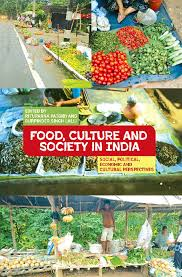
Food, Culture And Society In India: Social, Political, Economic And Cultural Perspectives, published by Berghahn Booksin 2026, takes you on a sensory walk evoking smells, images and flavours which might either remind you of your home or help you to visualise a dish you have only heard of. Rituparna Patgiri and Gurpinder Singh Lalli moved away from the biological act of eating to it being a relational and communitarian system rooted in historicity. The richness of the book lies in the distinct experience in each chapter, ensuring little room for disengagement and allowing curiosity to persist throughout. The book is divided into four parts, each attending to a separate concern.
The first part, entitled “Food, Culture and Identity”, acts as a window to the world beyond, allowing glimpses into realities otherwise unseen. This part makes you realise that for a diverse country like India, a generalised gastronomy wouldn’t do justice. It rightly proves that “you are what you eat”, as commensality “constructs” the different identities of caste, religion, gender, region, etc. The case of Bhumihars of Bihar shows how the supposed rigid caste identities are reshaped across changing political contexts to claim status and power, with food operating as the assertive mechanism that reconfigures castes. “Otherization” of caste extends to cuisines too. “Culinary apartheid”, as it has been called, is a hierarchy imposed by upper castes that often excludes, marginalises, and shames Dalit culinary traditions. While the unusual beef samosa of Bihar with keema fillings marks the identity of a residual culinary culture standing in confrontation with the ideals of the inherent Hindu sentimentality of the nationalist movement, the littoral gastronomies of the fishing community of Digha replicate the triad of caste-class-colonial-based culinary hierarchies standing at the crossroads of “unhygienic and uncivilised”, creating an “us and them”. This part also illustrates how new types of significations to food are continually constituted, producing new identities as seen among Naga youths, among whom cakes have become an integral part of celebration, while among the older generation, cakes as a food item hold meaning equivalent to nothingness.
The second part, entitled “Food, Memory and Migration”, points out how migrating communities are more conscious of preserving their cuisines as a means of holding onto their identity. As such, “gastro-nostalgia” becomes central in carrying the “local” in the global setting by the diasporic groups. Memories of food, more than mere nostalgia, embody affective traces from the past. Food is described as a “healing balm” to people, as it was the one constant thing that stayed with them when everything around them was changing. Bhakhri and salt- a meal once associated with hunger and deprivation, outgrew from stigma into agency and heritage for the East African Asian woman. While for Kashmiris living abroad, food transcended communal divisions, nurturing a collective Kashmiri heritage of cooking and eating beyond the Pandit-Muslim binaries, the Afghan restaurants and bakeries in Delhi recreate “sensecapes” of home, which creates a “culinary safe haven” for the asylum seekers. Exposure to global cuisines reshapes migrant food culture, which engenders the migrant community to preserve and reinvent culinary identities. Access to “authentic food” through recipe writing and sharing, through cookbooks and increasing digital media, provides a sense of reassurance to keep in touch with their culture. However, at a sensory level, migration can also produce repulsion for the “other” through smell and taste, as seen in the Bangal-Ghoti divide through the eating of shutki in postcolonial Bengal.
The third part of the book, entitled “Food, livelihood and nutrition”, showed how nourishment and work are mutually constitutive processes. Be it the mid-day meal (MDM) scheme or the HYV rice, each reflects an approach marked by dehumanisation. While the MDM reduces children to target groups and quantifiable units, ignoring their social and sensory practices around food, the nutritional aspect in the technocratic framework of HYV is completely overlooked, and the processes by which humans and the landscape co-produce each other are also ignored. In both cases, governance is exercised through biopolitical rationalities that deem people legible and manageable, while simultaneously undermining the moral economy of subsistence, care and justice through which people make sense of everyday life. In doing so, these frameworks produce a mechanical abstraction of social life.
The last part of the book, entitled “Food, Consumption and Media”, looks at the new kind of visibility that food has attained through media and technology. The digitisation of food has helped extend the “local” beyond territorial limits. Visual culture, such as anime and manga, introduced Indian audiences (especially those from North East India) to Japanese and Korean culinary culture, which is then commodified through cafes, cosplay events, and themed restaurants. The contemporary explosion in food vlogging and audio-visual culinary content has made people aware of their ethnocultural specificity, and it also attempts to portray the existence of an inclusive national imagination that celebrates the plurality of cuisines. In the age of increasing affinity for “organic food, digitization has also helped in visually mediating between producers and consumers, which is otherwise impossible given the long food processing chain. However, these processes are not without limitations. Food advertisements are very influential in reaching every household, and sadly, such a powerful force often reproduces gender stereotypes in portraying women as self-sacrificing caregivers confined to the kitchen. Moreover, without an understanding of the cultural background and lived histories associated with specific local foods, unfamiliarity and dislike for their taste often translate into devaluation of the culture from which they emerge.
Overall, the book offers readers an understanding of the structural conditions that produce and reproduce identities through food. It also gives an idea of how state policies and market forces shape food systems and access in unequal ways. The book is an important contribution to the field of food studies. I hope this volume inspires scholars working on food studies to work on climate change, extraction and food production among marginalised communities. This book is a valuable resource for scholars interested in the politics of food in India.
***
Praapti Sarma is a PhD scholar at the Department of Sociology, South Asian University (SAU), New Delhi.