
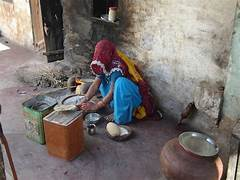
Foodwork is often viewed as household chores—natural, expected, and virtually invisible. It is common to think that cooking, eating, and serving food are decisions of habit or preferences. Feminist research has long demonstrated that food-related labour is socially organised, deeply gendered and central to the reproduction of everyday life (DeVault 1991; Hochschild 1989). But the labour involved in securing ingredients, cooking meals, deciding the menu and portion allocation is driven by larger caste, gender, and generation structures; and women are at the forefront of these processes. Yet women’s work in the kitchen is rarely seen as a space for agency.
In this essay, foodwork refers specifically to the everyday practices through which young women manage cooking-related labour within the household, including decisions around timing, methods of preparation, use of technology, sourcing food, and presentation of meals. Rather than treating foodwork as a fixed set of duties, the essay focuses on how these practices become sites where young Jat women tactically negotiate labour, authority, and expectations in their everyday lives.
This essay focuses on how young Jat women, especially young daughters-in-law, use agency within foodwork in a semi-urban village of Haryana. This essay explores the negotiation of these young women within the household, based on an ethnographic fieldwork study that involves seven Jat families in Rewali village. Women negotiate power within the household rather than openly resisting the authorities within the household. The study explores how agency in foodwork is a function of timing, concealment, selective use of technology, and control of visibility. This essay also explores how women use different strategies to reduce labour and control expectations instead of outrightly challenging these structures.
Rewali village is located in the Sonipat district of Haryana, which lies in the Delhi National Capital Region (NCR), a space that bridges the two worlds of rural and urban life. Most households have gas stoves, electric grinders, refrigerators, and food delivery platforms. But, food-related practices are still tightly controlled, particularly in a group setting where elderly women – most often mothers-in-law – have control over menus, how to cook, and timing of meals, etc. Daughters-in-law are expected to cook on time, eat according to set routines and believe in freshness and purity. In such a situation, confrontation is usually neither desirable nor feasible. Thus, for these young women, in the household agency is exercised through subtle negotiations and tactics as open refusal will lead to moral judgements, conflicts and the disruption of everyday relationships.
One of the strategies employed by young women is the management of time. Meal timings in these households are closely monitored by the elder women, especially for breakfast and dinner. Young women are at the forefront, ensuring that food is prepared and served at the “right” time. Rather than questioning these expectations, the young women reorganise how work is done. Some wake up early to complete labour-intensive tasks before others are awake; others prepare components of meals in advance and assemble them later. Time thus becomes a resource through which women negotiate control without openly challenging the authority. Michel de Certeau (1984) describes it as “tactics”—everyday improvisations that allow individuals to survive and move within the structures that they do not control.
Another strategy that is important is the selective and discrete use of technology. Although gas stoves, electric grinders, and refrigerators are common in many homes, their use is often monitored by the elders. They connect traditional practices with care, purity, and self-discipline. Instead of directly challenging these expectations, the daughters-in-law find subtle ways to ease their burdens. One woman shared that her in-laws are religious. This leads her to wake up early and play devotional bhajans loudly through a speaker while she uses an electric grinder. The noise from the grinder is masked this way. This clever use of technology helps her save time while keeping up the appearance of following household customs. As a result, technology is not seen as a sign of modernity and independence; it is strategically used within the limits of established moral standards.
Such practices connect with earlier feminist critiques of domestic technology. Ruth Schwartz Cowan (1983) argued that technological improvements do not automatically reduce women’s work. Instead, they often change how work is done while keeping the same expectations in place. In Rewali, technology helps women save time and energy, but this depends on using it in a subtle and socially acceptable way.
Food delivery platforms like Swiggy and Zomato show how young women handle food-related responsibilities. Older family members often view ordering food as a sign of neglect and a lack of purity. In response, younger women come up with smart ways to change this view. They place their orders at night when the elders are asleep. In the morning, they heat the food, add homemade spices, and serve it with fresh rotis. They create the impression of care with fresh rotis and timely meals, even if some of the food is from outside. What truly matters is not whether the food is made at home, but how it looks.
The flow of information is important in these discussions. Young women carefully decide who gets informed and when. In several families, husbands knew about the food ordering practices, while mothers-in-law didn’t. In some cases, sons or teenage boys accepted deliveries because their actions faced less scrutiny. By sharing information selectively, women manage their relationships at home. They maintain trust with some people while avoiding conflict with others. Their influence does not show through direct assertion but through controlling visibility and how information flows.
Rephrased methods for exchanging resources help women lighten their loads. In some households, younger women give raw vegetables to lower-caste women who work in their fields. In return, they receive help with household chores. These arrangements make their responsibilities easier and reduce questions from elders about unused ingredients. However, they still rely on and support existing caste structures, highlighting the limits of their choices within unfair social systems.
Storing and sharing food also play a key role. Refrigerators allow women to keep cooked meals for later, even though elders frown upon leftovers. Sometimes, they trade prepared meals with neighbours of the same caste, warming them up the next day before serving. These practices address purity concerns while redistributing tasks among trusted communities. Again, norms are not rejected outright but quietly stretched.
These instances highlight how agency goes beyond simple personal choices or direct rebellion. For young Jat women, agency doesn’t lie in challenging the household authority or changing gender roles right away. Instead, they find ways to work within the existing structures of caste, gender, patriarchy, etc. They use these everyday subtle strategies like changing their schedules, hiding specific actions, swapping tasks, and carefully managing how others see them and seek agency through these tactics and strategies. These strategies help them to navigate their everyday lives. As Saba Mahmood (2005) highlights, agency isn’t just about opposing norms; sometimes, it’s about finding ways to live with them in more manageable and sustainable ways.
By focusing on strategies of foodwork, this essay highlights the kitchen as a space of continuous, if understated, negotiation. Quiet kitchens are not sites of passivity, but of careful calculation and everyday action. Paying attention to these strategies allows us to recognise how women sustain themselves and their households within enduring structures of gender, caste, and authority—without reducing their actions to either submission or resistance.
References:
Certeau, M. de. (1984). The practice of everyday life. University of California Press.
Cowan, R. S. (1983). More work for mother: The ironies of household technology from the open hearth to the microwave. Basic Books.
DeVault, M. L. (1991). Feeding the family: The social organization of caring as gendered work. University of Chicago Press.
Mahmood, S. (2005). Politics of piety: The Islamic revival and the feminist subject. Princeton University Press.
***
Neetu Dagar is a Master’s student in Sociology at South Asian University (SAU), New Delhi. This article draws on fieldwork conducted as part of her dissertation on foodwork and everyday agency among young Jat women in rural Haryana, focusing on how women exercise agency through foodwork and kitchen spaces within the rigid structures of caste and patriarchy.