
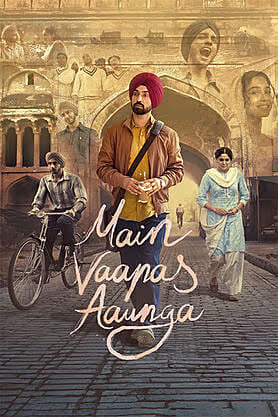
In Imtiaz Ali’s Main Waapis Aaunga, the promise to return finds its softer counterpart in the permission to leave.
If truthfulness means beauty par excellence, then here is a piece that embodies it. As the movie Main Waapis Aaunga came to an end, I wondered—how does one create cinema of this intensity? It makes Imtiaz Ali stand out as one of the finest directors of our times, creating a piece that is truthful, honest, and sincere. The movie hits you with a force intense enough to throw you out of your cubicle-like life, nudging you to encounter an unknown emotion that comes from deep within you. This work of art knocks on those unknown, long-buried, forgotten zones of your psyche that have become inaccessible, almost beyond reach. It stirs them in an unannounced manner, making them emerge, asking you to attend to them.
The movie centres around a 95-year-old Sikh gentleman, Garewaal (known as Keenu in his youth), whose family witnessed the bloodshed of Partition. The events of Partition hardened him, and while he became a successful businessman in Chandigarh, he also turned bitter and unaffable—the diametric opposite of the young Keenu, who grew up in his ancestral home in Sargodha (presently in Pakistan). Now, on his deathbed, he is unable to find his final release from life, as the memories of Partition and the life he lived in undivided India come to the fore. He had long buried that painful past with the vow of not looking back, “picche mudd ke nahi dekhna.” The power of this vow has indeed carried him through life, but it begins to crack in his final days, leaving him vulnerable, fragile and tender. The weight of the enormous pain that these memories bring is such that he lies suspended between life and death. His final release and redemption become possible only through his Muslim beloved, Jiya, whom he had left behind at the time of Partition with a promise to return (main waapis aaunga).
While the movie seems to be about this promise to return, woven just as strongly into it is its other side, the permission to leave, which comes from the other—in this case, Jiya. Unlike the vow of not looking back, made by a wounded Keenu, here we encounter his softer version that promises to return only when his beloved allows him to depart. Without that permission, he wouldn’t leave, and herein lies Imtiaz’s brilliance in creating an interesting double bind between promise and permission. Keenu might have made the promise of his own accord, but Jiya is already implicated in it, as he seeks her permission to depart. It is this permission that is at the centre, as it stands for an acknowledgement of the helplessness in which Keenu finds himself. There is indeed an inevitability to his departure, for the tragedy of Partition was such that he couldn’t have stayed back. Yet her permission does something important. It allows both of them to reconcile, however painfully, with the tragedy of the times that weighs so heavily upon them. Now in his final moments, he again seeks her permission so that he can depart once more—only this time, not to return. Her final gesture of allowing him to depart relieves him and dissolves the pain that he has carried for so long. It acknowledges his helplessness in the face of a crisis that was beyond him, absolving him of the curse that he feels his family carries for all the women whom they couldn’t save at the time of Partition. Such is the quiet strength of a permission—gentle in its gesture, yet surpassing the hardness that comes with vows and promises.
The movie takes the site of Partition to explore the collective pain that lies deep inside us, but it also transcends it by touching on the violence, displacement and forced migration that have become characteristic of our times. Nothing captures this better than Diljit Dosanjh’s final song Kamaal Hai. Subtly, the movie makes you feel the weight of the curse that we all carry, of the lives that we have turned away from—lives that we have allowed to be killed, that stand abandoned and are in abeyance. It softly makes you dwell in a zone of pain, where not only does the difference between personal and collective pain stand blurred, but also the one between victim and perpetrator. If the realm of violence can engulf all of us, collapsing us as one, then the only way to salvage ourselves is by inhabiting this zone of pain, where these distinctions stand dissolved.
We are increasingly inhabiting the world as independent, isolated entities, who in their self-assuredness find it possible to exist without having any relationship with the others and with the world. The movie dispels this myth, making you realise the strong connection that binds us with others—familiar or distant. It asks us not to turn away from the pain and suffering that is around us; instead, to witness and acknowledge them.
The redemption that we all need, wittingly or unwittingly, is only possible by paying attention to the other, by acknowledging their pain and suffering and by taking responsibility for it. If we choose to remain indifferent, immune and oblivious to the other—to the lives and suffering around us—then we live with a lump growing inside us, one that is not only hardening us but also taking away what it means to be human—the ability to curate a life that is marked by others.
***
Jyoti Dalal is a Professor at the Institute of Home Economics, University of Delhi and the current President of the Comparative Education Society of India (CESI).