
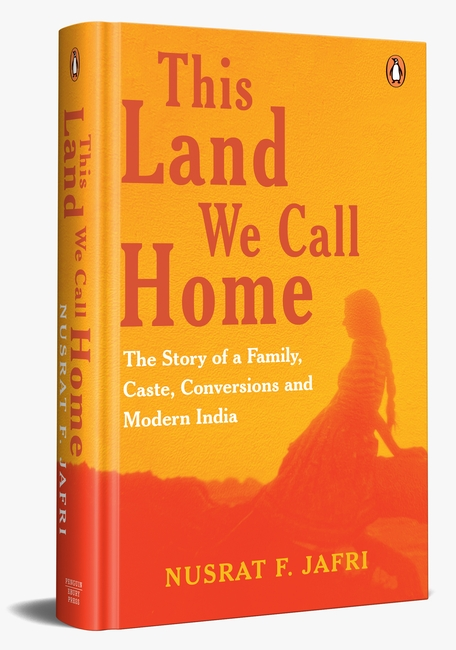
Nusrat F. Jafri’s memoir This Land We Call Home: The Story of a Family, Caste, Conversions and Modern India (published by Penguin, 2024) has considerable sociological relevance. The memoir is timely, as de-notified, nomadic and semi-nomadic communities (DNTs) are fighting for political recognition –separate enumeration and reservation in the Census and the III Schedule of the Constitution, respectively. Focusing on DNTs, Jafri’s account offers an important anthropological exploration of intertwined structures of caste, marginality, conversion, kinship and marriage, communalism and the relationship between communities and the Indian state.
The memoir illuminates how the nation-state, particularly its visible manifestations and invisible power in the form of laws and policies, interacts with different segments of its citizens, and their response to the nation-state. Jafri foregrounds the experiences of subordinate groups, women and minority communities, in negotiating state power. Historically, DNTs faced atrocities and humiliation due to an array of criminal legislation, such as the Thugee Act of 1836, Dacoity Act of 1943 and Criminal Tribes Act of 1871, which branded the whole communities as hereditary thieves and congenitally criminal. Despite being repealed, they continued to endure violence and stigma through instituting habitual offender statutes and police manuals in various states, empowering the police to hound them and conduct pre-arrest detentions.
Beyond these laws’ adverse effects, the memoir examines other laws—the ban on cow slaughter, the Citizenship Amendment Act (CAA), and the plan of introducing Uniform Civil Code (UCC) —and policies such as punitive birth-control measures. Jafri also engages with critical events such as the deaths due to poly-crisis (famine, Spanish Flu, Cholera, weak public healthcare system) amid World War I, grieving of masses after the demise of Gandhi and Nehru, state repression in the face of separatist demands by Sikhs and during Emergency, anti-Sikh riots, the demolition of the Babri Masjid, and vigilantism against inter-faith marriage. In Jafri’s narrative, these political crises and legal interventions are experienced not as distant events of state history but as forces that enter everyday sociality, reshaping/disrupting family relations, mobility, inter-community relations, belonging and strategies of survival.
The book is organised into three parts—‘Roots’, ‘Trunk’ and ‘Branches’—consisting of 16 chapters. The first part, ‘Roots’, encompasses chapters 1 to 6 and contextualises DNTs in the pre-colonial and colonial period while tracing Jafry’s family’s history. Discussion of caste and class hierarchy among North Indian Christians and Muslims is another focus. The second part, ‘Trunk’, consists of chapters 7 to 12, and explains the predicaments of DNTs after Independence until the 1970s. While engaging with the macro-political facts —decolonial movement, mass suffering due to partition, emergence of Constitutionalism making India a secular, socialist and democratic state, suspension of human rights during the emergency and the Janata Party alliance assuming power during the post-emergency. Jafri simultaneously delineates how these developments affected the lives of her maternal grandparents and parents. The third part, “Branches”, covers the period from the 1980s to the 2020s, discussing the introduction of draconian laws and resistance– mundane and organised —against these. In chapter 16, the author recounts her participation in the mass protest against CAA, which mandated minorities to prove their ‘Indianness’ to detached government officials, at August Kranti Maidan in Mumbai, a historic site where Mahatma Gandhi delivered a resounding speech demanding the British ‘Quit India ’, and reflects on the power of Faiz’s song “Hum Dekhenge”, a symbol of resistance. Her account of protest highlights the solidarity of people from all walks of life, including Cinema, Academia, nuns and labourers, displaying humanity and defying the image of Mumbai being apathetic to politics (p. 260).
The book’s major strengths are its lucid prose and its combination of lived experience with auto-ethnographic reflection. Jafri draws on her maternal ancestry among the Bhantus of Alwar, Rajasthan, to connect family history with broader questions of caste, mobility, religion and the state. The Bhantus trace their lineage to the Sansi tribe and derive their name from Rajput ancestor Raja Samsamal (p. 17). The community, now a relatively small community dispersed across several Indian states, is organised into eight exogamous clans: Gado, Dholia, Cherele, Banswale, Dhapan, Sadheke, Mina and Marwari (p. 119). The author integrates the oral history of her paternal ancestors with her maternal family through the themes of nomadism and the liminality of faith.
Methodologically, Jafri adopts an auto-ethnographic approach, drawing on personal memory, the social memory of extended kin, family photographs, songs of resistance and resilience — such as Hum Honge Kamyaab, Hum Delhenge and Mere Rang De Basanti Chola— and documented macro-history. She weaves these sources together to construct an account that moves between critical historical events, everyday experiences of state power, and the changing relationship between family and community. Importantly, she avoids romanticising or rejecting her family’s decisions and standpoints and instead contextualises them within the social and historical circumstances. In chapter 4, Jafri writes that post-conversion, her great-grandparents claimed their Rajput identity to avoid stigma associated with Dalit identity.
The author shows the relationship between caste exclusion and colonial criminalisation. Jafri lays bare the fault lines of the caste system, which coerced some Bhantus to explore collective thefts and crimes for survival on occasion (p. 12). She writes that although Bhantus were allowed to grow moustaches like Rajputs and served in the army of Rana Pratap, they were disallowed from buying land, living in the main village, or accessing education, and suffered many forms of discrimination imposed on them by upper-caste Hindus. In the absence of options, they relied on handmade crafts, cattle-keeping and hunting to make ends meet; unfortunately, thieving also became a desperate last measure for some Bhantus because of the limited avenues available to them (p. 23). Although Bhantus did not affiliate with the caste system, they were treated as outcasts. Their Bhantu identity preceded them even before they entered the periphery of the village in Uttar Pradesh, exposing them to discrimination shaped by rumour and prejudice (p. 12, 29). They were wrongly and unfairly designated as a criminal tribe during colonial modernity. She asserts that her great-grandfather and his tribe were not criminals but pastoralists. Through the history of her great-grandfather, ‘Hardayal Singh’, whom she describes as being housed in enclosed settlements called camps or reformatory settlements by the colonial regime and subjected to a ‘civilisational project’, Jafri demonstrates how colonial governance attempted not only to regulate mobility but also to discipline the cultural identity of the marginalised communities (p. 33). Later, he converted to Christianity in the hope of a better life and greater opportunities (p. 26), benefited from the rehabilitation support and assistance of the Methodist mission —an American Baptist and protestant- and learnt the relevance of empathy—an emotion previously alien to itinerants (p. 29, 36).
Jafri complicates the conventional assumption that conversion among marginalised communities was simply the result of missionary coercion. Through Hardayal Singh’s experience, she foregrounds the agency exercised by individuals who viewed conversion as a means of accessing dignity, education and social mobility. She also cites the case of her grandmother, Prudence and grandfather, John Wilson, who decided to convert to Roman Catholicism from Protestantism in order to provide Western-style (nursing) education to their children in 1957 (p.143). Similarly, her mother, Meera, willingly embraced Islam from Christianity after marrying a Shia Muslim. Jafri critiques another predominant view that marginalised communities completely upend their old cultural ties and values after conversion. Instead, she explains that even after conversion, her maternal family retained the practice of bride price in marriage, rearing buffalos and goats (p. 79), hunting and found solace in venerating their ancestors, practices that held deep meaning and significance for them. This serves as a poignant reminder of the resilience exhibited by marginalised communities in preserving their customs and beliefs, even in the face of adversity (p. 26). The memoir therefore treats identity as layered and historically produced rather than as a fixed category determined exclusively by religion or caste.
The book’s salient points include its treatment of the project of humanism, composite culture, and its insights into communal harmony— inter-faith solidarities in times of genocide or pogrom. Chapter 13 narrates how her parents rescued a Sikh neighbour – a retired brigadier – in Sahu Colony, Lucknow, during the anti-Sikh riots after the assassination of Indira Gandhi. Chapter 14 shows how some of her majoritarian neighbours – Mr Sharma uncle and a group of others – protected her family during the Ram Janmabhoomi movement. Jafry’s family is the living example of syncretism, which is aptly summarised in the epilogue. In the epilogue, she reflects on her embodiment of multiple identities: her parents being Muslims and maternal grandparents being Catholics while she married a Bengali Hindu. Her son’s name ‘Dylan Jafri Roy’ is a testimony to the plural identity which is consciously given to align with the depth of family roots and a signature of defiance to confine identity to the rigidity of one caste, religion and class. Although Jafry discerns many critical events and Constituent Assembly debates, she misses problematising the reservation debate, particularly the definition of ‘depressed classes’. Contemporary DNT politics, especially the demand for separate reservation, resuscitates this debate and flags a historical wrong: the exclusion of DNTs from the category of ‘depressed classes’ by the Sharp Commission in 1932 on the basis of representation by Dr Ambedkar. According to the Renke Commission, DNTs’ marginalisation persisted due to the uneven and irrational inclusion of certain DNTs under OBCs, SCs and STs while leaving other DNTs outside the ambit of affirmative action. Overall, this memoir is a wonderful resource for sociology of India, minority studies, caste and kinship studies, and studies on migration and nationalism.
***
Asima Jena is an Assistant Professor at the Department of Sociology, University of Hyderabad.