
Introduction
When a city prepares to receive the world, what happens to those who do not fit the image it wants to present? The people who build, clean, feed and sustain that city are often the same people who are asked to disappear from it while the world is watching. As Delhi hosts the 18th BRICS Summit on September 12-13, 2026, the city has once again entered a phase of intensive cleaning and beautification. Roads and prominent structures are being prepped, civic agencies are undertaking clean-up drives, and areas around the main venue are being readied for the arrival of international delegations. On the surface, this looks like routine urban improvement. But Delhi’s recent history suggests there is more to it than aesthetics: how a city looks is also equally, if not less, a question of who gets to be seen in it.
For decades, Delhi’s pursuit of becoming a ‘world-class’ city has involved producing a particular urban aesthetic: clean roads, curated public spaces, regulated streets, sanitised neighbourhoods. However, this image is often produced by making other forms of urban life less visible. Slum settlements, street vendors, informal workers and the homeless, despite being integral to the city’s everyday functioning, are often treated as obstacles to this vision.
Cities on Display
This pattern tends to intensify around mega-events, which serve as occasions for making a city ready for the world to see. Amita Baviskar (2014) argues that such ‘spectacular events’ allow cities to undertake transformations at a scale difficult to achieve through ordinary planning. This is not unique to Delhi. Solomon Greene’s (2003) study of mega-events across the Global South shows how Olympics, World Cups and similar occasions have often been accompanied by slum clearance, displacement and large-scale redevelopment. In Seoul, Beijing and South Africa, displacement of informal communities has repeatedly been justified under the garb of modernisation and beautification. South Asia too follows this pattern: slum evictions were seen before the 5th Non-Aligned Movement summit in Colombo in 1976, and beggars were removed from the streets of Dhaka ahead of the 2011 ICC World Cup. A spectacular city, in other words, is often produced through the removal of those who don’t fit its desired image.
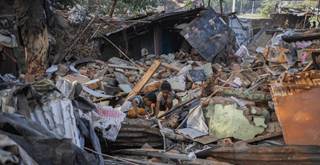
Delhi’s recent history follows the same model. The 2010 Commonwealth Games brought large-scale infrastructural alteration alongside street beautification and the sanitising of public space. Beggars were targeted through mobile courts, informal settlements were concealed behind screens (echoing a similar practice China adopted during the Olympics), and street space was tightly regulated. If one looks at this in light of the ‘core values’ of the Commonwealth, which are ‘Humanity, Equality and Destiny’, the actual application of these values on the ground almost seem ironical, considering the plight the urban poor had to endure during the many slum evictions and loss of livelihood that it resulted in.
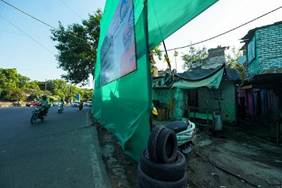
The 2023 G20 Summit hosted in Delhi repeated the pattern: roads and public spaces were renovated, flowers and fountains installed, murals painted, key routes transformed, while informal settlements near prominent routes and venues either faced demolition or were concealed behind large green curtains. The beautification drives ‘carried a price tag of $120 million’, which would help ‘showcase the world’s most populous nation’s cultural prowess and strengthen its position on the global stage’ (Lekhi & Nagpal, 2023). The BRICS Summit should thus not be seen as an isolated episode but as the latest moment in a longer process through which Delhi repeatedly reconstructs itself for international attention.
Delhi and the logic of Aesthetic Governance
Asher Ghertner’s concept of ‘rule by aesthetics’ (2015) is a useful lens here. Ghertner shows how aesthetic judgment increasingly becomes a basis for decisions about urban space, and how the question is no longer whether a settlement conforms to planning regulations or whether residents hold formal claim to land, but whether the space looks like it belongs to a world-class city. This shift matters because it lets informal settlements and livelihoods be treated as obstacles to the city’s visual and sensory image. A slum becomes a ‘nuisance’, a street vendor becomes an obstruction, a homeless person becomes undesirable, an informal settlement becomes an embarrassment along the route of foreign dignitaries.
The green curtains erected around settlements during the G20 Summit are perhaps the most literal expression of this logic: rather than transforming residents’ living conditions, the intervention simply transformed whether they could be seen at all. Poverty did not disappear. It was concealed. This distinction is the core of the argument: aesthetic governmentality does not eliminate poverty; it governs its visibility.
A city’s charisma, as Hansen and Verkaaik (2009) note, comes from its sensory qualities: architecture, roads, monuments, cleanliness, sound, and visual landscape. Delhi’s flowers, fountains, murals and renovated roads are part of manufacturing that sensory experience for visitors. But charisma has a negative side: certain sights, sounds and smells must be absent for it to hold. The spectacular city is therefore produced as much by what is eliminated from view as by what is added to it.
From Commonwealth Games to G20 to BRICS
Thirteen years after the Commonwealth Games, the G20 preparations followed a familiar script but sharpened it. Settlements and shanties in Janta Camp, Bela Estate, Tughlakabad, Mehrauli and parts of the Yamuna floodplain faced demolition and eviction, justified variously as ‘anti-encroachment’ action, environmental protection, heritage conservation, or the need to clear routes near summit venues. A report by the Concerned Citizens’ Collective documented the scale of displacement tied to G20 preparations (Mander et al., 2023).
But the more striking feature of that period was not demolition alone; it was concealment. Large green curtains were erected around settlements along key routes. Residents stayed where they were; their neighbourhoods were simply removed from the view of passing dignitaries. One resident, describing the logic, said the government did not want other countries to know there were slums in India (Baksh, 2024). This is the politics of visibility: the poor were not made absent from the city, but from its image.
The same tension has resurfaced with BRICS. Current preparations have focused heavily on sanitation, beautification, lighting, landscaping and the improvement of major roads and public spaces, and the New Delhi Municipal Council has explicitly framed these efforts around presenting a ‘clean, green’ capital to international delegates. Similar to what we saw during G20, curtains have again gone up outside informal settlements in South Delhi, and along the routes leading to the venue.
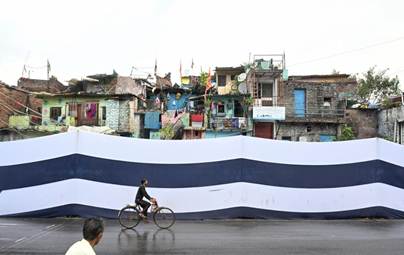
We need to note that not every BRICS-related intervention mirrors those during the G20 or Commonwealth Games. What gets repeated is the underlying logic: an international event intensifies the effort to manage the appearance, movement and experience of urban space.
Whose City, and at What Cost
What happens to the urban poor in this process cannot be reduced to a housing question. Gautam Bhan’s (2016) work on eviction, citizenship and inequality in Delhi shows how the language of ‘encroachment’ and ‘public interest’ delegitimises the claims of the urban poor. Once someone is categorised as an encroacher, their relationship to the city is reframed through illegality rather than citizenship, a reframing that especially manifests itself when their presence is treated as something the city must remove to make a good impression. The consequences extend beyond losing a home. Eviction also means losing proximity to employment, schools, social networks and established livelihoods. For street vendors and informal workers, the transformation of public space can directly threaten their ability to earn a living. During the G20, restrictions on movement and the removal of stalls affected workers whose income depended on being visible and accessible to passers-by.
And here is the contradiction the piece opened with: as Solomon Benjamin (2014) argues, the urban poor are not passive occupants of state-planned space but active participants who help produce the city through everyday negotiation and informal arrangement. Construction workers build its infrastructure. Domestic workers sustain its households. Street vendors feed its residents and workers. Sanitation workers keep its public spaces functioning. The very people whose labour makes the ‘world-class’ city possible are the people kept out of its visuals and its imagination when the city is placed on display.
A World-Class City, But for Whom?
Delhi’s experience with the Commonwealth Games, G20 and now BRICS suggests mega-events do not invent urban inequality or aesthetic governmentality from scratch. They intensify processes that already exist. What changes is the urgency with which the city must be made presentable. Each intervention produces a city that is cleaner, more orderly, more visually pleasing, and one from which certain forms of urban life have been excluded. The question is not whether Delhi can become world-class. It is what kind of world-class city is being produced, and for whom.
The spectacle Delhi builds for the world has a backstage, taken by those whose labour sustains the city and whose presence is repeatedly kept out of its curated image. The city does not become spectacular merely by adding flowers, fountains, lights and murals; rather it becomes spectacular when certain realities can no longer be seen. Perhaps that is the central contradiction of Delhi’s world-class imagination: the more spectacular the city becomes, the more systematically it must make some of its inhabitants invisible.
References:
Baviskar, A. (2014). Dreaming big: Spectacular events and the ‘world-class’ city: The Commonwealth Games in Delhi. In Palgrave Macmillan UK eBooks (pp. 130–141).
Benjamin, S. (2014). Occupancy urbanism as political practice. In S. Parnell & S. Oldfield (Eds.), The Routledge handbook on cities of the Global South (pp. 309–321). Routledge.
Bhan, G. (2016). In the public’s interest: Evictions, citizenship and inequality in contemporary Delhi. Orient Blackswan.
Ghertner, D. A. (2015). Rule by aesthetics: World-class city making in Delhi. Oxford University Press.
Greene, S. J. (2003). Staged cities: Mega-events, slum clearance, and global capital. Yale Human Rights and Development Journal, 6(1), 1–16.
Hansen, T. B., & Verkaaik, O. (2009). Introduction: Urban charisma. Critique of Anthropology, 29(1), 5–26.
Lekhi, R., & Nagpal, P. (2023, September 4). New Delhi got a makeover for the G20 summit. The city’s poor say they were simply erased. AP News. https://apnews.com/article/india-g20-new-delhi-poor-9d449f133d5ed0aa8855ee65485ce873
Mander, H., Pallical, B., Philipose, P., Panwar, T. S., & Yagnik, A. (2023). The forced evictions across India and G20 events. Concerned Citizens.
***
Sanya Sharma has pursued an MA in Sociology at the Department of Sociology, Delhi School of Economics (DSE), University of Delhi.