
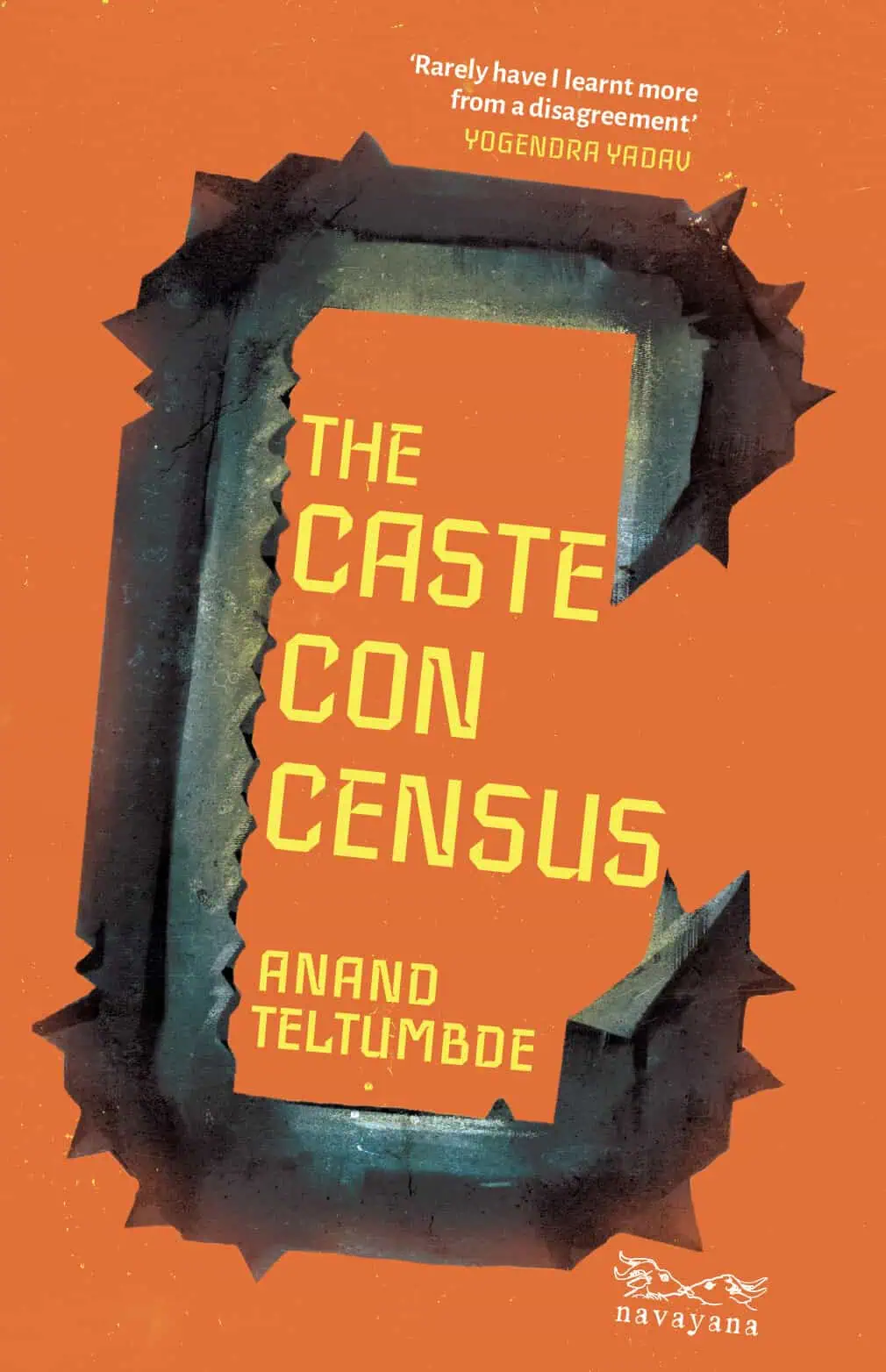
The 2027 decennial census will include caste-based enumeration beyond Scheduled Castes and Scheduled Tribes for the first time since 1931. Activist groups have long called for this exercise to expose socioeconomic inequalities and develop targeted welfare schemes in India. It has also been a key demand by state governments such as Bihar, Jharkhand, Odisha and Karnataka for facilitating an empirically grounded assessment of existing provisions on affirmative action. As crucial as this exercise sounds, what does the necessity of enumeration, as a governing procedure, reveal (or rather, conceal) about the institution of caste? Further, why did the Bharatiya Janata Party (BJP) shift its stance on the issue after years of opposing it on ideological grounds? These are the two primary questions around which Anand Teltumbde’s timely intervention, The Caste Con Census (published by Navayana in 2025), is set.
Since 1951, the independent Indian state has continued the decennial census begun by the British in 1871. In 1881, the British imperial government undertook the first synchronous census to identify, enumerate, and classify the Indian population by religion and caste. Viewing this exercise as an extension of the colonial logic of dividing the subcontinent into measurable and governable subjects, Teltumbde was one of the first to question the ideological underpinnings and the feasibility of a similar enumerating principle for a 21st-century census. Published in November 2025, The Caste Con Census stands out for three main reasons. First, Teltumbde’s longue durée approach to caste brings together a range of historical scholarship in conversation with contemporary journalistic discourse on caste; second, his scrutiny of caste-based enumeration with regard to historical precedents is rare in the tide of popular non-fiction; and finally, his cynicism and controversial disagreement with the inclusion of caste in the 2027 census is provocative within circles of social activism.
The text begins by challenging the idea of caste as a solely religious doctrine, highlighting its economic and political foundations. Tracing its roots to ancient Indian political practices and its subsequent development through Brahminical co-option, Teltumbde highlights how caste developed differently across regions in response to distinct material conditions. He draws from numerous archival and secondary texts on caste and religion to shed light on its deep entanglement with the subcontinent’s political economy and class structure. In doing so, he establishes his distance from Ambedkarite thought, which almost exclusively colours anti-caste activism in India. He builds a case for it by elaborating on the limitations of emancipatory paths provided by religious conversions in the first few chapters of the book, highlighting the persistence of caste in the face of Shramanic resistance (Buddhism and Jainism), Islam, and folk movements influenced by Bhakti and Sufi thought. He points to their strengths in challenging the Brahminical discourse on purity and hierarchy, but emphasises their respective material entanglements with caste, which inhibited them from annihilating it.
He then traces the development of caste as a social category through early-modern and colonial practices of enumeration – foregrounding how enumerating exercises have historically resulted in the crystallisation of relatively fluid social demarcations. He builds substantially on differing strands of historical scholarship on caste which include the colonial historiographers (C.A. Bayly, Bernard Cohn, Nicholas Dirks, Susan Bayly), the Subaltern collective, and the Ambedkarite Tradition (Gail Omvedt, Raghavendra Rao and K. Satyanarayana). In doing so, he establishes an academic anchor to his analyses, which very few commentators on the census have done so far. This section also marks the beginning of his sustained critique of India’s reservation policies. Consistent with his earlier work, Republic of Caste (2018), he argues that annihilation of caste is impossible as long as it is naturalised as the sole basis for redistributive social justice in the modern state. This is also where his cynicism regarding the upcoming census begins to take shape. Instead of acting like a springboard for social reforms, he highlights the possibility of caste data becoming a managerial tool for undermining reparative justice altogether.
At this juncture, midway through the book, he moves away from the chronological development of caste enumeration to a rigorous survey of caste-conscious politics in India. Beginning with a critical examination of the recommendations by the Mandal Commission in 1980, his core argument in this section is thus: redistributive policies can only sit on a universalist framework that addresses unequal access to land, education, healthcare, and income. In an absence of a material foundation ensuring substantive equality, he illustrates the inevitable appropriation of reservation policies by the ruling classes, and the subsequent reproduction of inequality with minor accidental disruptions. His reading of Mandal politics, the implications of OBC reservations, and the rise and compromises of Bahujan political parties in India’s larger electoral politics, then, cogently turns into an elaborate apprehension towards the BJP-led government’s sudden announcement of caste-based enumeration. Rather than viewing it as a victory for decades-long social advocacy, he fears it to be a potential Trojan horse that could ultimately undermine constitutional provisions intended to advance social justice.
Surveying the ruling party’s use of data politics as a key tool for building narratives since 2014, Teltumbde elaborates on the well-trodden mechanisms the party can potently use to abolish caste-based reservations or deem them ineffective. He highlights how the original logic of reservations as a tool for social justice has already been overturned through the introduction of reservations for Economically Weaker Sections (EWS) in 2019. Thus, the legal provision through which census data can be used to introduce multiple ‘creamy layers’ and subfactions already exists. This can, he argues, aid the ruling majoritarian party to tailor policy benefits around specific groups, further consolidating its electoral dominance and weakening the opposition’s influence.
The second half of the text reads almost prophetically amid the ongoing campaign ‘Reservations Hatao Andolan’ (hereafter, RHA), where the demonstrators are ostensibly supporters of the ruling party. Closely following the organisational and protesting strategies of the Cockroach Janata Party (CJP) for educational reforms in July 2026, the RHA took to platforms like X and Instagram to call for reforms in reservation policies. The spokespersons demand more weight on economic conditions, subcategorisation through the creamy-layer criterion, and conflation of EWS with the Scheduled Castes category to equalise provisions across caste lines. (Hindustan Times, 2026) Besides reflecting disturbing caste-based prejudices, it also demonstrates a complete misunderstanding of the social goals of reservations, and misdirected anger among the upper-caste youth. It also aligns significantly with Teltumbde’s calculated warning on the direction post-census policy interventions could take. Crucially, however, it affirms his analysis of the narrative and structural weaknesses inherent in India’s reservation policies in the absence of effective capacity building.
The strength of Teltumbde’s work lies in its methodological rigour, shaped by earnest cynicism and followed through with an honest scrutiny of assumptions most academic-activists take for granted. However, he abruptly departs from this approach in the final section of the book, where he outlines possible solutions to reservation’s shortcomings through a scoring system. He proposes a “reservation usage score” to rank a candidate’s claim to a quota, which deviates significantly from the questions he begins the monograph with, falling back on the logic of elimination instead of inclusion. From a narrative perspective, it limits the critical stance that was taken in the preceding chapters. While the polemical thread of the book seemed to be an apprehension regarding the future of skewed data politics in India, the immediate aftertaste is, perhaps unintentionally, oriented around cursory reservation reforms.
In conclusion, the book’s insistence on examining the material foundations of caste and contemporary data politics makes it an indispensable contribution to the discourse on affirmative action. Rarely does an activist engage so sportingly with diverse and opposing schools of thought, and synthesise their work into a coherent and accessible treatise. The gaps in his proposed solutions invite questions that would undoubtedly enliven further debate on the topic, which ultimately serves the purpose of the book — to engage with caste in all its complexity instead of reducing it to a static category.
References:
Hindustan Times. (2026, August 22). ‘Reservation Hatao Andolan’ protesters say govt agreed to talks on reform, clarify movement is ‘not over yet’. https://www.hindustantimes.com/india-news/reservation-hatao-andolan-protesters-say-govt-agreed-to-talks-on-reform-clarify-movement-is-not-over-yet-101787397684800.html
Teltumbde, A. (2018). Republic of caste: Thinking equality in the time of neoliberal Hindutva. Navayana.
***
Bihan Bandyopadhyay holds an MA in English from the University of Hyderabad. She is broadly interested in contemporary culture and politics, and academically inclined towards critical posthumanism and visual culture.