

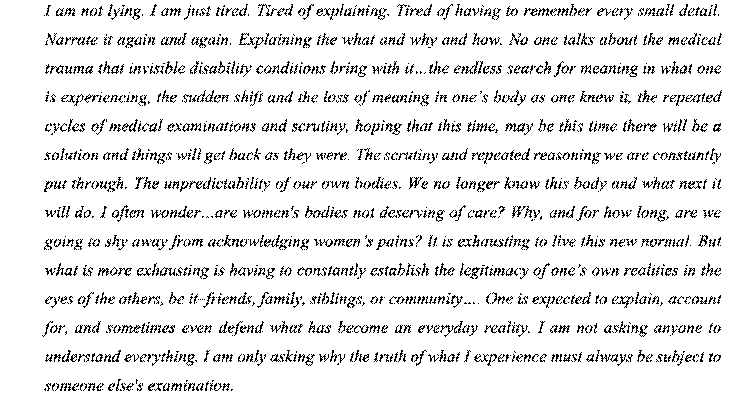

Invisible disability, also known as hidden or non-visible disability, refers to physiological, neurological, neurodivergent, cognitive, psychosocial, chronic, sensory, or autoimmune conditions that may not have visible markers but can significantly shape, limit, or challenge a person’s movement, activities, and ways of being in the world. Such conditions become disabling not only because of impairment but due to structural, institutional and socio-cultural barriers that restrict access to life opportunities, participation in the public sphere, and recognition of differences and accessibility needs. What is at stake here is not diagnosis but ‘recognition’ of how social life is organised around what can be seen, verified and consistently performed. Living with an invisible disability thus means carrying a story that is constantly misread. In the absence of visible signs of vulnerability, the narratives of experiencing life as a person with invisible disability are often contested, as the world continues to treat their bodies as stable, uncomplicated, and reliable instruments. The burden to prove one’s realities quietly settles on one’s own shoulders. Pain must thus be narrated again and again to be believed, fatigue justified, and limitation continually negotiated. Misrecognition and disbelief become routine features of everyday life. This routine dismissal often operates as a form of epistemic unfairness—as analysed by legal scholar and activist Amita Dhanda in the Indian context—where the individual’s subjective testimony or knowledge of their own bodily reality is systematically stripped of credibility by an ableist social order demanding visible evidence.

At first, individuals may resist the labels of ‘disability,’ convincing themselves that nothing is different. But the body insists. On certain days, ordinary activities like standing in a queue, climbing stairs, completing daily chores, or even sustaining conversations demand an unanticipated amount of energy. One often falters in understanding one’s own needs and capacities, as a dissonance arises between what is externally visible and what is internally felt. Everyday life becomes a landscape where one’s sense of self is constantly renegotiated, as one translates their experiences for others in the hope of recognition, while still trying to make sense of it for oneself. Over time, this persistent labour of explanation subtly reshapes how one imagines oneself—one’s selfhood. Identity gradually begins to shift, shaped by an acute awareness of pace, boundaries, rest, and support, as one learns to negotiate their needs and limitations.
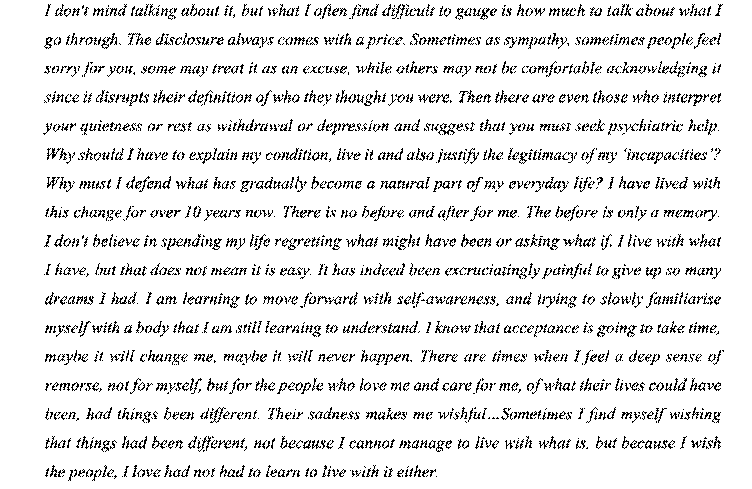
These shifts, however, are not failures; they make us imagine ourselves not despite the disability, but through it. Perhaps the most critical shift that occurs is in how we perceive control. Plans become tentative, routines require adaptation, and ambitions get moderated by uncertainty, while rest is often accompanied by guilt and an urge to be over-productive. Family, friendships, romantic relationships, and work environments often emerge as ableist spaces that rarely recognise the emotional labour of persons with invisible disability to simply appear ‘normal.’ Unsolicited medical advice becomes a generic part of conversation, as one is repeatedly labelled lazy, tired, rude and restless, disinterested, and unambitious, while some even recommend psychiatric intervention. Such misrecognition can be perilous to one’s dignity, voice and self-esteem, continually undermining the legitimacy of one’s sense of being. An inexplicable rage begins to take root, not only in response to external expectations, but also in the struggle to comprehend and articulate what has changed within oneself.
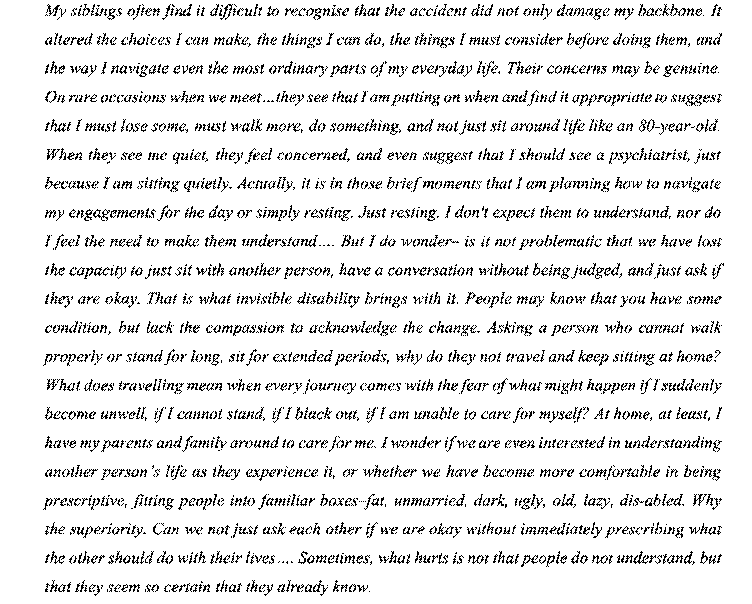
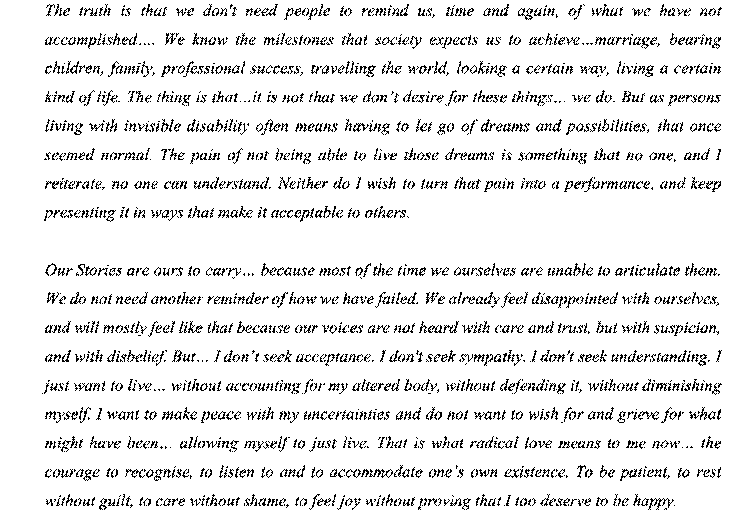
Living with an unpredictable body therefore demands a surrender that is neither defeat nor passivity. It requires an intimate recognition of both endurance and interdependence on medication, care, support networks, and the generosity of others. This recognition unsettles dominant ideals of independence and self-sufficiency. Gradually, with time, the questions one seeks to address also begin to shift–from ‘What is wrong with me?’ to ‘What new ways of being are possible for me?’ We learn to value slowness, recognise resilience in quiet forms that may not appear heroic, and appreciate days that are simply steady. However, moving through this terrain requires sustained kindness towards the self, enabling one to navigate self-doubt, guilt, judgement, and social dismissal, and to simply be. Within this endurance, radical love begins to take shape, not as a sentiment, but as a politics for survival, forged through uncertainty, constraints, and persistence.
This is where radical love emerges, not as an abstract ideal or a sentimental expression of self-love, but as a personal politics of living and survival—an ethic of care rooted in patience, gentleness, and belief. It begins with a difficult decision to stop treating oneself as a problem, a willingness to learn to listen to one’s body when the world refuses to, to honour one’s limits in a culture that equates worth with relentless endurance, resisting the internalisation of doubt. As we begin to learn about ourselves more closely than before, our journey towards accepting the invisible begins. Embracing the invisible as a legitimate and generative part of one’s identity brings a quiet, enduring liberation. But this liberation demands courage—the courage to assert one’s authorship of one’s self, one’s dignity, and faith in the credibility of one’s own narrative, without seeking legitimacy through external validation. Silence, in this context, becomes an act of self-preservation and quiet resilience. Radical love, here, becomes a quiet refusal to accept that one’s will must be established through conformity, productivity or independence.
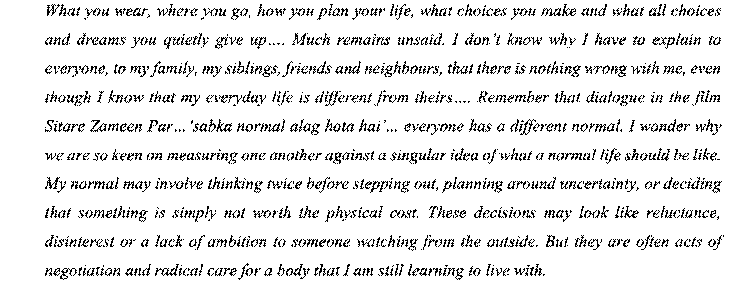
Invisible disability can thus become a lens to reframe what we value, how we engage with people – relationality – and how we understand ourselves. Living with an invisible disability challenges one’s sense of being, in a society that is often incapable and unwilling to recognise and accommodate diverse disabilities. Such experiences deepen one’s sensitivity to hidden struggles and develop scepticism toward simplistic narratives of strength and success that presume consistency and performance. Yet invisible disability remains inherently paradoxical; it grants privacy while denying recognition. Conditions that are visible are readily acknowledged, while what cannot be easily seen is often doubted, questioned, trivialised, or stigmatised. The struggle, therefore, is not only to live with impairment but also to assert the legitimacy of one’s experiences in a world structured around predictability, efficiency, and performance.
The Social Grammar of Visibility
Social life relies on legibility and performance, creating stable and coherent narratives of the body and mind that conform to predictable scripts of human existence. These scripts privilege bodies that appear dependable, readable, and capable of consistent performance, shaping social expectations about how individuals should appear, behave, and function in social contexts. Invisible disability disrupts these expectations when capacities fluctuate, generating frictions in everyday interactions and destabilising dominant frames of interpretation that rely on coherence and control. Bodies and minds that fail to conform to these norms are rendered unreliable within prevailing social grammars of disability, revealing how inclusion is structured around visibility rather than accommodation of diverse disabilities.
These grammars of visibility also operate within formal institutions like educational institutions or workplaces, and permeate intimate and relational spaces. Within families, fluctuating capacity is often interpreted as exaggeration or moral weakness, while friendships may strain when fatigue or withdrawal is misread as disinterest or unreliability. Romantic relationships can become sites where care is unevenly distributed, and desirability is often tied to consistent emotional availability and bodily performance. In each of these spaces, love and acceptance become conditional upon legibility. Educational institutions, including schools, colleges, and universities, reinforce norms through rigid attendance requirements, standardised assessments, and expectations of sustained participation, while workplaces privilege the ‘ideal employee’—constantly available and unfailingly productive. These rigid structures actively penalise what disability theorists like Alison Kafer refer to as ‘crip time’, i.e., a non-linear temporality of unpredictability, speed, rest and fluctuation that sociologists like Renu Addlakha remind us is routinely pathologised by institutional architectures and social systems built exclusively for uncompromised speed, ‘ideal bodies’ and standard output. Disclosure of an invisible condition in such settings carries the risk of disbelief, stigmatisation, infantilisation, stalled progression, or subtle exclusion. Non-disclosure, on the other hand, demands continuous masking and silent endurance of environments and behaviour hostile to fluctuating capacities. The exhaustion and burnout that follow from negotiating with such systems are not personal failings, but predictable outcomes of institutions that are not responsive to diverse capacities.
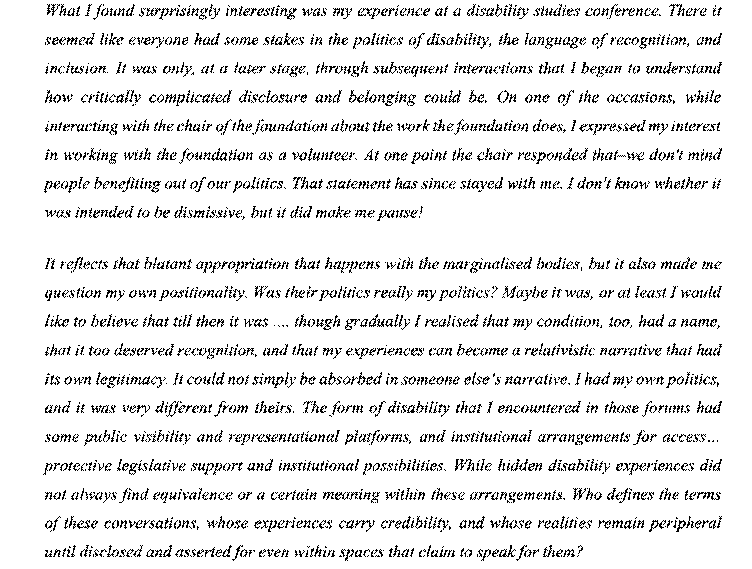
In the Indian context, these norms get further reinforced through the bureaucratic frameworks of documentation and certification that readily label or recognise disability when it is visible, stable, and can be classified under pre-determined categories. While legal frameworks like the Rights of Persons with Disabilities Act, 2016 provide formal recognition and enable access to life opportunities, their reliance on certification often prioritises measurable impairment over lived realities, thereby, as Indian disability scholars like Nilika Mehrotra and Nandini Ghosh argue, obscuring meaningful differences in experience and needs. Such norms structure everyday interactions, while fostering disbelief and disciplining bodies that do not conform to established categories. These dynamics are also shaped by the intersectionality of social identities—gender, caste, class, sexuality, ethnicity, culture, region, and other layers of identity, which intensifies marginalisation for those navigating multiple axes of exclusion; further complicated when individuals experience multiple disabilities.
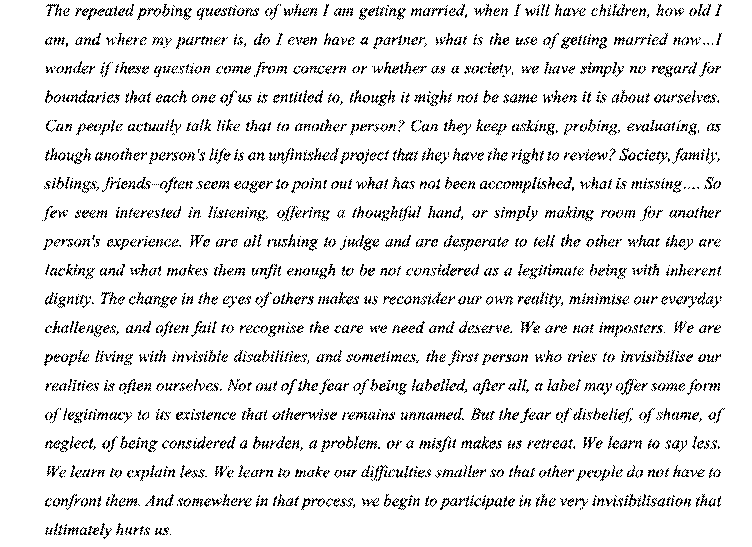
Invisible disability thus challenges not only the narrow definitions of ability, but also the cultural grammar through which society understands the diversity of human bodies, minds, care and support. It emphasises belief without spectacle, care without proof, and accommodation without guilt, rejecting productivity, visibility, and consistency as measures of human worth. The politics of recognition must thus move beyond what is legible to the eye, towards an ethics of care that is responsive to differences, and grounded in belief and human dignity. This reframing aligns with the critical interventions of South Asian scholars like Nilika Mehrotra and Nandini Ghosh, who urge us to look at embodiment not as a site of bureaucratic classification, but as an ongoing relational space of interdependency. The quiet labour of invisible disability does not seek admiration for resilience and endurance, but socio-cultural, institutional, relational (community willingness) and infrastructural change, and a reimagination of love—as a radical, sustained practice. Its politics insists that softness is not fragility and dependence is not failure, but rearticulates how we imagine strength, care and social living.
Note:
This essay seeks to communicate the exhaustion of having to explain oneself, the loneliness of being misunderstood by people who care, the quiet grief of an altered life, and the discomfort of finding that even spaces intended for disability recognition can reproduce their own forms of exclusion. It is an appeal to the world to judge less, to pause, to see, and, above all, to listen with the intention to understand.
The term invisible disability is used in this essay to refer specifically to disabilities that are not readily apparent to others and are often neither recognised nor acknowledged as disabilities. The usage of the term invisible disability does not intend to suggest that other forms of disabilities are inherently visible, nor does it imply that invisibilisation is exclusive only to disabilities that are hidden. Invisibilisation is a wider social experience through which disabled persons, their identities, everyday experiences and voices are often overlooked, misunderstood or excluded from dominant narratives. The essay does not claim to represent or speak for the entire disability community. It rather offers a reflection of one of the forms or dimensions of lived experience within the wider landscape of diverse disability experiences.
References:
Addlakha, R. (2008). Disability, gender and society. Indian Journal of Gender Studies, 15(2), 191–207.
Butler, J. (1993). Bodies that matter: On the discursive limits of “sex”. Routledge.
Crenshaw, K. W. (1989). Demarginalizing the intersection of race and sex: A Black feminist critique of antidiscrimination doctrine, feminist theory, and antiracist politics. University of Chicago Legal Forum,1, 139–167.
Dhanda, A. (2007). Legal capacity in the Disability Rights Convention: Stranglehold of the past or lodestar for the future? Syracuse Journal of International Law and Commerce, 34(2), 429–462.
Freire, P. (1970). Pedagogy of the oppressed (M. B. Ramos, Trans.). Continuum.
Ghosh, N. (Ed.). (2016). Interrogating disability in India: Theory and practice. Springer.
Goffman, E. (1959). The presentation of self in everyday life. Anchor Books.
Government of India. (2016). The Rights of Persons with Disabilities Act, 2016 (Act No. 49 of 2016). Ministry of Law and Justice. https://www.indiacode.nic.in/bitstream/123456789/8859/1/a2016-49disableact2016.pdf
Kafer, A. (2013). Feminist, queer, crip. Indiana University Press.
Mehrotra, N. (2011). Disability rights movements in India: Politics and practice. Economic and Political Weekly, 46(6), 65–72.
Nussbaum, M. C. (2006). Frontiers of justice: Disability, nationality, species membership. Harvard University Press.
Taylor, C. (1994). The politics of recognition. In A. Gutmann (Ed.), Multiculturalism: Examining the politics of recognition (pp. 25–74). Princeton University Press.
***
Anuradha Bose holds a PhD from the National Institute of Educational Planning and Administration, New Delhi. Her research interests include diversity and inclusion, higher education policy, human rights, and questions of identity and lived experiences. Email: anuradhabose.2025@gmail.com