
Situating the ugly and the bizarre within a framework of the pleasing and the attractive has always been a matter of acute contestation and provocation, in art as well as in life. The fascination with aesthetics has found its expression typically in philosophical and theoretical exegesis over the course of human history while parallelly, human preoccupation with departures from normatively demanding standards of beauty and acceptability has been pervasive and tellingly judgmental. Modifying Gilles Deleuze and his striking body of work on art and aesthetics, we may find the symbols of beauty and ugliness to be ‘operating through a double gesture of isolation and generation, of abstraction and generalisation’. The witch as a figure is one such powerful visual, with a ‘cluster’ of sensory attributes about it, dominating human imaginaries and attendant constructions of the societal, at once threatening and in need of being subjugated. One might indeed discover that an academic study on witches is as much about the ‘domesticated’ and the ‘normal’ as it is about its antagonistic imagination, namely the witch.
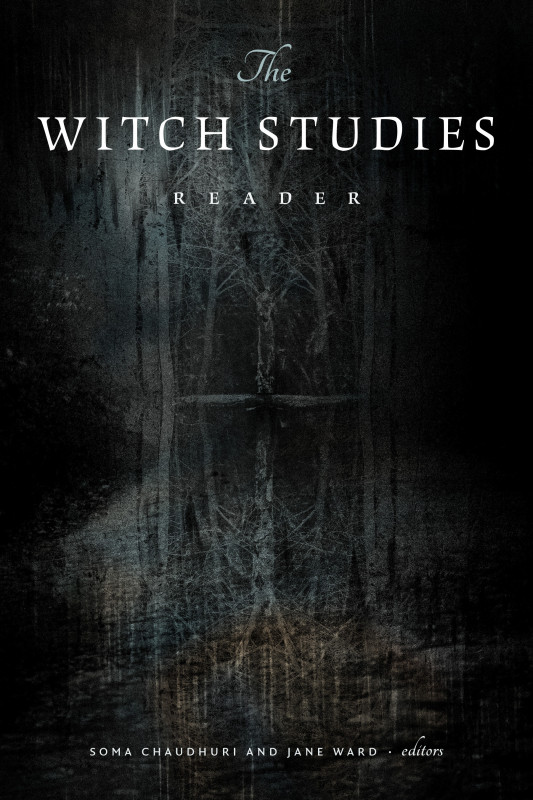
The Witch Studies Reader, edited by Soma Chaudhuri and Jane Ward (Duke University Press, 2025), divided into six parts spanning thirty-two chapters, is a remarkable volume in its approach, methodology, and scope. With an ominous-looking book cover, emitting the vibes suited to the mood of the chapters, it is without a doubt the most comprehensive examination of the field from diverse and divergent points of view, covering both extensively and in depth the numerous nuances, heuristic referents, significations, and implications of the figure of the witch as a cultural symbol, as an empirical lived experience, and above all, as an epistemological conduit of resistance, transgression, redefinitions of aesthetics and reimaginations of political sensibilities.
Introducing the book and the academic field of analysis, the editors, suggestively terming it ‘Manifesting Witch Studies’, are, indeed, unique in terms of their personal and intellectual proximity to the theme at hand, declaring, ‘manifesting ’, to use a contemporary expression, at the outset that they are both ‘obsessed with witches’. They amuse the reader by confessing that ‘scholars and witches are sometimes the same people’, and because witches ‘loom large’, they keep ‘suppressed knowledges’, manifest ‘new futures’, generate new theories and praxis. The volume goes on to demonstrate this pursuit and this hidden but omnipresent reality.
Four chapters in Part I titled The Colonial Encounter bring to light the historical sources of witch practices. The respective authors clarify how the violence and trauma of colonial conquests dominate the emergence of witch ‘stories’ and how non-mainstream categorisations of the feminine are an inevitable part of how the South has come to be subjugated. Discursive questions of identity and ideas of life and living are aplenty in these narratives, even as witchcraft comes to be pursued as an effective form of resistance to colonial domination.
The last part, titled Witch Epistemologies, consists of five chapters and the reader may discern some thematic continuity with the first part. From Ruth Charnock to Marion Goldman, scholars posit the centrality of witch studies to a feminist future with strong queer overtones, a line of academic thinking which can effectively call into question the knowledge-power nexus of patriarchy and capitalism. In this sense, witchcraft can be a powerful form of a manifesto, laying down the outlines of a substantive alternative to present binaries of identities, modes of action, and conceptualisations of praxis.
Part II, consisting of seven chapters and called Lineages of Healing, is a section which is filled with potentially rebellious voices. Being able to ‘live well in the universe’ and ‘transform domination’ despite the overarching structures of oppression is the common thread of the chapters here. Looking at Black Witch networks hidden in indigenous heritages and a variety of magical practices in different parts of the world, these chapters assert that healing wounds is a process of self-definition and self-identification.
Five chapters in Part III continue the discursive strand differently as they examine Killing the Witch. As the title reveals, this part is about the relentless instances of violence and terror inflicted upon the feminine prototype of the witch and the witch-like. Gruesome incidents of marking deviant bodies and thereafter carrying out these acts of willful destruction operate within a rigid framework of norms, a sense of collective wellbeing, self-custodianship and so on. From India to Tanzania, this is common and socially accepted.
Part IV comprises seven chapters and is called Art, Aesthetics, and Cultural Production. This is arguably one of the most analytically dense parts of the book, establishing how the alternative world of witch art and culture makes it possible for the reader to interrogate given critiques as well, and look beyond the hegemony of both the ‘normal’, the legitimacy of the Anthropocene, as well as the streamlining of the existing body of critiques to it, operating within the same oeuvre of assumptions and predictions of human predominance and control over the non-human world. The world of music and literature fits into this discussion in remarkably interesting ways.
Four chapters in Part V titled Protest and Reclaiming cover the theme from an interesting perspective which necessarily slides into feminist studies of diverse kinds. Defiance is the mood of the writings here; shock therapy seems to be the logical way out of the stigmatisation that has always been imposed upon figures of difference. While one of the chapters (Carolyn Chernoff) bases itself on the group which goes by the acronym WITCH, with its clear roots in anti-patriarchal movements, two other chapters create a celebration around ‘debased femininity’, loving its ‘ridiculous’, ‘messy’, ‘hysteric’ forms (Tina Escaja and Laurie Essig), and engaging in learning ‘practical tools for practical magic’ in a witch school (Jacquelyn Marie Shannon). The purpose of all these chapters is palpable. They wish to utilise the image and the reference of the witch to make a point, to drive through an argument, to raise a storm, to spread discomfort. Captioning a chapter ‘We Are All Witches’ takes this political programme further ahead. Bernadette Barton rejoices in being a Wiccan, in announcing it to people, in breaking stereotypes, and in embracing paganism in multiple ways through one’s lived experiences. Intersectionality, openness towards trans forms, and so on constitute some of the striking aspects of these four chapters. In effect, they help us redefine feminist studies through this lively and academically honest contribution to the field.
In sum, witch studies as a practice is one which is, given its essential nature, coded into multiple parole and langue frameworks, to use Barthesian terms, but not codified, or accommodated into comprehensible terms of acceptance and rejection, or modification and negotiation. Extending itself from familiar feminist theory circles, it becomes a distinct line of academic and phenomenological inquiry in itself, raising its claims to being recognised in its own right.
***
Prothoma Rai Chaudhuri teaches Political Science at St Xavier’s College, Kolkata, and reads and writes on several interdisciplinary themes including urban studies, biopolitics, cultural studies, and ecoliterature, and writes fiction, for which she has been nominated thrice for prizes, under the name of Shrutidhora P Mohor. Her academic research and works of fiction have been published nationally and internationally.