
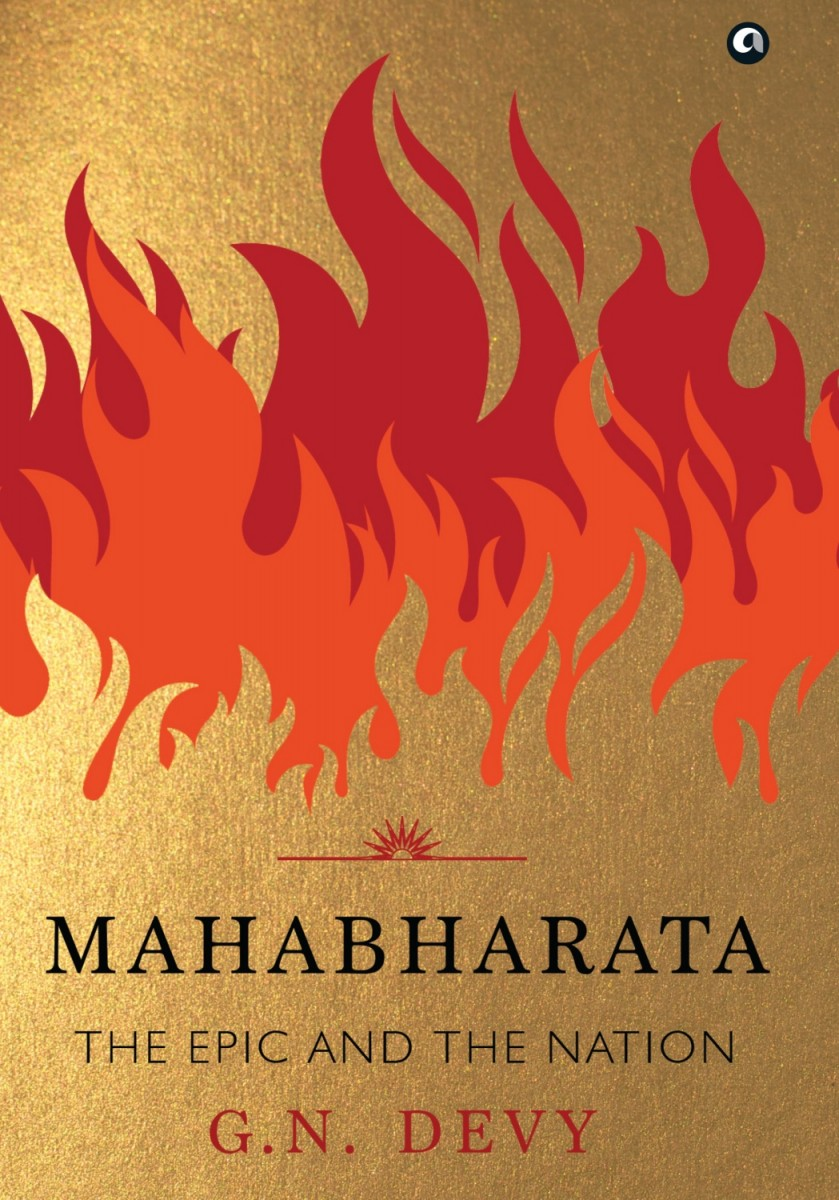
G. N. Devy’s Mahabharata: The Epic and the Nation (published by Aleph Book Company in 2022) explores the reasons for the epic’s hold over the Indian subcontinent for more than two millennia. The book is divided into two parts or chapters, the first of which is titled ‘The Epic Quest’. He begins the chapter by comparing the importance of the Mahabharata with that of epics from different parts of the world and from different epochs. But the popularity of the Mahabharata epic surpasses that of all of them for the reason that, after the advent of industrialisation in Europe in the 18th century, the connection of people with their epics was eclipsed. The age of epics was replaced with the age of modern sensibilities, where modern novels and poems were the accepted modes of literature. In the Indian context, even after the introduction of print capitalism during the colonial period, the epic Mahabharata was never considered outdated. On the contrary, Devy views the high point of engagement with the epic in India as occurring during the colonial period, as many spiritual, social, and political leaders engaged with it to draw their own conclusions.
Devy finds its answer in the distinction between the Mahabharata and the religious texts of its time. While the religious texts engaged with metaphysical philosophies and questions, the Mahabharata kept itself mostly away from these questions. The epic was indeed written between the 3rd and 1st centuries BC in the later Vedic period, just as texts like ‘Manusmriti’ were. But while Manusmriti was an exposition of a socio-religious nature which propounded different rules for keeping Indian society under a ‘Chaturvarna’ system, the Mahabharata was mostly silent on this aspect. According to Devy, this distinction made the Mahabharata accessible to all non-Brahmin classes who were earlier excluded from reading the Vedas and Upanishads.
The reason that Devy puts forth for the Mahabharata’s shying away from engaging in the caste question was that the epic’s actual existence preceded its written version by many centuries. The epic had started circulating in the Indian subcontinent since the beginning of the first millennium BC, or around 1000 BC. It used to be orally recited by the ‘Sutas’, who were bardic poets. Their audience could be from every class, as there were no Brahminical rituals associated with the recitation of the epic. Earlier, it was known as ‘Jaya-Itihas’ (History of Triumph) or ‘Bharata’. The composer of the latter Mahabharata, which is generally ascribed to Ved Vyasa, had to keep his allegiance to the original narrative of the epic. Hence, he did not superimpose the discourse on caste or Varna of his times onto the narrative of the Mahabharata.
In the second part of the book, which is titled ‘The Wheel’, Devy shifts his attention to understanding the fundamental purpose of the epic. The way the past is constructed in the epic is a point of fascination for him. The different approach of the epic to ‘Remembering the Past’ gives him a tool to understand the epic’s uniqueness. First, he connects the symbol of ‘Chakra’ (Wheel) from within the epic to the outside secular world, where the invention of the wheel and its coming into the Indian subcontinent had a huge impact on the psychology of people. Then he explores the meanings that this symbol represents in the Mahabharata. According to Devy, the wheel or Chakra represents time and its circular nature. The character of ‘Yama’ is represented as both the God of death and the timekeeper in the epic. As per Devy, time is the concept around which the epic revolves. Rather than anything else, the justification of ‘Kala Chakra’, or the continuity of time, is the philosophical purpose of the epic.
Through this continuity of time, the composer of the Mahabharata reconstructs the past for his audience. This method of remembering the past is not historical but mythical, and has no beginning and no end. The time never stops. This is why, even after the end of the war of ‘Kurukshetra’, the narrative of the Mahabharata keeps going on. For Devy, the epic does not hold its power over the imagination and consciousness of people for such a long time because it is a treatise on philosophy or religion. Instead, it gives a different method to people to remember their past. The past does not always have to flow as a sequence of causal events and their consequences. The epic deploys many supernatural mythical tools to perpetuate the narrative instead of resorting to causal explanations for justifying historical events. This gives its readers several possibilities to remember their own cultural and social histories. This is why people belonging to all classes have kept going back to the epic for generations and used it to imagine their own world views.
Devy in his work is consistent in showing that the epic that he is engaging with is a part of the common social world of Indian people. He does not view the Mahabharata solely as a religious text. Instead**, he views it** as a text that encapsulates the history of ‘pre-history’ (the period before Buddha) in India in its own way. Likewise, Devy wants to judge the popularity of the epic based on its utility for people. But the problem is that he is not able to explain how the Mahabharata is completely insulated from the feelings of religiosity or sacredness of common people. As quoted above, he himself admits that the epic became a substitute for the religious texts for those who were earlier denied access to them. So, there is a high possibility that people not only viewed the epic as a literary marvel but also as an important text in their religious domain. Despite this possibility, Devy never takes this aspect into account while exploring the reasons for the Mahabharata’s influence and popularity in Indian society. Also, the epic uses religious myths such as the incarnations of different gods from the Hindu pantheon to carve out its own characters. The purpose behind this could be to provide a religious sanction to the epic, which has worked successfully, more or less. Hence, the distinction that Devy makes between the Mahabharata and other religious texts has some lacunae, which he just glosses over.
One of the important claims of Devy regarding the Mahabharata is that it does not vehemently justify the caste structure of Indian society. He has quoted Dr B. R. Ambedkar’s valid criticisms of the Mahabharata from his famous work, ‘Annihilation of Caste’ (1936). Somehow, he answers those criticisms by resorting to the argument that caste is mentioned only at a few moments in the epic. One of those moments is when, in the ‘Bhishma Parva’ (one of the 18 Parvas into which the epic is divided), Arjuna is engaged in a conversation with Krishna. Here, Arjuna expresses his fear of the ruin of his clan, which involves the intermixing of different castes. But the narrative also has many points where rigid caste boundaries are subverted. For example, the characters of Kunti, Krishna, and Subhadra are said to belong to the ‘Yadava’ clan or caste, but they are all in familial relations with the Pandavas, who are the ‘Kshatriyas’. This can be a valid argument. But Devy seems to overlook some of the episodes in the Mahabharata where caste is nakedly present. The episodes involving the characters of ‘Eklavya’ and ‘Karna’, where they are discriminated against on the basis of their birth into non-Kshatriya Varnas, are not mentioned by Devy. This could be an intentional or unintentional omission on his part, but these episodes go against his claim that the epic has only a feeble defence of casteism. Hence, the Mahabharata also shares the justificatory logic with other Hindu religious texts about the caste structure of Indian society.
Devy’s Mahabharata: The Epic and the Nation is an important work of literary and social inquiry into the relations between Indian society and one of the greatest epics ever written. It opens doors for new research and commentaries on the Mahabharata, as it does not just engage with the meaning of the text, but it also engages with questions relating to its existence, influence, and its hold over the imagination of the masses for more than two thousand years. More scholarly works on these aspects will surely help us understand the significance of epic culture for our society in a better way.
***
Kislaya Priyadarshi is a research scholar at the Department of Political Science, University of Hyderabad.