
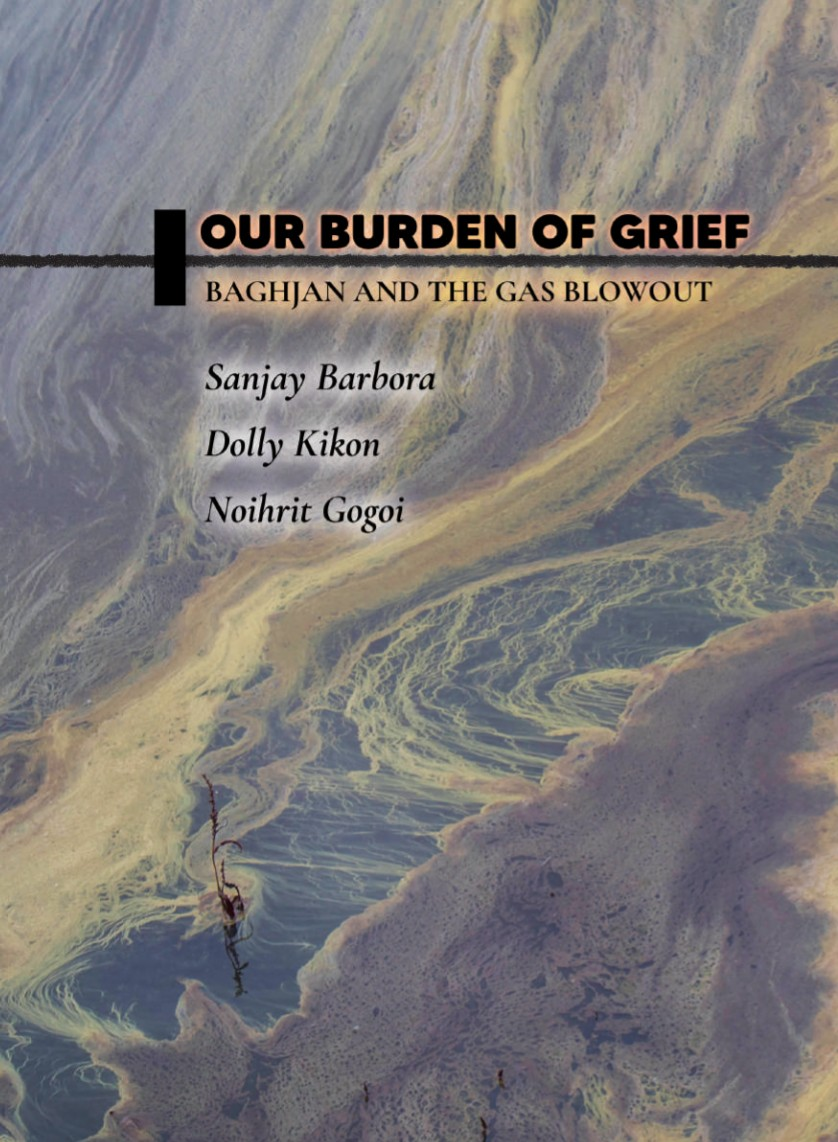
On 27 May 2026, the Baghjan Blowout in Tinsukia, Assam completes six years. Reading Our Burden of Grief: Baghjan and the Gas Blowout, written by Sanjay Barbora, Dolly Kikon, and Noihrit Gogoi (published by North Eastern Social Research Centre in 2025), can remind one of the lived precarities of people, places, and planetary beings in proximity to the oilfields and plantation worlds. The book reminds us how swift it is to shift the focus from accountability to compensation into a complete erasure in telling histories of violence from Northeast India, in this case, the violence of resource extraction upon the local communities.
The bookis divided into three parts: the first part, Engaged Research and Report, covers the authors’ first visit to Baghjan and offers an analysis of the blowout, connecting it to the histories of developmental interventions in the district and its impact upon people, food, fish, birds, and habitat. This part of the book includes reflections from students and scholars who accompanied the authors to Baghjan. The voices of the community find a space here through the poetry which had in them their deep sense of despair. The second part, Media and Advocacy, compiles reports from Assamese media, published commentaries from the authors, and helps the readers navigate the aftermath of the Baghjan oil well blowout in judicial hearings. The third part, A Public Health Crisis and the Way Forward, reveals the impact of the blowout on the physical and mental wellbeing of the community, based on a collaborative survey.
Drawing on the work of anthropologist Anna Tsing around the capitalist expansions under authoritarian regimes in Indonesia, the authors invite us to see the Baghjan blowout both with a sense of despair where the state, court, and the oil management fail to comprehend the economic, ecological, and health concerns of the community, as well as with a sense of hope where villagers refrained from being silenced. This ‘awkward engagement’ of multiple actors and situations was what Anna Tsing calls ‘friction’ that can both amplify the power of the capitalists or challenge them.
A couple of months after the announcement of the pandemic-induced lockdown in India in 2020, news from Tinsukia shook the people of Assam when an oil spill blowout was reported from Oil India Limited’s (OIL) Well No.5 of Baghjan village in Tinsukia district of Assam. The flames, sound, and light could be witnessed as far as Tinsukia’s bordering districts. The instant evacuation of the staff as well as that of the villagers, followed by the death of two firefighters, Durlov Gogoi and Tikheswar Gohain, in the following weeks, informed the intensity of the blowout. The arrival of experts from Singapore for capping exercises and for controlling the blowout further marked the lack of preparedness and expertise in Assam, where humans and other planetary beings cohabit around the oilfields. What was even more gruesome was to see how the industrial disaster had pushed the villagers to relief camps, completely violating the lockdown norms. Assam was not prepared for an industrial disaster like that.
The book covers interviews with legal experts, petitioners, and journalists, which offer deep insights into the factual realities of the legal battle against OIL. The legal battle fought by civil society showed not just violations in the functioning of the oilfield but also discrepancies in disbursing the compensation to the affected people. Our Burden of Grief arrives here as a reality check, for it draws on the voices from the community directly living through the consequences of the disaster. The book also tracks down the journeys of the authors as well as of the university students to Baghjan and their engagement with the community in knowledge production centred on ecological justice and public health in the aftermath of the disaster.
While the visual representation of the blowout in the book is sharp, the map on p.10 is extremely resourceful for students, researchers, or policymakers navigating through the intersecting sites of mines, oil fields, and plantation economies. In June 2023, when I was doing fieldwork in Tinsukia, I visited the site of the Baghjan blowout. The remnants of the fire visible in the burnt roof of a thatched hut brought me a mental map of a deserted house in the aftermath of the death of a family member. A locked-up oil spill site, a burnt house, no humans around, and just as stated in the poetry of Papul Gogoi (p.53-59), I wondered what the place would have looked like before the oil spill. In this sense, the Resource map of Tinsukia district would guide any visitor in Baghjan to comprehend the intensity of environmental loss in the aftermath of the blowout as well as carve out the cartographies of resource extraction in the region.
On another note, I perceive the health survey conducted in 545 out of 612 households in Baghjan as a significant contribution of the book, as it draws attention to specific health concerns of the community. The data shows that people had to consume contaminated water, which led to water-borne diseases. The Air Quality Index (AQI) of Baghjan is stated to be 375 during the course of the survey, which is considered to be a ‘very poor’ category. Consequently, people experienced conditions like skin rash, hyperpigmentation, headache, teary eyes, dry eyes, hearing loss, body aches, to name a few. People of Baghjan also recorded mental health issues, as many experienced nightmares, anger outbursts, and feared Post-Traumatic Stress Disorder.
The Baghjan blowout is a reminder of how extractive economies can turn communities vulnerable overnight and how these are not mere accidents but involve long histories of land dispossession and oppressive structures of functioning. The authors of the book have made a commendable effort in bringing out voices from the remote villages affected by the oil blowout. They have also brought together people actively endorsing the concerns of the local community. What might be equally interesting to know: did the widespread media coverage, legal proceedings, and public protests hold OIL accountable? Why is it that the local communities have faced the backlash of getting richer in the aftermath of the oil spill? Who disseminates these narratives? What should have been the real concerns? Our Burden of Grief breaks the myth that disasters can happen only to “other people”; this case brings the repercussions of potential industrial disasters closer to home.
***
Dixita Deka teaches at the Department of International Relations, Peace and Public Policy in St.Joseph’s University, Bengaluru. She was earlier a Postdoctoral Associate with the Program in Agrarian Studies at Yale University, New Haven, CT.