
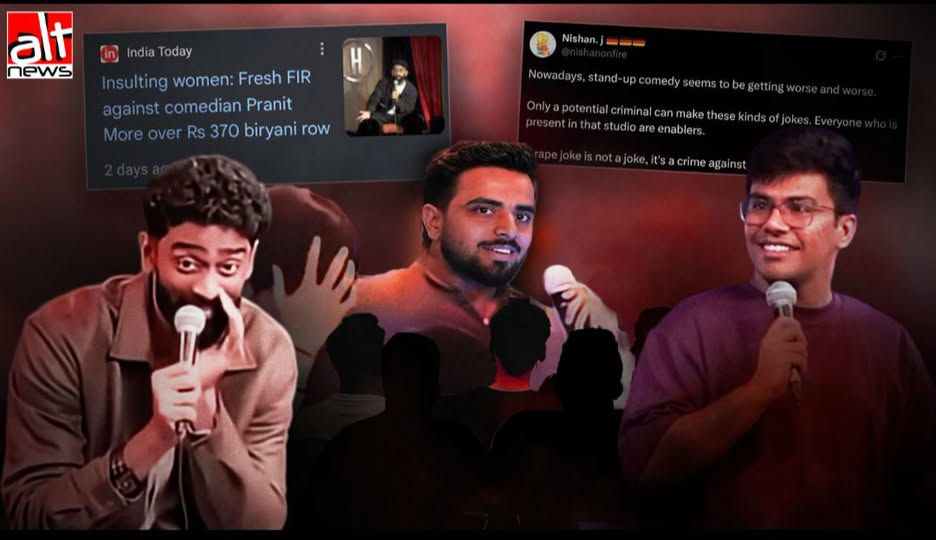
Netizens are showing outrage over the viral clip from Pranit More’s stand-up show, known as the “Rs 370 Biryani” controversy. To put it briefly, the reel is a clip from a stand-up comedy show where a man narrated a date experience, suggesting that because he had spent Rs 370 on biryani, he was entitled to physical intimacy. Patriarchal beliefs and an androcentric worldview condition men to have expectations from women to conform to assigned roles at the expense of their autonomy. The narration in the clip is not one more offensive individual action. It reflects a socially embedded manner of thinking about women and her consent. This androcentric worldview, which tends to objectify women and equates sexual consent, rules the social sphere from private interactions to socially legible forms like marriages. As MacKinnon (1993, p.28) notes: “The sex is not chosen for the sex. Money is the medium of force and provides the cover of consent”. Hence, the obligation of sex in the viral reel must be contextualised as cover for consent. In this article, I shall elaborate on the involved objectification of women in attempts to price consent, and enquire into unquestioned notions of consent and obligatory sex in marital rape and its legal obscurity.
Masculine Beliefs and Objectification
This viral reel exposes various patriarchal beliefs that society has about women; firstly, that any favour from men must be reciprocated with a sexual relationship by women, secondly, that consent can be bought, and one can pay for it and lastly, the underlying notion of objectification of women. I would say it is these masculine beliefs that guide the social interaction of men and women. Dworkin (2000) noted that objectification occurs when a human being, through social means, is made less than human, turned into a thing or commodity, bought and sold. When objectification occurs, a person is depersonalised, so that no individuality or integrity is available socially or in what is an extremely circumscribed privacy. It is objectification which dehumanises women, where ‘their humanity is diminished’, and they are depersonalised (pp.30-1).
One can easily point out the objective orientation of consumption entailed in these beliefs, where women are seen as a body to be consumed rather than a dignified human to be respected. Too often in relationships, women are reduced to objects without sexual agency; their sexual fate is rendered to these masculine beliefs. Expecting sexual consent in response to expense is highly problematic as it takes away autonomy, ownership and denies subjectivity to women. I argue that acts in which sexual consent is priced and commoditised are produced by underlying tendencies of objectification of women. My argument is consistent with the conception of objectification as described by Nussbaum (1995), where she mentions seven features involved in the idea of objectification: instrumentality, denial of autonomy, inertness, fungibility, violability, ownership, and denial of subjectivity. These masculine beliefs often manifest into the extrapolation of consent by men and self-censure on the side of women during interactions. This fills women with structural suspicion and consistent fear of being sexually exploited while reducing men to slaves of primal desire. It is these masculine beliefs that reduce women’s sexuality into something that men can hold into his hands and buy.
Instituting the Objectification
MacKinnon (1987) points out that within our patriarchal societies, men and women have clearly defined roles: women (all women) are objectified, whereas men (all men) are their objectifiers. A reproduction of this division can be observed in viral reels and marital rape. I think the focus of debates and discussions around the issue of consent has been about the price rather than the principle. My observations on social media revealed that dissent is limited to price and not consent. The discussions around marital rape can be contextualised in this regard, where it may not be the money that equates consent, but rituals marked by symbolic rules that presume sexual consent. I think there is homology in terms of marital rape and this case, which are based on the common belief that money or marriage, i.e. some sort of social contract, can compensate for sexual consent.
There is a legal reproduction of objectification with the ‘marital rape exception’ under Section 63 of the BNS (formerly Section 375 of IPC), which punishes rape; however, if a husband forces his wife, above 18 years of age, into sexual intercourse, it shall not be considered a criminal offence. The court too remains divided on the issue, as in Joseph Shine v. Union of India (2018), declaring adultery as unconstitutional while affirming that women can not be treated as property of husbands; however, in Independent Thought v. Union of India (2017), the apex court recognised sexual autonomy to girls aged between 15-18 and declined to extend these protections to adult women. Even in the Delhi High Court in RIT Foundation v. Union of India (2022), one judge declared exception 2 of Section 375 unconstitutional, and the rest upheld it, on the grounds of “wedding expectations”, thereby leaving the issue unresolved.
I argue that instances like ‘Rs 370 Biryani’ may seem exceptional cases, but the objectification of women and associated commodification of consent are socially accepted and institutionally reproduced in marriage and legal provisions. One can not ignore how structurally women are made to surrender their sexual agency in marriages. In this viral case, it is money that is invoked to compensate for consent. In the case of marriages, social institutions and notions of duties are invoked to justify sexual control of women in marriages. The subjective rationales often obscure the patriarchal control of women’s sexuality and their subsequent objectification. Objectifications and pricing of consent involved in institutions like marriage are morally permissible and socially legitimate, even as it violates the rights of women. I suggest we must reject the notion that consent can be priced individually or institutionally.
Rejecting the Objectifications
Sociologically speaking, our everyday social life is structured with institutional ways of thinking, behaving and acting; however, our social and cultural behaviour is driven by unconscious social beliefs. Simply stating that our individual actions are also tendencies which we imbibe socially, these social tendencies may also be produced by dominant and naturalised ways of thinking. Bourdieu (1997) refers to this social unconscious as ‘doxa’, i.e. unquestioned naturalised social beliefs. This elaboration is particularly helpful to uncloak the ‘androcentric doxa’, i.e. male-centric worldview and dispositions of objectification of women.
The change in gender relations requires a symbolic revolution of its kind, which I think mandates inquiry into the naturalised, given and unquestioned beliefs. The preferential anger and ‘the cherry picking’ of events to show one’s dissent while ignoring the deeper structures of gendered suffering seems inefficient. It reduces differential power relations to individual actions, obscuring the underlying social beliefs that perpetuate inequality. We must question the accepted modes of objectification while venting our anger. We must question the ubiquitous nature of an androcentric worldview. One of the initial steps is the uncovering of the various ways in which masculine domination is dispositioned in us and how it remains outside us, instituted as traditions which are seldom questioned.
References:
Bourdieu, P. (1977). Outline of a theory of practice (R. Nice, Trans.). Cambridge, MA: Cambridge University Press.
Dworkin, A. (2000). Against the male flood: Censorship, pornography, and equality. In D. Cornell (Ed.), Oxford readings in feminism: Feminism and pornography (pp. 19–44). Oxford, UK: Oxford University Press.
MacKinnon, C. A. (1987). Feminism unmodified. Cambridge, MA: Harvard University Press.
MacKinnon, C. A. (1993). Only words. Cambridge, MA: Harvard University Press.
Nussbaum, M. C. (1995). Objectification. Philosophy & Public Affairs, 24(4), 249–291.
***
Jatin Mathur is a postgraduate in Sociology from Delhi School of Economics (DSE) with interests in Sociology of Identity, Sociology of Education and Critical Realism.