
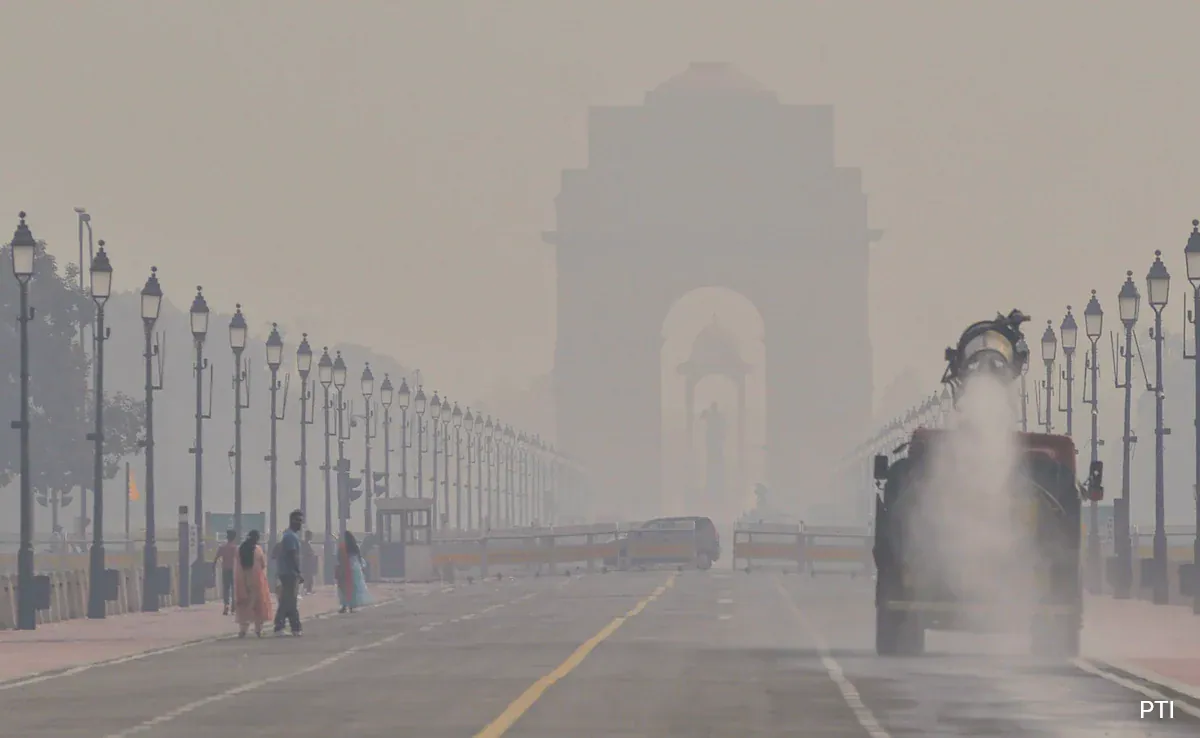
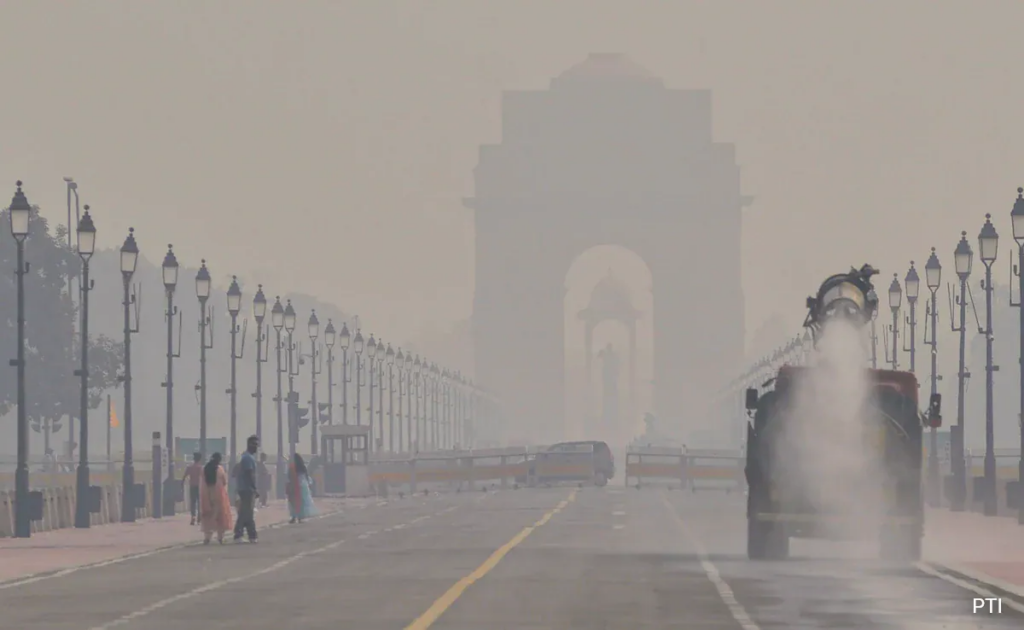
On 4 November 2025, the Air Quality Index at Anand Vihar read 487, “severe plus” in the official language. Schools had been shut for the third day running. The Supreme Court convened an emergency session. Hospitals reported a spike in respiratory admissions. And yet politicians across parties seemed more interested in attribution than in the air itself. Delhi’s Chief Minister went so far as to describe the AQI, in public, as a temperature parameter measurable “with any instrument” (Deccan Herald, 2025). That gap, between the scale of the crisis and the character of the response, is what calls for sociological rather than purely technical analysis. A look at the material conditions of Delhi’s pollution alongside the political narratives that grew up around them becomes important.
Delhi’s landlocked geography and its post-monsoon atmospheric inversions are meteorological facts. But they don’t explain why an emergency affecting millions turned into an extended debate about firecrackers and religious sentiment, or why official communication was so often vague and evasive. Ulrich Beck’s (1992) idea of the “risk society” is useful here. Beck argued that the hazards of industrial modernity are unevenly distributed and routinely misattributed. This piece treats Delhi’s crisis in that spirit, as the outcome of an arrangement of power, governance and vulnerability, traced across three contested sites: firecracker regulation, vehicular emissions standards and inter-governmental blame.
Beck’s broader claim is that late industrial modernity produces hazards its own institutions are structurally unable to manage. This isn’t a failure of competence. It’s a failure of design. The same state that grants emissions deadline extensions to industry is the state issuing health advisories to residents. Risk gets manufactured while accountability quietly disappears. You can see this most clearly in who actually suffers. Those with sealed apartments and HEPA filters experienced the smog as an inconvenience. Everyone else experienced it as a medical emergency. Blaikie and Brookfield’s (1987) political ecology sharpens the point further, insisting that environmental degradation is never just a natural process. It’s socially mediated, informed by property relations, state policy and economic pressure.
Take the farmer burning stubble. He isn’t being careless. He’s responding to a cropping calendar squeezed by late paddy harvests and to years of state support that has quietly been withdrawn from the alternatives. Chandra and Gupta (2025) trace this back further than most people bother to look, to decades of agricultural policy in Punjab and Haryana that left burning as one of the only options still making economic sense. Even the Supreme Court seemed to sense as much. During one hearing, a bench asked, pointedly, why Delhi’s skies had cleared during the 2020 lockdowns even though stubble burning had carried on as usual. The bench went on to caution that farmers “can’t be made scapegoats” for the capital’s air (Rajagopal, 2025).
Gadgil and Guha (1995) would recognise the pattern. Their argument, made three decades ago, is that Indian environmentalism has a habit of enforcing rules on whoever is easiest to see and hardest to defend, while industrial polluters quietly negotiate their own terms behind closed doors. None of this is to say Delhi’s air wasn’t dangerously real in 2025. It was, and the consequences were measurable in hospital admissions. But who got blamed for it, and which fixes counted as politically possible, was never simply a matter of science. It was social, through and through (Dunlap, 2010). Both things are true at once. Neither cancels the other out.
This dynamic played out most visibly around Diwali. In October 2025, the Supreme Court allowed “green” firecrackers even as air quality turned toxic. The BJP, newly in government after the February 2025 elections, framed cracker regulation as anti-Hindu while blaming AAP for eleven years of neglect, with Deputy CM Parvesh Verma pointing to “incomplete tasks” left behind (Upadhyay, 2026). AAP, for its part, counter-alleged that pollution data had been manipulated on Diwali night (Times of India, 2025). The “green cracker” policy has itself been criticised as scientifically incoherent and, frankly, unenforceable (Perincheri, 2025). No authority is checking individual households. Firecrackers, after all, are discretionary. They aren’t structural.
The argument that restricting them offends Hindu sentiment is also overstated. Diwali predates gunpowder by a long way, and was historically a festival of light, not of crackers. The whole controversy functions as political theatre, and it obscures the public health question sitting underneath it. If anything, the state’s continued tolerance suggests it would rather concede to cultural pressure than enforce an outright ban.
A more substantive regulatory failure lies in the confusion around Bharat Stage emission standards. India’s jump from BS IV to BS VI norms by April 2020 was sold as bold environmental policy. In practice, it landed on commuters without warning: restrictions on non-BS VI vehicles kicked in abruptly, leaving public transport scrambling to absorb the overflow (Jha & Alam, 2025). Nobody disputes that stricter norms make sense in principle. What’s harder to defend is who ends up paying for them. Individual owners, many dependent on older vehicles simply to earn a living, are handed an ultimatum: scrap the vehicle and absorb the cost, or cut back on the mobility their livelihood depends on. The automotive industry, meanwhile, gets extended timelines and room to adjust. That asymmetry is telling. It makes the state look less like a neutral referee and more like a partner to industry.
Meanwhile, the Pollution Under Control certification system, and options like repair or retrofitting, have been left to languish. The push towards scrapping and replacement gets all the institutional energy. It’s a set of priorities that reads as much like market expansion as environmental policy. The costs of this transition trickle down to middle- and lower-middle-class citizens, even as real alternatives to private vehicles remain thin on the ground. The contradiction only sharpens when set beside the state’s continued tolerance of something as avoidable as firecrackers.
Beneath both controversies sits a more familiar story: political paralysis standing in for coordinated governance (Kaul, 2025). Take Lieutenant Governor V. K. Saxena. In 2024, he was publicly pressing the Delhi government to tackle road dust. By November 2025, under a different political arrangement, he had gone quiet, choosing instead to attend a hot air balloon event on the banks of the Yamuna while the city choked (Newslaundry, 2025). It’s a small moment, but it captures something Beck called organised irresponsibility: institutions responding not to the severity of a crisis, but to which way the political wind happens to be blowing.
The pattern repeats itself elsewhere. The Delhi government pointed to the failures of past administrations (Verma, 2025). The opposition pointed to the incompetence of the current one (India Today, 2025). Stubble burning kept getting invoked as a convenient single cause, even after the courts had warned against reducing the crisis to one scapegoat (Rajgopal, 2025). At one point, an RTI response claimed Delhi’s air had actually been the cleanest in eight years, a claim that sat oddly next to official declarations of a public health emergency (Upadhyay, 2026). The result is a structured diffusion of accountability. When every actor can point elsewhere, responsibility simply dissolves.
Across all three sites, governance looks reactive, uneven and strategically selective, prioritising face-saving over problem-solving. This isn’t incompetence. It’s incentive. Accountability stays diffuse across jurisdictions while reputational risk remains immediate and personal, so explanation becomes more urgent than solution. What Delhi inhaled in 2025 was not only pollution but the consequences of a system built to evade its own culpability, thick air and thin accountability, connected causally rather than by coincidence. Clean air is a fundamental right, not a seasonal concern, and denying it is inherently political. Delhi’s crisis is cyclical, not exceptional. The conditions that produced it will return in a few short months. The question left standing isn’t who is to blame, but who will act, and whether governance can finally move beyond narrative and towards responsibility. Without such a shift, environmental crises will cease to shock and instead be absorbed into the ordinary.
References:
Beck, U. (1992). Risk society: Towards a new modernity. Sage Publications.
Blaikie, P., & Brookfield, H. (Eds.). (1987). Land degradation and society. Routledge.
Chandra, A., & Gupta, G. (2025). Delhi’s air pollution and what lies beneath. Centre for Civil Society.
Deccan Herald Web Desk. (2025, November). Delhi CM Rekha Gupta says AQI is a temperature, can be measured with any instrument; gets trolled by AAP. Deccan Herald. https://www.deccanherald.com/india/delhi/delhi-cm-rekha-gupta-says-aqi-is-a-temperature-can-be-measured-with-any-instrument-gets-trolled-by-aap-3824097
Dunlap, R. E. (2010). The maturation and diversification of environmental sociology: From constructivism and realism to agnosticism and pragmatism. In M. R. Redclift & G. Woodgate (Eds.), The international handbook of environmental sociology (2nd ed., pp. 15–32). Edward Elgar.
Gadgil, M., & Guha, R. (1995). Ecology and equity: The use and abuse of nature in contemporary India. Routledge.
India Today. (2025, December 20). Delhi pollution: Air quality record, AAP blames BJP, GRAP IV non-compliance. India Today. https://www.indiatoday.in/cities/delhi/story/delhi-pollution-air-quality-aqi-record-december-aap-blames-bjp-grap-iv-non-compliance-2839128-2025-12-20
Jha, B., & Alam, S. (2025, December 18). Delhi pollution crisis: Govt restricts non-BS VI vehicle entry; commuters slam abrupt move, metro faces extra pressure. The Times of India. https://timesofindia.indiatimes.com/city/gurgaon/vehicle-ban-chaos-delhi-restricts-non-bs-vi-entry-commuters-residents-slam-abrupt-move-metro-faces-extra-pressure/articleshow/126028424.cms
Kaul, V. (2025, December 19). Delhi’s toxic winter: A public health crisis met with political paralysis. Frontline. https://frontline.thehindu.com/the-nation/public-health/delhi-air-pollution-crisis-structural-failure/article70415335.ece
Newslaundry. (2025, November 26). Last year LG slammed Delhi govt over pollution; this time he is in a balloon. Newslaundry. https://www.newslaundry.com/2025/11/26/last-year-l-g-slammed-delhi-govt-over-pollution-this-time-he-is-in-a-balloon
Perincheri, A. (2025, October 16). Why permitting ‘green’ Diwali crackers in Delhi defies logic and science. The Wire. https://thewire.in/environment/why-permitting-green-diwali-crackers-in-delhi-defies-logic-and-science
Rajagopal, K. (2025). Farmers can’t be made scapegoats for air pollution in national capital: Supreme Court. The Hindu. https://www.thehindu.com/news/national/supreme-court-on-air-pollution-in-delhi-ncr/article70345253.ece
Times of India. (2025). Four government agencies manipulated Delhi’s pollution data on Diwali night: AAP. The Times of India. https://timesofindia.indiatimes.com/india/four-government-agencies-manipulated-delhis-pollution-data-on-diwali-night-aap-saurabh-bhardwaj/articleshow/124743969.cms
Upadhyay, S. (2026, April 18). Delhi govt claims city’s air was cleanest in 8 years in 2025: What RTI report says. India Today. https://www.indiatoday.in/cities/delhi/story/delhi-government-polution-air-aap-bjp-congress-rti-2897797-2026-04-17
Verma, A. (2025, December 18). Delhi pollution blame game begins: Minister says air crisis due to incomplete tasks of 11 years by AAP regime. India TV News. https://www.indiatvnews.com/delhi/delhi-pollution-blame-game-begins-minister-says-air-crisis-due-to-incomplete-tasks-of-11-years-by-aap-regime-delhi-air-quality-news-parvesh-verma-2025-12-18-1022270
***
Anahat Caur is a Master’s student of Sociology at Delhi School of Economics (DSE), University of Delhi.