
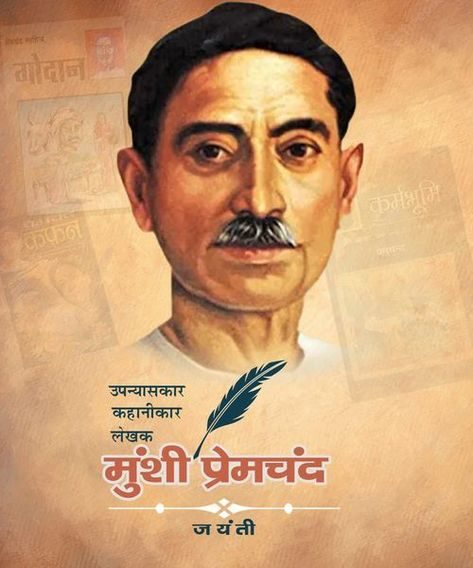
I read my first Premchand short story in grade 4, aged 10, as part of my school Hindi syllabus. It was Thakur Ka Kuan (Thakur’s Well) that I had read. I still remember the central characters- a village woman named Gangi and her ill husband Jokhu, who, in the absence of access to fresh water, is forced to drink water unfit for consumption. I also remember Gangi’s unsuccessful quest to get water for her husband. I read this story several times since then, but at that age, I did not understand that this story strongly highlighted gender and caste relations in rural India. At that age, I just thought of it as a water issue, but what structural factors made water an issue was something I do not remember discussing in class.
I continued to encounter Munshi Premchand’s writing in all the subsequent grades- Idgah, Do Bailon Ki Katha, Panch Parmeshwar, Boodhi Kaki, and many more stories that I began reading on my own. Much later, when I began engaging with Sociology as a discipline, I realised that Premchand’s writings were highly insightful for the discipline. This July 31 would be Munshi Premchand’s 146th birth anniversary, and what joy would it be to discover him as a sociologist, one of the greatest writers from the Hindi-Urdu tradition, from a sociologist’s eye.
Literary traditions in any language are indispensable for a sociologist, remarked MN Srinivas (2009) in one of his essays. He remarks, “When an anthropologist is studying a society which has a literary tradition, he [sic] has to become familiar with its literature for the latter provides a window to the thoughts, emotions, values, dilemmas, and conflicts of indigenes” (Srinivas, 2009, 603). What an insight from Srinivas, because Premchand’s writings provide insights into exactly these aspects of people’s lives and thus could be of great importance to a sociologist.
In this article, I primarily focus on Premchand’s literary sensibilities that make his writings important for a sociologist. Secondly, I briefly look at his life itself as an “ethnographic field” against the backdrop of the great social and political churn amidst which his sensibilities as a writer developed. There might be limitations in what I am attempting to do, but the prospects of looking at the figure of Premchand sociologically are bright.
Premchand as a sociologist?
In any introductory course in Sociology, one is taught the foundational tenets of the discipline- take nothing for granted and question everything- the spirit of inquiry that it inherited from the Enlightenment and French Revolution, in its complex but profound travel here. Similarly, in his writings, Premchand challenges the social order that places people differently, which leads to skewed life chances for people belonging to marginal social locations- it seems like Sociology, no!
For him, writing was a way to challenge the social order, and such challenges often put him in trouble from various quarters. For instance, his first collection of short stories, Soje Watan, was considered seditious, and only after this episode did he change his name from Dhantpat Rai to Premchand.
His literary sensibilities clearly align with sociology’s focus on lived experiences. Consider his short story Sadgati, featuring Dukhi the tanner, who dies due to the heavy physical work he is asked to perform by the village Brahmin, or the disabled and old Kaki, the protagonist of the celebrated Boodhi Kaki- all of whose senses are centered around taste who exercises her agency by deciding to eat the leftovers after a family ceremony where no one cared about giving her food. The kind of questions this story raises about ageing and disability are exactly the questions that sociological scholarship is raising today about population ageing, which generates considerable anxiety the world over.
In Sociology, we often study agency, structure, and their relationship, using this framework to examine and understand social life. While reading Premchand’s biography, Kalam Ka Sipahi (which received the Sahitya Academy Award in 1963) by his son Amrit Rai, I could find that while Premchand’s life was shaped by the structures that surrounded him, he actively reshaped those very structures because of which he was on the receiving end. Consider his marriage- he got married while still in his teens, something that he detested, and yet, because of the structures he was surrounded by, he had little choice. On top of that, his father expired within just a few years of his marriage, leaving the burden of the household (which included his newlywed bride, his stepmother, and his very young stepbrother) on the shoulders of a teenager. While his first marriage did not work out, Premchand exercised his agency when he married a second time. He married Shivrani Devi, a child widow, after seeing an advertisement in a newspaper. This must have been breaking many structures at a time when widow remarriage was gaining traction and had also been on the agenda of the social reform movement of the late 19th and 20th centuries. Premchand was not untouched by these winds of change, and in that sense, he also could be said to be a product of his times- not only does he marry a child widow, but he also takes up their cause in his writings.
Premchand as a product of his times
Like a sociologist, Premchand was abreast with affairs around him, not only locally but also globally. His life unfolded against the national movement, and he himself was deeply touched by the ethos of the fight for independence. At Gandhiji’s call during the non-cooperation movement, he resigned from his government job in the education department. A voracious reader, he also read literature from other languages and had a good command of English himself. He was also alert to epoch-making changes going around in the world order, like the Russian revolution, the rise of Hitler in Germany, the demand for Pakistan, and his stories and essays reflected these currents.
Some of the themes that makes his writings very insightful for a sociologist today include his stories depicting human-animal relations (a very relevant theme in contemporary sociology and social anthropology), religious fundamentalism (this too continues to be relevant today), caste relations (this too), the question of language and the relationship between Hindi and Urdu (he had warned us against linguistic nationalism), rural- urban divide, everyday life in households and much more- I am not even remotely a Premchand expert!
In the Bombay film industry
Premchand also had a close brush with the nascent talkies in Bombay (now Mumbai) of the thirties. To improve his financial condition (which resulted from his attempts to run a printing press), he ended up in Bombay as part of his contract to write stories with Ajanta Cinetones, a film-making company. Living in Dadar and writing scripts for production houses, Premchand also gained firsthand experience of many aspects of the film industry. Like a sociologist, he was commenting on its workings. He was upset about producers wanting to make only commercially successful films and not using cinema for change (like he insisted literature should be used for social change)- whatever sold well on the screen was made (it has a resemblance to contemporary times too!). In a letter he writes to Jainendra Kumar (a stalwart of Hindi literature), Premchand reflects (Rai, 2021, 580) on what he considers an unfruitful stay in Bombay. He observes (my translation from Hindi),
“…None of the intentions with which I had come here seems to be getting fulfilled. The kind of stories that these producers tell- they cannot move even an inch away from the conventional types. They call vulgarity “entertainment value”. Their beliefs are strange…I have written social stories which might interest the educated classes too, but they doubt making films on these as they doubt if these will work (commercially) or not…It feels as if (here) I am destroying my life.”
What a powerful commentary on the early years of the talkies in Bombay. Interestingly, the film Mazdoor (1934) that he wrote was not passed for screening in Bombay and in a few other cities by the censor boards.
I remember reading a memoir that poet and writer Mahadevi Verma wrote about Munshi Premchand, her literary senior. What she observes reveals much about Premchand’s sensibilities as a writer. Once in Allahabad for some work, Premchand decided to meet Mahadevi and reached her house. The gate was opened by Bhaktin, Mahadevi ji’s domestic help, who, not finding anything imposing about Premchand, told him that Guruji (referring to Mahadevi) is doing some important work and cannot meet right away. Hearing this, Premchand told her, “You do not seem to be doing any important work- come sit with me and let us talk”. Later, writes Mahadevi in her memoir, the gardener, the chowkidar, and others join them, and their conversation becomes something like that of a village chaupal. An hour later, when Mahadevi came looking for Bhaktin, she was upset that Premchand had not conveyed the information of his arrival. Hearing this, Premchand responds, “You are a poet- you can even write in isolation. But I have found a lot of material here for my stories”. Clearly, his writings capture the pulse of Indian society, and this was made possible because of the close distance from which he saw the social life unfold around him.
Premchand’s writings clearly display the sensibilities of a sociologist and provide rich material for sociological analysis. The rich texture and details of social lives that we find in his writings continue to be relevant.
References :
Rai, A. (2021). Premchand: Kalam Ka Sipahi. Lokbharati Prakashan.
Srinivas, M. N. (2009). The Oxford India Srinivas. Oxford University Press.
***
Vinay Suhalka is an Assistant Professor of Sociology at IIT Delhi. His research interests are in the field of Disability Studies, Ageing Studies and sociology of religion.
An illuminating article!