
This is the story of Manju, a 45-year-old woman, a daily-wage labourer. When I first met her, she was waiting at the labour chowk along with her fellow workers for the thekedars to come and take her to work since early morning. Waiting wears her down. She is desperate to get a contractor to hire her. She finally does not get work that day. This continues for a whole week. Every day, after cooking food and completing all the household chores, she reaches the labour chowk by 7 a.m. Most of the days, she returns home without work. All the male and female workers of the village gather at the labour chowk early in the morning. The contractors come and take or do not take the workers to the site. Those who are taken by the contractors go to work, and the rest who do not get work by 9 a.m. come back to their homes. This is the normal routine for the workers of the village.
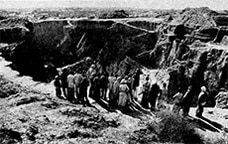
Manju does not have any formal years of schooling and has been working as an earth digger since childhood. She does not remember the exact age at which she started working but recalls that she was very young when she took up this work. Her husband is also an earth digger, and her parents also did the same work. She lives in a half kachcha, half pucca house with her husband and five children, three daughters (two of them are married), and two sons in Bhati Mines village in Delhi, inhabited mainly by migrants from the Odh community. They are primarily known as earth diggers (mitti khodne wale) and have been doing this work for generations. They have migrated from different states across the country and established the colony in the 1970s on forest land, presently under threat of eviction. Manju does the load-carrying work and assists the mason. Her tasks include “Mitti Khodna, Tasla uthana, and Rori uthana” (dig out soil, carry a pan overhead consisting of construction debris, cement bags, and bricks). She is paid Rs 250 per day for 8-10 hours of work.
The 45-year-old is finding it difficult to continue working due to the physically intense and rigorous nature of the work. She feels dizziness and pain in the neck, back, wrist, and legs while carrying a load on her head. If the contractor gets to know about any of these health issues, he will not bring her to work from the very next day. He would say, “You take rest and be healthy; then only come to work. It would lead to loss of wages for a few days”. Therefore, she never shares this with him for as long as possible to keep working and continue getting work in the future. She gets a maximum of 10 days’ work, and her husband manages to get 15 days of work per month. The uncertainty of getting work every day is a key concern for the community, especially for the older women. Health provides a means for personal and social evaluation. Health is a concept grounded in the experiences and concerns of everyday life. When people talk about health, they give expression to cultural notions of well-being and overall quality of life (Blaxter, 2010).
Manju’s story is no exception. It is about precarious livelihood, health hazards and the presentation of bodily well-being. For therein lies the possibility of earning. Furthermore, health, in general, is not easy to understand unless we ask people to talk about their everyday lives and life histories and the subjective dimensions of well-being. Much of our identity and health beliefs come from life narratives (Blaxter, 2004). These are not just narratives but tools to make sense of life, which is reflected through the narratives of Asha Devi. Asha Devi, a 60-year-old worker and resident of Bhati mines village, says, “hamesha saas foolta hai kaam karte hue”. She feels breathlessness most of the time while working because of her age and some respiratory problems. The contractor is implicitly aware of this. Therefore, she is not getting work as the thekedar prefers young women who can do more work, and the older women are paid low and often left without work.
“On average, I get 10 days of work in a month. But during the rainy season, when the digging work stops, we have to stay without work for two to three months. It becomes extremely difficult for us to manage for such a long time without work,” said Asha Devi. She added, “If we get two or three days of work a week, then still, it is manageable. But three months is a long time, and then we have to look for something else so that at least we get something to feed our children and grandchildren”. She does not have enough work, and the family is presently fed by borrowing money. “How can I be healthy with all the tension and stress? We need enough work and good food to be healthy and to live a stress-free life. The work that we do is physically demanding and injury-prone. Nobody can do it for a very long time. Everyone is equally prone and vulnerable to injury and developing health issues,” she said.
There is no first aid facility at the construction sites. Worksite injuries like abrasion of the skin, swelling of hands and feet, crushing and pinching of body parts, and minor and major fractures and severe crushing injuries are quite prevalent and frequent because they work bare-handed and barefoot, without any PPE kit or safety measures at the site. Manju says that “it is a dirty job. Our skin itches. Most women have developed scars and corns on their hands and feet. You talk to any women working as earth diggers; they have infections and scars on their hands, feet, and arms. Whenever we get any cut or injury, we put chuna (lime); this is what we mostly do”.
Through everyday life narratives and life histories, individuals rearrange their experiences, explain their actions, and contemplate their situation in the social world (Blaxter, 2004). Narratives evoke a revision of histories and identities. Identity is understood as “life story: an internalised integration of past, present and anticipated future” (McAdams, 1989, p.161 cited in Blaxter, 2004). It further describes how the self changes within some basic continuity. This is particularly true for narratives of fatal injuries and chronic illness that pose a permanent challenge to identity. Hazardous work and hazardous working environments manifest as injuries to the human body. In extreme cases, it also results in death or severe disability (Qadeer and Roy, 1989).
Deepak, a 27-year-old worker, was limping and unable to walk because of a swollen ankle and foot. He had not gone to the labour chowk for the last 3 months. Now he is looking for work. As none of the other family members was working, he could not sit idle for long. He is yet to fully recover from multiple fractures that he got while digging at one of the sites in Gurugram when a wall fell on him. He injured his ankle bone and got a tibia and hip joint fracture. Thereafter, the thekedar, to save money, took him to a Vaid and got a bandage wrapped around his leg. He requested the thekedar to take him to a hospital or an allopathic doctor. Despite this, he took him to the Vaid multiple times. A total of six rounds of bandages were wrapped, but even after three months, he still has swelling in his leg and foot. When he insisted that the builder get him treated in a good hospital, he gave him just Rs 6000 and asked him to get treated on his own.
Deepak’s father also did the earth-digging work for many years until he met with an accident while working and sustained multiple fractures. Due to the severity of the injury, he could not resume work after that. His mother also developed excruciating pain in her neck and swelling in her hands due to carrying construction material. She had to stop working. Consequently, he had to take up the family’s responsibility and started working as an earth digger at the early age of ten. Since then, he has been doing this work.
He shared: “We have so many health problems in the family. Father got injured and stopped working; the mother is also not well, and both have serious health issues. Further, we have financial problems due to which we cannot buy our monthly ration. There is no fixed source of income and very high uncertainty of work. We are constantly stressed and anxious about what will happen tomorrow. The biggest challenge is getting regular work and having a regular source of earnings. The uncertainty of getting work and then meagre wages, combined with the occupational hazards and injury, makes life so uncertain and full of anxiety.” The work is hard, irregular, and wages are poor. Manju says, “If a worker does not get to work for half of the month, what would they eat? How would they be healthy? She said, “We want a monthly source of income. A monthly payment ensures we pay our ration bills and other expenses. We will not have to borrow money from our neighbourhood”.
Earth diggers are not covered and protected by any social protection measures of the state or principal employer. Manju has a labour card but has not received any of the stated benefits. She says, “Whenever the government gives something for us, the Gram Pradhan sells everything. We never receive anything that is meant for us. Nothing reaches the poor people of the colony. During the lockdown also, he sold the ration given by the government and distributed it only to very few people known to him. Because of the lockdown, some families got wheat as a free ration from the government. Once the lockdown is over, they will be charged for this. Then they will have to buy this from their earnings”. She did not get ration or any financial aid during the lockdown. Cooked food was distributed in the village. However, the quantity was insufficient to feed all the family members. She shared, “One family got only five chapattis and a vegetable, so how many people would eat from that? We gave that food to the children and cooked whatever we had for the family’s elders. Also, there were very long queues to get the cooked food”. Besides, she had borrowed Rs 15000 to feed her family during lockdown. Her family had no savings at all. The wages that we get are hardly enough to take care of the basic needs; therefore, how could we save money for the future? As a result, I had to sell some of my jewellery and belongings to meet my family’s basic needs,” she said.
When asked about the meaning of health and well-being, she just showed a bag full of medicines that keep her continuing to work. What else do I need to say in this regard? This is all which is required to carry on working. Eat whatever you have cooked and take some of it for lunch; these are the medicines that keep you going for the day. Almost invariably, I feel weak and dizzy, my back aches, my body aches, and despite this, I have to go to work to meet the family food expenses. You cannot lead a good life, a dignified life (Izzat ki zindagi) without regular work and a source of monthly income. You cannot be healthy and give your children a good and healthy life if you do not have a regular source of work or an assured monthly income”. She added, “If you have a regular source of work and income, then everything is good. But if you go every day searching for work and most of the days, come back without work, what is life? What kind of life do we have?” She further added, “Matlab kya hai aisi zindagi jine ka?” (What is the point of living life like this?).
The World Health Organisation (WHO) Commission on Social Determinants of Health recommends improving the working and daily living conditions of people to improve their health status, which is determined by where people are born, live, work and grow (Commission on social determinants of health, 2008). When we analyse the experiences of women’s lives were centred around the task of survival and ‘social reproduction’. They ascribe meaning to their experiences of work and life that highlight their fight for survival and a dignified life. Their identities are shaped and constructed through the kind of work that their bodies can do and their ability to sustain and meet the demands of their work and family’s needs. A majority of them live under continual threat of impoverishment and deprivation. The narratives highlight how they negotiate and sustain the demands of work and family and how life becomes much more unsustainable when there is a severe shortage in the supply of elementary services. It alludes to social suffering, which is a complex interplay of socioeconomic, biological, institutional, and political factors (Baru, 2005). While illness and injury are afflictions of the body, suffering is more about the affliction of the person, not the body (Beckwith, 2014). Suffering is purely subjective and poses a threat or damage to personhood (Cassell, 1998).
The perceptions of health and well-being and overall well-being are primarily determined by the availability of work, wages, and the injury that they and their family members sustain every day. An injury to the earning member of the family can put the whole family at risk of impoverishment. The narratives and perceptions of health and wellbeing were directly related to living with dignity, and self-worth is an integral determinant of health. When we look at health as physical and mental experiences of living, most health and illnesses have social causes constructed by professional activity, history and culture (Blaxter, 2010). We need more such stories to deconstruct the meaning of health and well-being, contrary to the reductionist and dominant biomedical view of health that informs existing curative health care services. Understanding and alleviating suffering, in addition to physical affliction, is the primary end of public health as a discipline.
Note: The narratives presented in the paper were documented as part of my PhD work conducted at the Centre of Social Medicine and Community Health, Jawaharlal Nehru University (JNU), Delhi.
References:
Baru, R. V. (2005). Disease and suffering: Towards a framework for understanding health-seeking behaviour. Indian Anthropologist, 35, 45–52.
Beckwith, N. M. (2014). Redefining suffering and illness. Harvard Medical Student Review, 1(1).
Blaxter, M. (2004). Life narratives, health and identity. In Identity and health (pp. 182–211). Routledge.
Blaxter, M. (2010). Health. Polity Press.
Cassell, E. J. (1998). The nature of suffering and the goals of medicine. Loss, Grief & Care, 8(1–2), 129–142.
Qadeer, I., & Roy, D. (1989). Work, wealth and health: Sociology of workers’ health in India. Social Scientist, 45–92.
***
Sonu Pandey is a public health researcher and faculty member at Azim Premji University (APU), Ranchi.