
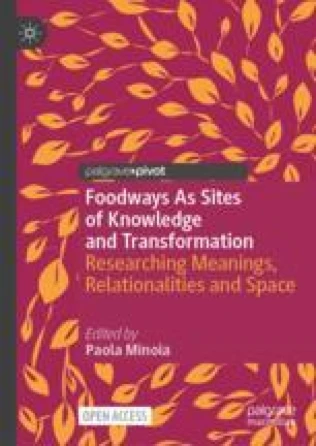
“What do we mean by participation in research? Who is expected to participate, and in whose projects?” This line mirrors the essence of the book. Foodways as Sites of Knowledge and Transformation: Researching Meanings, Relationalities and Space, edited by Paola Minoia and published by Palgrave Macmillan in 2026, contributes to critical food studies by advancing a relational perspective that foregrounds local knowledges, multispecies subjectivities, and the practices of everyday life. Drawing on ethnographies of urban food transformations, Minoia proposes a reflexive approach to see how every community deals with ecological change, urbanisation, and extractivism differently. This book, therefore, invites readers to debunk universal solutions and to rethink food systems as situated contexts, and each “foodway as a relational microcosm in which affective, cultural, political, and ecological exchanges take place” (p. 2).
Changes in the foodscape due to neoliberal urban development scream of the coloniality of technoscientific development narratives that marginalise local knowledges and their food sovereignty. These systemic changes have ignored the fact that food is deeply entangled in political-economic relations. Hence, this volume engages with three interconnected elements of radical food geographies praxis: critical theoretical engagement with power and structures of oppression, often drawing on local and non-white feminist scholarship; analysis grounded in specific geographic and ecological contexts; and research-action that involves collaboration with civil society (p. 4). In doing so, the book proposes a relational approach to food research to bridge the gaps in neoliberal academic modes. The book acknowledges the long-standing debate that methods for studying humans’ relationship with the surrounding environment need to differ from those of the natural sciences, while acknowledging that the neoliberal research environment still favours the latter’s methods because the former (focusing on emplacement, walking along, cooking, etc., among others) are hardly appreciated by objective, solution-oriented funding agencies and projects.
The book, therefore, develops a methodological framework that accounts for the epistemic differences in understanding the relationships among humans, more-than-humans, and environments. Food here becomes the methodological entry point for analysing the sociological transformations. The book argues that food as a method requires co-presence in convivial spaces and focuses on relational, slow, and situated practices of knowing-with whose lived experience it is. It demands research to move beyond extractive observation to understand the social, ecological, and political challenges that have transformed production systems, territorial relations, and forms of subsistence (p.10-11). It discusses a grounded decolonial and feminist research method that consistently attends to ethics and reflexivity in relation to how power operates within research relationships. Food, in this methodology, is more-than-food and much more than just a tool- it builds relationships and gives a closer look into people’s politics.
Food in the context of Amman showed how it speaks about social, political, spatial, and temporal relations. Along with the development of capitalist configurations, there were simultaneous attempts to rebuild organic relationships with land and social fabric, with hopes of food justice, which disrupted the unilinear capitalist global order. Tangier saw structural transformations in the fishing sector when new ports disrupted the co-produced ecology between nature and society, restricted locals’ access to the shoreline and to culturally compatible food practices, and affected artisanal fishing and broader urban marine foodways. Food production, transformation, and consumption in Sidi Bounouar, a village on Morocco’s southern Atlantic coast, showed how gender roles and spatial separation entail relations of belonging and power, amid ecological degradation that has led to a shift from subsistence agriculture to reliance on sea-based livelihoods. The authors used a trans-scalar lens in all these studies, where, from structural processes to everyday practices, to wider transitions to specific frictions were studied (p. 72).
While the book has rightly critiqued the techno-scientific and developmental narrative, it could have benefitted from a more critical look into the local knowledge systems- are they all egalitarian and environmentally sustainable? Secondly, foodways as a methodology could be more beneficial if a closer look into the local knowledges enabled researchers to critically analyse internal inequalities. The book explained the dangers of fixing communities into static identities and asked readers to look into the internal differences of gender, generation, class, and political positions. Yet with the partial exception of chapter five, where they differentiated the interests of women and men, these internal fragments receive less attention in its conceptualisation of “community knowledge.” Thirdly, the book’s engagement with practices situated outside capitalism could have been looked at more critically, for not every practice outside capitalism is necessarily post-capitalist. Sometimes, everyday practices are simply acts of survival or cultural continuity through socialisation. For instance, gender separation could be simultaneously voluntary, socially cohesive, and structured by unequal power relations. Therefore, a more reflexive and critical approach might refrain from and resist idealising all everyday habits as acts of resistance.
However, what stood out the most in this book was the promise to adopt a relational approach; it discusses in detail how to give back to the communities who made the research possible. The authors noted that sharing images as the final output of research at specific restitution events, such as photographic exhibitions or community gatherings, is a crucial way to return the research process to participants and broader communities, making it more horizontal and accessible. Local gatherings can also offer opportunities to discuss research findings with practitioners and experts in the field and to gain insightful feedback from a curious audience. They pointed out that establishing ventures like this requires collaboration with local actors and associations, as well as a willingness to go beyond research requirements. The study uses a reflexive approach to deconstruct fieldwork power dynamics and legitimation processes, which can facilitate reciprocity but can also, at times, result in misunderstandings or unanticipated interactions. Nonetheless, the book teaches us that sharing research with participants is important as it “creates a mirror in which they feel recognised and valued” (p. 153).
***
Praapti Sarma is a PhD Research Scholar at South Asian University (SAU), New Delhi.