
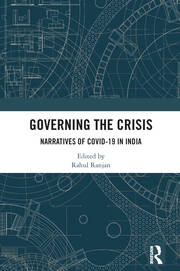
Governing the Crisis: Narratives of COVID-19 in India (published by Routledge in 2025), edited by Rahul Ranjan, is a collection of ten meticulously researched chapters documenting the multidimensional impact of the COVID-19 pandemic on the social lifeworld of the poorest and marginalised communities in India. The book intricately links policy failure with narratives of suffering to expose poor governance and lack of political will in explaining the effects of the pandemic on these communities.
Organised into three parts, the book moves from the broader questions of law and policy response to the more granular neglect of Adivasi, nomadic, and migrant communities, to questions of labour, caste, and precarity. Part I on “Law, Biomedical Emergencies, and Public Response” questions India’s weak governance structures, lack of political leadership, and its underdeveloped public health infrastructure. Drawing on large-scale and in-depth interviews, the opening chapters examine the facets of India’s law enforcement apparatus during the pandemic, revealing the disproportionate burden it placed on socio-economically disadvantaged sections. These challenges were further aggravated by the unequal availability and access to COVID-19 vaccines, as the following chapter argues. Part 1 closes by assessing the impact of the pandemic and subsequent government response on Adivasis and forest-dwelling communities in Jharkhand.
Building on this critique in governing the Adivasi communities during the pandemic, Part II “Migration, Indigeneity, and Cultural Impact”, turns to the neglect and negligence shown toward Adivasi communities during the pandemic as it underscores the interrelationships between care, neglect and violence to demonstrate the multiple forms of mismanagement that marked the COVID-19 crisis among these groups. The following chapter analyses the intersections of COVID-19 and its impact on the livelihood and subsistence of traditionally nomadic communities of Jammu and Kashmir. The phenomenon of precarious existence is further extended to explore the socio-economic plight of tribal migrant workers in the context of the pandemic. Part II closes with a chapter on the cultural impact of the pandemic on the creative industry (mobile theatre) in rural Assam, which not only disrupted the already weakening employment, but the disruption fell disproportionately on the lower-caste and lower-class artists and workers.
The canons of caste, discrimination and humiliation are further highlighted in chapter 8 of Part III on “Frontline Workers, Caste Dynamics, and Labour Force”. The chapter observes caste hierarchies and practices of stigmatisation among sanitation and waste workers in Delhi during COVID-19. The volume draws a structural parallel to the conditions faced by brick kiln migrant workers in the Delhi-NCR region, who suffered an acute livelihood shock from the combined effects of pandemic lockdowns and air pollution. The book closes with a chapter on community resilience in the country’s Western Himalayan region, framed as a response to the intersecting pressures of climate change and the pandemic.
What unites these otherwise separate case studies together is the editor’s insistence on moving beyond the more visible, well-documented aspects of the pandemic, towards a more granular and varied voices anchored in governance failures and narratives of marginality. The volume’s multidisciplinary range, from anthropology, public policy, politics, sociology, and legal studies, gives it a genuinely robust account of the crisis by engaging with each dimension of COVID-19.
While each chapter is empirically rich, the volume could engage more systematically with the wider scholarship on the politics of crisis management and governance; a more explicit conceptual framework linking all chapters would have increased the overall coherence of the volume. Moreover, the absence of geographical coverage involving southern or western states limits broader generalisations on pandemic governance nationwide. Moreover, while there is adequate emphasis on institutional failures, it would have been interesting if a comparative analysis had explained why certain institutions or communities responded to the pandemic more effectively than others. Nevertheless, the book makes an important contribution with its empirical richness, methodological diversity, and interdisciplinary scope, and will be valuable to scholars and practitioners working on citizen-state interaction, development studies and South Asian studies.
***
Akanksha Sanil is a PhD scholar at the Department of Political Science, University of Delhi.