
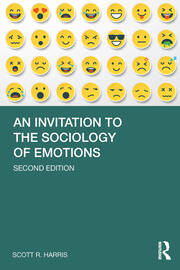
What is emotion? Why should emotions be studied in sociology? What is Sociological about emotions? What are the benefits of studying emotions in sociology? By asking these and other questions, An Invitation to the Sociology of Emotions by Scott R. Harris (Routledge, 2024) invites readers to understand the basics of the sociology of emotions. The author deliberately titles the book an invitation rather than an introduction to the sociology of emotions, since its scope is not comprehensive. The effort is to initiate an interest in the field as it is a book for beginners.
The author has carefully divided the book into seven chapters and has chosen topics that will attract readers to explore the sociology of emotions. To elaborate on the various concepts of emotion in Sociology, the author has drawn a parallel between basic sociological concepts and emotions. This is evident in the chapter on emotional labour and the social exchange of emotions, which are derived from social norms and social exchange theory, respectively.
The first chapter of the book begins with an intriguing idea of what is sociological about emotions, exploring why emotions should be a subject matter in sociology. This chapter questions many preconceptions regarding emotion in sociology. Like, emotions are not only trivial or biological but also social; they are not automated, and many other doubts have been addressed. In the subsequent chapters of the book, themes such as emotional norms are explored, helping readers see how social expectations shape their daily emotional experiences and fostering a sense of relevance and connection. In this chapter, the author has extended the concept of social norms and defines emotional norms as the feelings an individual should have in certain social situations. How emotional norms are learned through socialisation and how they vary across social contexts.
In the book, as with other themes, the author discusses emotional management, introducing Hochschild’s concepts from her pioneering book, The Managed Heart: Commercialisation of Human Feeling (1983), to help readers elaborate how emotions are regulated in everyday life and at work through surface and deep acting. According to her, surface acting refers to how individuals change their outward expressions to change their emotions or hide their actual emotions. Similarly, deep acting refers to how an individual manages their emotions by changing their inner feelings through various mechanisms. The author has explained the concept of emotions from the perspective of social exchange theory, how emotions can be a factor or an outcome in social exchange, and how cost-benefit factors are analysed in the context of emotions.
The author also discusses the concept of emotional labour, how, in certain professions, they are required to manage their own emotions, and are paid to hide their actual emotions according to the requirements of the job. The emotional labour performed by individuals also depends on social conditions, such as race, gender, and an individual’s position in the social hierarchy. Another important issue discussed in this book is how to identify emotions. Generally, it is assumed that the identification of emotions depends on an individual’s psychological and biological conditions. However, the author explores how the identification and labelling of emotions are social processes, and how social factors determine their labelling; how the vocabulary of emotions, the metaphors used to express them, and the description of emotions in a given situation depend on that specific culture.
The book ends with the chapter Why Study the Sociology of Emotions, in which the authors explain the benefit of studying the sociology of emotions. The author notes the shortcomings of this book himself, such as its focus on only a few topics, such as emotional management, emotional norms, emotional labour, etc. He has neglected other important dimensions of the sociology of emotions, including affect control theory, expectation states theory, identity theory, ritual theories and other theories. Despite these limitations, the simple language and examples in the chapters make this an essential read for those who are interested in the sociology of emotions.
***
Anmol Tiwari is a Research Scholar at the Department of Sociology, Banaras Hindu University (BHU).